Summary
- WASHINGTON/ISLAMABAD: A sharp shift in American public opinion toward Israel is raising questions about the future of Washington’s Middle East policy, particularly as the United States continues its confrontation with Iran and reassesses its military commitments abroad.
- Marquette Law School polling in September found 29% of Americans viewed Israel favorably, while 59% held an unfavorable opinion.
- The Iraq withdrawal may ultimately prove to be a limited policy adjustment—or the beginning of a broader rethink involving Iran, Ukraine and US military commitments abroad.
WASHINGTON/ISLAMABAD: A sharp shift in American public opinion toward Israel is raising questions about the future of Washington’s Middle East policy, particularly as the United States continues its confrontation with Iran and reassesses its military commitments abroad.
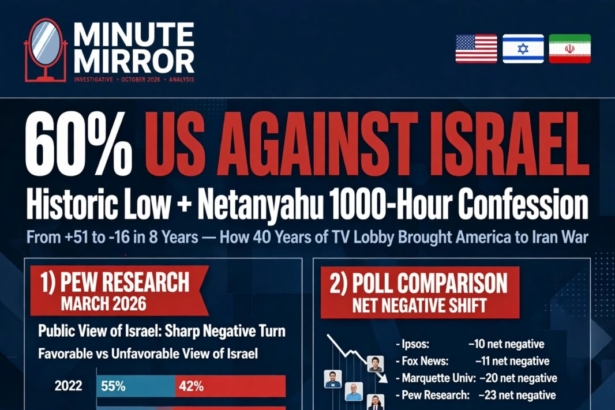
Recent polling cited in the original analysis indicates that a growing share of Americans now hold an unfavorable view of Israel. Pew Research reported that 60% of Americans viewed Israel unfavorably in 2026, compared with 37% who expressed a favorable opinion. Among younger Americans, opposition was significantly higher, with 74% of respondents aged 18 to 34 holding an unfavorable view.
Other surveys have also recorded declining support. Marquette Law School polling in September found 29% of Americans viewed Israel favorably, while 59% held an unfavorable opinion. The same survey found that 55% believed the United States was providing too much military assistance to Israel.
The trend has increasingly crossed traditional party lines. Polling cited in the analysis suggests that younger Republicans, like younger Democrats, are becoming more critical of Israel, indicating that the issue is no longer confined to one political constituency.
The debate gained further attention after Israeli Prime Minister Benjamin Netanyahu discussed his long-running efforts to influence American public opinion on Iran.
In an August 30 interview with Israel’s Channel 14, Netanyahu reportedly said he had spent nearly 1,000 hours on American television over the years explaining the Iranian threat and seeking to persuade US audiences.
His remarks have since been cited by Iranian officials as evidence that Israel played a major role in shaping Washington’s approach toward Tehran. Iranian Foreign Minister Abbas Araghchi criticised Netanyahu’s comments, arguing that the Israeli premier had openly acknowledged influencing the US administration.
The issue has also revived comparisons with the 2003 Iraq war. The invasion was justified by the George W. Bush administration on claims that Saddam Hussein possessed weapons of mass destruction. Subsequent investigations failed to find the stockpiles alleged before the invasion, while the war imposed enormous financial and human costs.
The United States’ September 30, 2026 withdrawal from Erbil, Iraq, has therefore been interpreted by some analysts as a possible sign of a broader reassessment of prolonged military engagements.
Washington has faced similar questions over its ongoing confrontation with Iran and its extensive support for Ukraine. Supporters of a reduced US military footprint argue that the Iraq model—ending combat operations while retaining training and intelligence capabilities—could potentially provide a framework for other conflicts.
However, such comparisons remain speculative. The previous US withdrawal from Iraq in 2011 was followed by the rise of ISIS and the return of American forces in 2014, highlighting the risks associated with disengagement.
The changing American mood toward Israel could nevertheless become an important political factor ahead of the 2026 midterm elections. Younger voters in particular appear increasingly focused on the humanitarian and financial consequences of US foreign policy.
For President Donald Trump, the challenge is balancing America’s strategic relationship with Israel against changing domestic opinion and the costs of continued military involvement overseas.
The Iraq withdrawal may ultimately prove to be a limited policy adjustment—or the beginning of a broader rethink involving Iran, Ukraine and US military commitments abroad. What Washington does next will determine whether the Erbil departure becomes an isolated event or the first step in a much larger foreign-policy shift.
We welcome your contributions! Submit your blogs, opinion pieces, press releases, news story pitches, and news features to opinion@minutemirror.com.pk and minutemirrormail@gmail.com