Summary
- Despite the intense downpour, officials claimed that newly completed drainage interventions and a coordinated emergency response helped prevent widespread urban flooding in the city.
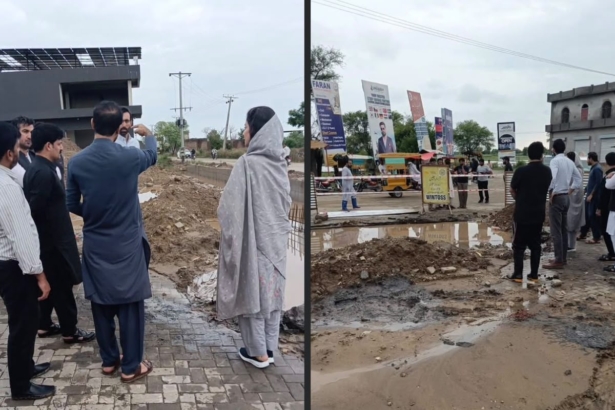
- Deputy Commissioner Noor-ul-Ain Qureshi remained in the field throughout the operation, inspecting drainage arrangements and monitoring the performance of five newly completed interventions executed by the Irrigation Department under the Punjab Development Programme.
- However, officials maintained that the combination of newly completed irrigation works, continuous field monitoring by the deputy commissioner and round-the-clock WASA operations enabled the city to withstand the 153mm rainfall without any major disruption to traffic or public life.
GUJRAT: Torrential monsoon rain measuring 153 millimetres battered Gujrat, triggering a district-wide rain emergency and keeping the civil administration, Water and Sanitation Agency (WASA) and other civic departments on high alert. Despite the intense downpour, officials claimed that newly completed drainage interventions and a coordinated emergency response helped prevent widespread urban flooding in the city.
Deputy Commissioner Noor-ul-Ain Qureshi remained in the field throughout the operation, inspecting drainage arrangements and monitoring the performance of five newly completed interventions executed by the Irrigation Department under the Punjab Development Programme. The projects, completed in a record five months, were designed to protect Gujrat from sheet flow entering the city from the Bhimber and Azad Jammu and Kashmir (AJK) side during heavy monsoon rains.
According to the district administration, each of the five newly constructed drains has the capacity to carry 200 cusecs of water, diverting the incoming sheet flow towards Bhinder Nullah and Halsi Nullah. Officials described the projects as a significant step towards improving Gujrat’s flood resilience, saying they played an important role in reducing pressure on the city’s drainage network during the latest spell of heavy rain.
Meanwhile, Managing Director WASA Gujrat Kashan Hafeez Butt supervised rain emergency operations across the city, with 20 emergency teams deployed in the agency’s three operational zones. Dewatering sets, suction machines and heavy machinery remained operational throughout the day to remove accumulated rainwater from roads, markets and residential areas.
Among the worst-hit locations was Madina Bazaar Staff Gali, where rainwater accumulated to nearly one foot. WASA teams carried out continuous pumping operations before clearing the area. Water also collected at Dhakki Chowk, where approximately six inches of standing water was removed after several hours of drainage work.
Officials said traffic on Rehman Shaheed Road, Shadman Colony and other major arteries remained largely uninterrupted due to the timely deployment of emergency teams. Field staff continued monitoring low-lying areas to ensure rainwater did not accumulate again as intermittent showers continued.
Residents acknowledged that several streets experienced temporary waterlogging during the peak of the rainfall but said conditions improved as emergency crews reached affected areas. Commuters reported slow-moving traffic in parts of the city during the morning because of reduced visibility and rainwater on roads.
The district administration maintained close coordination with WASA, the Irrigation Department, Rescue 1122 and other relevant agencies throughout the operation. Officials said emergency personnel would remain on alert as further monsoon rains are forecast, with machinery stationed at vulnerable locations for immediate deployment if required.
Authorities also appealed to residents to cooperate by avoiding the disposal of garbage into storm-water drains, warning that blocked drainage channels significantly reduce the efficiency of the drainage system during heavy rainfall.
The latest monsoon spell once again tested Gujrat’s urban drainage infrastructure. However, officials maintained that the combination of newly completed irrigation works, continuous field monitoring by the deputy commissioner and round-the-clock WASA operations enabled the city to withstand the 153mm rainfall without any major disruption to traffic or public life.
The district administration said all departments would continue monitoring weather conditions and remain prepared to respond swiftly to any further rain-related emergencies.