Summary
- Pakistan, Saudi Arabia and Türkiye’s landmark defence agreement draws international attention; Shehbaz Sharif and Field Marshal Asim Munir play pivotal roles in historic strategic breakthrough The landmark Makkah Joint Defence Agreement between Pakistan, Saudi Arabia and Türkiye has triggered intense international interest, with analysts viewing the accord as a potentially significant development in the evolving security architecture of the Middle East and wider Muslim world.
- Field Marshal Syed Asim Munir, Chief of Army Staff and Chief of Defence Forces of Pakistan, has played a pivotal role in strengthening Pakistan’s strategic and defence relationships with Saudi Arabia and Türkiye.
- The emergence of a formal defence framework linking Pakistan, Türkiye and Saudi Arabia introduces a new variable into India’s strategic calculations.
Pakistan, Saudi Arabia and Türkiye’s landmark defence agreement draws international attention; Shehbaz Sharif and Field Marshal Asim Munir play pivotal roles in historic strategic breakthrough
The landmark Makkah Joint Defence Agreement between Pakistan, Saudi Arabia and Türkiye has triggered intense international interest, with analysts viewing the accord as a potentially significant development in the evolving security architecture of the Middle East and wider Muslim world.
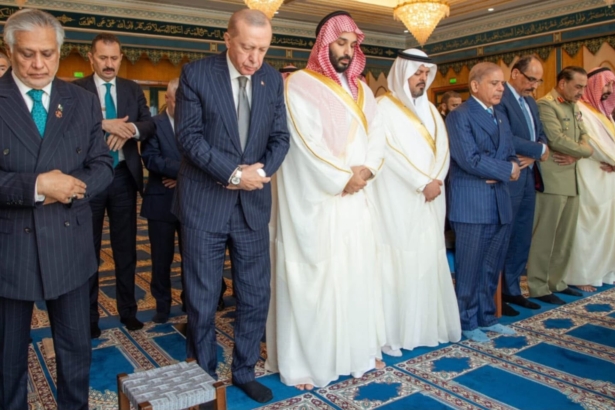
Signed in Makkah by Prime Minister Shehbaz Sharif, Saudi Crown Prince and Prime Minister Mohammed bin Salman and Turkish President Recep Tayyip Erdoğan, the agreement establishes a collective-defence principle under which an armed attack against any one of the three countries will be regarded as an attack against all three.
The pact brings together three strategically important states with highly complementary capabilities: Saudi Arabia’s economic and energy weight, Türkiye’s powerful conventional military and expanding defence industry, and Pakistan’s extensive military experience and strategic deterrent.
The combination has prompted international analysts to examine whether the Makkah agreement could become the foundation of a more autonomous, regionally driven security framework.
Ishaq Dar: agreement is defensive, not directed against any country
Pakistan’s Deputy Prime Minister and Foreign Minister Senator Ishaq Dar has sought to clarify the scope and purpose of the agreement amid growing international interest.
Dar described the Makkah Accord as “purely defensive in nature” and “not targeted against any country”, stressing that its purpose is to strengthen collective security and promote peace and stability.
He said the agreement does not replace or undermine existing bilateral or multilateral arrangements maintained by the three countries with each other, other states or international organisations.
Under the accord, Dar explained, an external armed attack against any one of the three countries would be considered an attack against all, consistent with the inherent right of individual and collective self-defence under Article 51 of the UN Charter.
Dar also said the framework remains open to other countries that share its principles and are prepared to resolve differences through mutual respect, cooperation and peaceful means.
His clarification is strategically important because it positions the Makkah framework as a mechanism of deterrence rather than confrontation, without identifying Iran, Israel or any other state as a permanent adversary.
Hakan Fidan compares mutual-defence provision with NATO Article 5
The most significant international description of the agreement’s collective-defence provision has come from Turkish Foreign Minister Hakan Fidan.
Fidan said the provision is technically comparable to NATO’s Article 5, under which an attack against one member is treated as an attack against all.
The comparison does not mean that the Makkah framework has NATO’s integrated command structure or institutional architecture. The practical response to any attack would be determined according to the circumstances.
Fidan said a ministerial committee would be established and a general secretariat based in Saudi Arabia would oversee the framework, with further operational details to be developed.
He also indicated that Türkiye wants the framework to expand, identifying Egypt as a potential future member.
The prospect of expansion is potentially significant because it could transform a trilateral arrangement into a wider regional security mechanism.
OIC welcomes agreement as an ‘important strategic step’
The Organisation of Islamic Cooperation has welcomed the agreement, with Secretary General Hissein Brahim Taha expressing strong support and describing the pact as an “important strategic step” reflecting the commitment of Pakistan, Saudi Arabia and Türkiye to strengthening cooperation.
The OIC response gives the agreement significance beyond the three signatories and places it within the wider context of cooperation among Muslim-majority countries.
The development comes at a time when several regional states are reassessing existing security arrangements and seeking greater strategic autonomy.
Saudi Arabia: strengthening security without abandoning existing partnerships
Riyadh has emphasised that the new defence framework does not replace its existing security arrangements.
Saudi Deputy Minister for Public Diplomacy Rayed Krimly said the agreement does not supersede or replace existing bilateral or multilateral agreements involving the three countries.
The position reflects Saudi Arabia’s broader foreign-policy strategy of strategic diversification.
The Kingdom continues to maintain a major relationship with the United States while simultaneously deepening strategic, economic and defence ties with Türkiye, Pakistan, China and other powers.
The Makkah pact therefore appears less a replacement for existing alliances than an additional layer of regional deterrence.
Chatham House: Türkiye pursuing strategic ‘hedging’
The Makkah agreement has also given renewed significance to earlier analysis by Chatham House.
Tim Chattell of the International Security Programme at Chatham House examined the prospect of a Turkish strategic arrangement with Saudi Arabia and Pakistan before the trilateral agreement was signed.
He argued that such cooperation formed part of Ankara’s wider strategy of “hedging” — developing alternative strategic partnerships while retaining its NATO commitments.
Chattell also identified potential synergy between the three countries, particularly because Türkiye and Pakistan possess complementary defence capabilities while Saudi Arabia has significant financial resources that could support defence cooperation and industrial development.
What had previously been examined as an emerging strategic alignment has now become a formal defence commitment.
Atlantic Council: a ‘double deterrence tool’
The Atlantic Council has also examined the evolving Saudi-Pakistan security relationship.
Analyst Eleonora Ardemagni described the Saudi-Pakistan defence pact as a “double deterrence tool”, arguing that the relationship reflected both immediate security concerns and Saudi Arabia’s longer-term drive towards greater defence autonomy.
Her analysis highlighted military training, capacity building, defence-industry cooperation, technology transfer and potential co-production as important elements of the emerging partnership.
The inclusion of Türkiye adds another major military and defence-industrial dimension to that relationship.
A strategic triangle of complementary power
The significance of the Makkah pact lies partly in the capabilities each country brings to the partnership.
Saudi Arabia contributes enormous economic and energy influence, strategic geography and financial resources.
Türkiye contributes a major conventional military, NATO experience and an increasingly sophisticated indigenous defence industry.
Pakistan contributes one of the region’s largest and most experienced armed forces, longstanding military cooperation with Saudi Arabia and Türkiye, and a nuclear deterrent.
The three-way combination therefore creates a strategic partnership in which each member contributes capabilities that complement those of the others.
That is why analysts are examining whether the agreement could eventually develop into a permanent regional security institution.
Shehbaz Sharif’s pivotal diplomatic role
For Pakistan, the agreement represents a major diplomatic achievement and the culmination of sustained engagement with both Riyadh and Ankara.
Prime Minister Shehbaz Sharif’s participation in the Makkah summit places Pakistan at the centre of a strategic framework connecting South Asia, the Gulf and the wider Muslim world.
The diplomatic challenge for Islamabad has been to deepen its defence relationships while avoiding becoming part of a confrontation between rival regional powers.
The defensive language of the agreement provides Pakistan with room to pursue that balance.
Sharif’s role has therefore been pivotal in helping create the political environment in which Pakistan’s longstanding relationships with Saudi Arabia and Türkiye could be brought together under a formal trilateral framework.
Field Marshal Asim Munir and the military dimension
The political significance of the agreement is reinforced by the military relationship underpinning it.
Field Marshal Syed Asim Munir, Chief of Army Staff and Chief of Defence Forces of Pakistan, has played a pivotal role in strengthening Pakistan’s strategic and defence relationships with Saudi Arabia and Türkiye.
Pakistan and Saudi Arabia have decades of military cooperation, including training, professional exchanges and defence coordination.
Pakistan-Türkiye defence relations have also expanded substantially, covering military technology, naval cooperation, training and defence production.
The Makkah framework provides an opportunity to bring these strands of cooperation into a broader strategic structure.
Its future credibility will depend on military interoperability, intelligence cooperation, joint exercises, defence technology, institutional coordination and contingency planning.
Field Marshal Munir’s role will consequently be central to translating the political commitment made in Makkah into practical military cooperation.
Iran: deterrence without confrontation
Iran is likely to remain one of the most important considerations in international assessments of the agreement, although Tehran is not identified as an adversary.
The pact was signed against the backdrop of heightened regional tensions, making its potential implications for the Gulf particularly significant.
However, both Türkiye and Pakistan have stressed that the agreement is not directed against Iran.
Saudi Arabia has also pursued diplomatic engagement with Tehran, while Pakistan shares a border with Iran and has consistently sought regional stability.
Türkiye maintains its own complex relationship with Iran, combining competition, economic engagement and cooperation in selected areas.
The strategic objective therefore appears to be deterrence without formally designating an enemy.
India watching the development closely
India is another major regional power assessing the implications of the agreement.
The emergence of a formal defence framework linking Pakistan, Türkiye and Saudi Arabia introduces a new variable into India’s strategic calculations.
Türkiye has close defence relations with Pakistan, while Saudi Arabia remains an important economic and strategic partner for India.
New Delhi is therefore likely to maintain its engagement with Riyadh while closely monitoring how the trilateral defence framework develops.
The immediate Indian response has been cautious, reflecting the complexity of its relationship with Saudi Arabia and the wider Gulf.
Israel faces a new strategic calculation
Israel also faces a more complicated regional environment.
Türkiye and Pakistan have adopted strong positions on the Gaza conflict, while Saudi Arabia remains one of the most influential Arab and Muslim states.
The immediate military implications of the Makkah agreement for Israel remain uncertain.
Much will depend on whether the framework remains focused on territorial defence or develops into broader political, intelligence and military coordination.
The possibility of additional countries joining could make the arrangement considerably more significant.
Egypt could transform the framework
The possibility of Egyptian participation is among the most consequential developments surrounding the agreement.
Egypt is one of the Arab world’s major military powers and occupies a strategically vital position linking the Mediterranean, Red Sea and Africa.
Türkiye has indicated that Egypt could potentially join the framework once technical issues are resolved.
Pakistan, Saudi Arabia, Türkiye and Egypt already cooperate through the R4 mechanism, creating an existing platform for strategic consultation.
If Egypt joins the defence framework, the geographical and military significance of the arrangement would increase substantially, potentially connecting major powers across South Asia, the Gulf, Anatolia, the eastern Mediterranean and North Africa.
Not NATO — but potentially the beginning of something bigger
International analysts caution against describing the Makkah agreement as a new NATO.
NATO has decades of institutional development, an integrated military command and established operational mechanisms.
The Makkah framework is at an early stage.
Its strategic significance, however, does not depend solely on whether it immediately develops NATO-style institutions.
Collective-defence agreements alter strategic calculations by increasing the potential cost of aggression.
If an adversary believes that an attack against one country could trigger military, intelligence, economic and diplomatic consequences involving two additional major powers, the calculation changes.
That is the essence of deterrence.
The United States factor
The agreement also raises questions about the future role of the United States in regional security.
The Makkah pact should not automatically be interpreted as Saudi Arabia, Türkiye or Pakistan turning away from Washington.
Türkiye remains a NATO member.
Saudi Arabia maintains a major strategic relationship with the United States.
Pakistan also has a long history of engagement with Washington.
The more accurate interpretation is strategic diversification.
Regional powers increasingly want multiple security partnerships rather than dependence on a single external guarantor.
The Makkah framework fits within that broader transformation.
Pakistan’s strategic importance rises
For Pakistan, the agreement represents a significant expansion of its role in regional security.
Islamabad now finds itself at the intersection of South Asian, Gulf and wider Muslim-world strategic affairs.
Its longstanding defence relationship with Saudi Arabia provides historical depth, while its growing partnership with Türkiye offers access to an increasingly sophisticated defence-industrial ecosystem.
The political leadership of Prime Minister Shehbaz Sharif and the strategic and military leadership of Field Marshal Syed Asim Munir have been central to positioning Pakistan within this emerging framework.
The agreement could also create opportunities for expanded joint exercises, intelligence cooperation, defence production and military technology partnerships.
The nuclear dimension
Pakistan’s nuclear capability inevitably adds another dimension to international assessments of the pact.
However, the publicly described terms of the Makkah agreement do not establish a formal Pakistani nuclear guarantee to Saudi Arabia.
It would therefore be premature to describe the agreement as creating a nuclear umbrella.
Pakistan’s nuclear capability nevertheless contributes to the overall strategic weight of its participation and inevitably forms part of the deterrence calculations surrounding the agreement.
The real test begins now
The signing in Makkah is only the beginning.
The credibility of the agreement will ultimately depend on implementation.
The three countries will need to establish practical mechanisms for military coordination, intelligence sharing, joint exercises, defence-industrial cooperation and crisis consultation.
The proposed ministerial committee and Saudi-based secretariat will be important first steps.
The future direction of the framework will also depend on whether Egypt or other regional states eventually join.
Why Makkah matters
The significance of the agreement lies in the convergence of political will, military capability and strategic geography.
For the first time, Pakistan, Saudi Arabia and Türkiye have placed their collective security relationship within a formal trilateral defence framework.
The location of the signing adds exceptional symbolic importance.
The agreement was concluded in Makkah, Islam’s holiest city, at a time when the wider region is facing profound geopolitical uncertainty.
But the significance is not merely symbolic.
The three countries possess substantial economic, military and diplomatic weight, and their cooperation could influence strategic calculations well beyond their borders.
A new era of strategic autonomy
The Makkah Joint Defence Agreement should therefore be viewed as part of a broader transformation in regional geopolitics.
Saudi Arabia is seeking greater strategic autonomy.
Türkiye is expanding its independent regional influence while retaining its NATO membership.
Pakistan is seeking a stronger role in regional security and Muslim-world diplomacy while maintaining its wider international relationships.
All three increasingly recognise that the international system is becoming more fragmented and that regional powers must develop greater capacity to protect their own interests.
The Makkah pact is therefore potentially the beginning of a new regional security architecture.
Its ultimate success will depend on implementation, political cohesion and the ability of the three countries to reconcile their different threat perceptions.
But the strategic message from Makkah is already clear:
Pakistan, Saudi Arabia and Türkiye are signalling their determination to strengthen collective deterrence, increase strategic autonomy and assume a greater role in shaping the security future of the region and the wider Muslim world.
For Pakistan, the diplomatic leadership of Prime Minister Shehbaz Sharif, reinforced by the strategic and military role of Field Marshal Syed Asim Munir, has been pivotal in bringing the country to the centre of this emerging geopolitical equation.
What began in Makkah as a trilateral defence commitment could, if successfully institutionalised and expanded, become one of the most consequential new security frameworks in the wider region.
We welcome your contributions! Submit your blogs, opinion pieces, press releases, news story pitches, and news features to opinion@minutemirror.com.pk and minutemirrormail@gmail.com