Summary
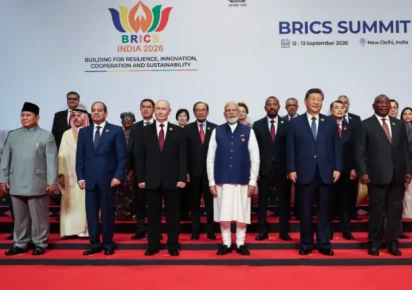
- NEW DELHI: China, Russia and India have called for deeper economic cooperation within BRICS as leaders gathered in New Delhi for the second day of a summit focused on inclusive global growth, trade and the changing international order.
- Economic cooperation takes centre stage China has pushed for stronger economic integration within the expanded BRICS grouping, while Russia has backed efforts to build a more multipolar global economic system.
- As the New Delhi summit concludes, BRICS leaders are seeking to demonstrate that their diverse group can translate political influence into meaningful economic cooperation and a stronger voice for the developing world.
NEW DELHI: China, Russia and India have called for deeper economic cooperation within BRICS as leaders gathered in New Delhi for the second day of a summit focused on inclusive global growth, trade and the changing international order.
Indian Prime Minister Narendra Modi urged members of the expanded bloc to turn their differences into an advantage, arguing that cooperation among diverse economies could help create stronger opportunities for developing countries.
“The power of BRICS lies in our diversity and cooperation,” Modi told leaders including Chinese President Xi Jinping and Russian President Vladimir Putin.
“We have tried to push inclusive global growth,” he said, adding that countries may be “rooted in different realities” but can rise together through cooperation.
BRICS, originally formed in 2009 by Brazil, Russia, India, China and South Africa, has expanded its membership in recent years as emerging economies seek a greater role in global economic and political affairs. The group now represents a substantial share of the world’s population and economic activity.
The New Delhi summit is seeking to strengthen practical cooperation in areas including trade, finance, energy, technology and development. Leaders have also discussed the impact of geopolitical conflicts, disrupted supply chains and growing economic uncertainty on developing countries.
The bloc’s New Delhi declaration reaffirmed its commitment to closer economic cooperation and highlighted work on cross-border payment mechanisms and greater use of local currencies in trade and investment.
Middle East conflict tests BRICS unity
The summit has also been shaped by the escalating conflict in the Middle East, which has exposed differences among BRICS members.
After difficult diplomatic negotiations, the leaders agreed on a joint statement expressing concern over rising tensions in the Middle East and calling for maximum restraint. The agreement was seen as a significant diplomatic achievement for India, which has sought to maintain working relationships with countries on opposing sides of the conflict.
The Middle East crisis has also created economic concerns for BRICS members, particularly because instability can disrupt energy supplies, shipping routes and global trade.
Xi and Modi seek to improve ties
Xi’s presence in New Delhi has added another important dimension to the summit. His visit is his first to India since 2019 and comes after years of strained relations between the two Asian powers following a deadly border confrontation in 2020.
Xi and Modi held talks on the sidelines of the summit, signaling a cautious effort to improve bilateral relations despite unresolved territorial disputes and economic tensions.
Xi said China and India could complement each other’s strengths and work together toward mutual development. India, meanwhile, stressed the importance of maintaining peace along the disputed border and finding a fair and mutually acceptable settlement.
Economic cooperation takes centre stage
China has pushed for stronger economic integration within the expanded BRICS grouping, while Russia has backed efforts to build a more multipolar global economic system.
Modi has also emphasized that BRICS cooperation should produce practical benefits for developing countries rather than remain limited to political declarations.
The summit therefore represents both an economic opportunity and a diplomatic test. Despite disagreements over security, borders and foreign policy, the leaders are attempting to find common ground on trade, investment, technology and global development.
For India, the challenge is to balance its growing partnerships with China and Russia while maintaining close relations with the United States and other Western powers.
As the New Delhi summit concludes, BRICS leaders are seeking to demonstrate that their diverse group can translate political influence into meaningful economic cooperation and a stronger voice for the developing world.
We welcome your contributions! Submit your blogs, opinion pieces, press releases, news story pitches, and news features to opinion@minutemirror.com.pk and minutemirrormail@gmail.com