Summary
- Eliot’s 1925 masterpiece, The Hollow Men, serves as a haunting mirror for a society undergoing a severe spiritual and moral crisis.
- While these hollow men are drawn to the concept of a divine power or a higher moral order, their paralyzing skepticism and fear of judgment stand directly in their way.
- The hollow men admit they dare not meet these eyes, even in dreams, because doing so would force them to confront their own moral failures and superficiality.
Modern life, with its rapid technological advancements and digital distractions, often leaves us feeling oddly disconnected. While this feels like a uniquely 21st-century problem, the seeds of this existential numbness were planted a century ago. Written in the shadow of World War I, T.S. Eliot’s 1925 masterpiece, The Hollow Men, serves as a haunting mirror for a society undergoing a severe spiritual and moral crisis.
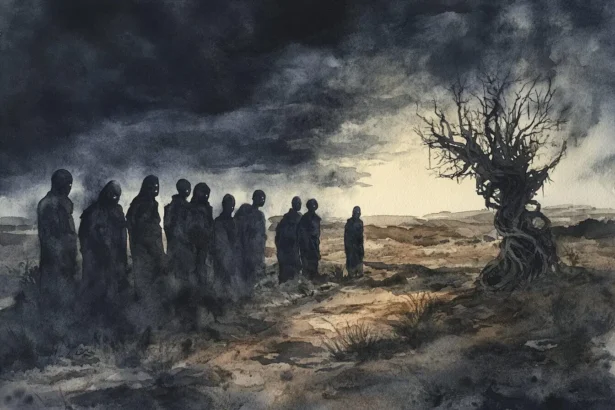
An analysis of this classic work reveals that our contemporary struggle with identity and faith is part of a longer historical cycle. The core dilemmas of Eliot’s poem remain deeply relevant. It showils how easily humanity can lose its way when material pursuits override spiritual grounding. The Hollow Men was written during a period of massive cultural upheaval. In the early 20th century, modernist poets rebelled against the structured traditions of Victorian poetry. Instead, they embraced fragmented styles to reflect the fractured nature of modern life. The poem presents a bleak portrait of a society stripped of its moral compass. Its characters are not lost violent souls but rather empty vessels beings stuffed with straw, living without purpose, conviction, or true identity.
We are the hollow men
We are the stuffed men
Leaning together
Headpiece filled with straw.
This imagery paints a picture of a collective lack of substance. These figures whisper in voices as quiet and meaningless as wind blowing through dry grass. They possess human forms but lack any distinct individuality or agency. At the pivot of Eliot’s work is an ethical dilemma. As science and industry progressed, humanity fell into two dangerous illusions. Believing that technological and scientific advancements make humans all-powerful. Believing that immediate, material gains are the only things that matter. This hyper-focus on materialism and physical existence has caused a severe imbalance. People mistake their physical bodies for their true selves, completely ignoring their spiritual essence. Furthermore, the survivors of the Great War were deeply traumatized, plagued by guilt and existential confusion. This trauma fostered a persistent state of doubt. While these hollow men are drawn to the concept of a divine power or a higher moral order, their paralyzing skepticism and fear of judgment stand directly in their way. They are caught in a perpetual limbo. Therefore, ended up longing for salvation but too terrified to face the light of truth.
Throughout the poem, eyes serve as a powerful symbol of spiritual challenge and accountability. The hollow men admit they dare not meet these eyes, even in dreams, because doing so would force them to confront their own moral failures and superficiality. In their cactus-filled desert, the eyes are noticeably absent. This absence represents a world that has turned its back on classical wisdom and religious faith. They don’t pray for grace. They worship broken stone and material idols, wandering aimlessly on the banks of a symbolic river, unable to cross over into a meaningful existence..The poem concludes with a children’s nursery rhyme, emphasizing the tragic absurdity of a life spent in paralysis. Between the desire and the action, a shadow always falls, preventing these figures from achieving anything genuine.
Here we go round the prickly pear
Prickly pear prickly pear
Here we go round the prickly pear
At five o’clock in the morning.
Lastly, to overcome this modern numbness, we must look beyond our physical senses and materialistic drives. True humanity requires a conscious effort to cultivate virtues, self-awareness, and a connection to something greater than ourselves. Without this inner work, we risk remaining in a state of cultural and spiritual infancy, fading away not with a bang, but with a quiet, tragic whimper.
We welcome your contributions! Submit your blogs, opinion pieces, press releases, news story pitches, and news features to opinion@minutemirror.com.pk and minutemirrormail@gmail.com