

Summary
- According to sources familiar with the development, General Raza is the first four-star officer to head the National Strategic Command, a change described as a significant development in Pakistan’s strategic command structure.
- Pakistan’s national security priorities Sources said discussions between Dar and General Raza also covered the wider regional security situation, including challenges along Pakistan’s eastern and western borders and maritime security concerns in the Arabian Sea and Bab Al-Mandab.
- Regional and Saudi dimension The strengthening of Pakistan’s strategic command structure is also being closely watched in Riyadh, according to sources familiar with Pakistan-Saudi strategic relations.
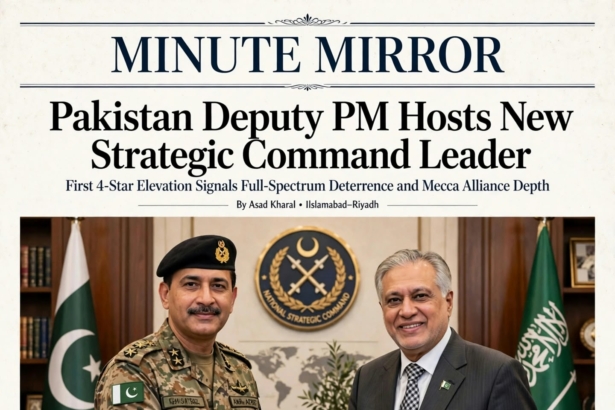
ISLAMABAD/RAWALPINDI: Deputy Prime Minister and Foreign Minister Senator Mohammad Ishaq Dar on Wednesday hosted General Raza, the newly appointed Commander of the National Strategic Command, in his first official call following his appointment in late July 2026.
According to sources familiar with the development, General Raza is the first four-star officer to head the National Strategic Command, a change described as a significant development in Pakistan’s strategic command structure.
During the meeting, Dar congratulated General Raza on his promotion and appointment. The two sides discussed national security, regional developments and the importance of continued coordination to safeguard Pakistan’s national interests and contribute to regional peace and stability.
Official photographs from the meeting showed Dar and General Raza exchanging a handshake, holding discussions with the national flags in the background and walking through the Ministry of Foreign Affairs.
Strategic significance of four-star appointment
The National Strategic Command has traditionally been headed by three-star officers. Its elevation to four-star leadership in July has therefore attracted attention within strategic and security circles.
Sources familiar with the development said the move could strengthen coordination over Pakistan’s strategic capabilities and allow faster decision-making at the highest level. They also viewed the change as an effort to maintain institutional parity with an increasingly complex regional security environment.
The elevation is also being seen as a step toward ensuring continuity and credibility in Pakistan’s deterrence posture, while keeping strategic matters under a centralized command structure.
A source familiar with the development said the change was less about rank itself and more about demonstrating the importance Pakistan attaches to strategic deterrence and national security.
Timing after Mecca defence framework
The meeting also comes shortly after the reported activation of the Mecca Joint Defence Framework involving Pakistan, Saudi Arabia and Türkiye.
According to sources, the framework, signed in Mecca on August 7, includes a collective defence understanding under which an attack on one member would be treated as a threat to all. The arrangement has also been linked by officials and sources to the broader security of the region and the protection of the Two Holy Mosques.
The development has increased attention on Pakistan’s strategic role within its broader defence relationship with Saudi Arabia and other regional partners.
Pakistan’s national security priorities
Sources said discussions between Dar and General Raza also covered the wider regional security situation, including challenges along Pakistan’s eastern and western borders and maritime security concerns in the Arabian Sea and Bab Al-Mandab.
The discussions reportedly focused on maintaining close coordination between diplomatic and security institutions while pursuing Pakistan’s stated objective of peace through credible deterrence.
Pakistan has consistently maintained that its strategic capabilities are intended to safeguard national sovereignty and prevent conflict rather than promote confrontation.
Regional and Saudi dimension
The strengthening of Pakistan’s strategic command structure is also being closely watched in Riyadh, according to sources familiar with Pakistan-Saudi strategic relations.
They said Saudi Arabia considers Pakistan an important defence partner and that closer institutional coordination could contribute to broader regional security, including the protection of trade routes and strategic maritime passages.
However, no operational details regarding the National Strategic Command were publicly disclosed during the meeting.
The meeting marks an important engagement between Pakistan’s diplomatic leadership and its strategic command at a time of evolving regional security dynamics. Further consultations between relevant civilian and security institutions are expected, sources said.
We welcome your contributions! Submit your blogs, opinion pieces, press releases, news story pitches, and news features to opinion@minutemirror.com.pk and minutemirrormail@gmail.com