Summary
- Because in the end, Prime Minister, the question is not whether you worked hard.
- Not a reshuffle in which the same officers swap chairs, like musical chairs with a guaranteed seat for everyone, but a real change: merit-based appointments, real accountability, measurable targets, and the devolution of power to elected local governments who can be voted out by the people they serve.
- Because in the end, Prime Minister, the question is not whether you worked hard.
Dear Prime Minister, What Will Remain When You Leave?
Let me say first, as every honest critic should, that I am your greatest fan. I was your fan on 11 April 2022, when you took the oath, and I am your fan today, writing this with a handkerchief in one hand and a pen in the other. The handkerchief is for the tears of blood. The pen is for the truth, which I have kept in the drawer for four years and now take out with great regret.
Almost four years have passed since you first took charge, if we count generously and treat the caretaker interlude as a short tea break. Four years is a serious span. Roosevelt (1933 to1937) built a new economic order in less. Atatürk (1924 to 1928) rebuilt a state in about the same. Deng Xiaoping 1978–1982) opened the door of a nation of a billion people and walked them through it. I hoped, sir, that you would be all of them, and perhaps also Mandela (1990 to 1994) on weekends.
So I ask one gentle question, the sort a fan asks over tea: what will remain when you leave?
I do not ask what you have done. Everyone knows what you have done. You have worked harder than any prime minister in living memory. You have risen early, held meetings, formed committees, reviewed the reviews, and issued so many notices that the paper industry should send you a thank-you card. Nobody can accuse you of laziness. If governance were measured in hours, we would be a superpower and the clocks would be exhausted.
But governance is measured in results, and that is where my handkerchief comes in.
When the Interior Minister, and later the DG ISPR, said that governance in Pakistan had collapsed, I wept so loudly that even the Himalayas cried with me. The glaciers, I am told, have been melting faster ever since, though scientists blame other causes. I prefer my theory. When the alarm is raised from inside the house, a loyal fan has no choice but to cry, and a loyal fan with a pen has no choice but to write.
Consider your brigade of favourite bureaucrats, the loyal officers of the Pakistan Administrative Service who have followed you since your Lahore days. They are devoted men. But in reality, they are also the custodians of a system built by colonial rulers to collect revenue and keep order, a purpose it still serves with remarkable efficiency. The citizen who wants a certificate, a permit, a registration or a simple answer still meets the same iron wall, only now it has a fresh coat of paint and a WhatsApp group.
Here I must say something painful, sir, and I say it with trembling hands. Your mode of governance through the PAS bureaucracy has proven, in the eyes of many citizens, worse than the Raj itself. The colonial administrator at least had a purpose, however unjust, and a deadline set by London. Our modern version has inherited the powers of the Raj without its sense of urgency, and the arrogance of the Raj without even its paperwork discipline. The citizen, who was once a subject, is now a subject of a different kind: a subject of correspondence, pending forever.
Now consider your ministers, who are my second great sorrow. Take the Minister for Planning, Ahsan Iqbal, a man of great vision. His vision is so large that it has never fit inside a single year. We have been promised plans, frameworks, roadmaps and visions, each more beautifully printed than the last. I admire them as I admire fine calligraphy: with respect, and without expecting them to move. Pakistan has never lacked a plan. It has lacked a plan that survived contact with a bureaucrat. I once sent the Planning Ministry a humble proposal on energy reform and circular debt. It was received with great courtesy and has since entered the great silence that awaits all good ideas, where it keeps company with thousands of others.
Then there is the energy sector, where your Power and Petroleum ministers sit at the centre of the greatest family drama in the country. Circular debt is the one member of the household that never leaves. It grows quietly, it eats well, and it is passed from one government to the next like a precious heirloom nobody wants. Power plants are paid for electricity that was never used. Consumers pay for electricity they can barely afford. Petroleum prices rise and fall in a way that is explained to us every month by officials who seem to understand it much better than we do.
I do not say the ministers are idle. I am sure they are busy, in the way a ceiling fan is busy: always turning, always humming, and moving the same hot air from one corner of the room to another. If effort were electricity, our load shedding would be a distant memory.
And so, dear Prime Minister, I come back to my question. What legacy are you leaving?
If the answer is a good name for hard work, you have it already, and no one can take it from you. But history is a harsh examiner. It does not give marks for attendance. It asks what changed in the lives of ordinary people. Is the electricity bill lower? Is the tax system fairer? Is the courtroom faster? Is the officer at the counter more polite, or at least more honest? Does the citizen feel the state is a servant instead of a landlord?
When historians search for your legacy, I fear they will find a very large pile of files, a very busy calendar and a team that managed to look productive without disturbing anything. This is a rare talent. It is not, I am afraid, the talent of Roosevelt or Deng.
Please do not think I am asking you to leave. I am a cricket lover, and cricket lovers know that the nation shouts at the whole team when a match is lost, not only the captain. The captain at least turns up, sweats and takes the blame in the post-match interview. I only suggest that the captain look at the squad he has been carrying for years. Eleven players who have lost a long series together do not need a pep talk. They need a new batting order, and perhaps some fresh faces from the domestic circuit.
So here is my humble suggestion, offered with all the affection of a fan whose heart is slowly breaking.
My dear Prime Minister, when you leave your passion for the PAS bureaucracy, and I pray that day comes soon, fill your team with engineers equipped with AI. Look across the border, where a bureaucracy with the very same colonial DNA has begun to reform itself. India’s grievance portal, CPGRAMS, now uses AI to read, classify and route citizens’ complaints within seconds, and officials report very high disposal rates. The Income Tax Department’s Project Insight mines data to catch evaders without waiting for an inspector’s mood. Digital rails built on Aadhaar and UPI flag irregularities in real time. I do not claim their system is perfect, because no system run by humans is. But an officer who knows an algorithm is watching behaves remarkably well. Engineers do not ask for a file to be moved to the next table. They build the table out of existence.
It is time, sir, to change your whole team, so that 260 million people may get some relief in your era and not in someone else’s. Not a reshuffle in which the same officers swap chairs, like musical chairs with a guaranteed seat for everyone, but a real change: merit-based appointments, real accountability, measurable targets, and the devolution of power to elected local governments who can be voted out by the people they serve. Cricket teaches that you cannot win with the same eleven who lost the last ten matches.
Work six hours a day instead of eighteen. A leader who is everywhere has built a government that works nowhere without him. Shelve the Planning Commission as India did something similar in 2014, and while I do not admire everything across the border, a good idea has no passport.
And then, sir, take a day off. Come to Rawal Dam and go fishing. I will bring the bait and a spare rod. The fish are honest, patient and have no interest in your cabinet. I promise to mention circular debt no more than twice, and I will try to cry quietly, since the Himalayas have already cried enough for one season.
Because in the end, Prime Minister, the question is not whether you worked hard. We know you did. The question is whether the system you leave behind works at all when you are not there to supervise it. A true legacy is not what a leader does by himself. It is what continues after he has gone home.
You still have time. A match is never over until the last ball, and the crowd, however angry, still hopes to cheer. I remain your devoted fan, and my tears are real, even if I have been told that blood is no longer fashionable.
Engineers, AI and Synthetic Intelligence Experts, Not Bureaucrats: A Blueprint to Save Pakistan’s Governance
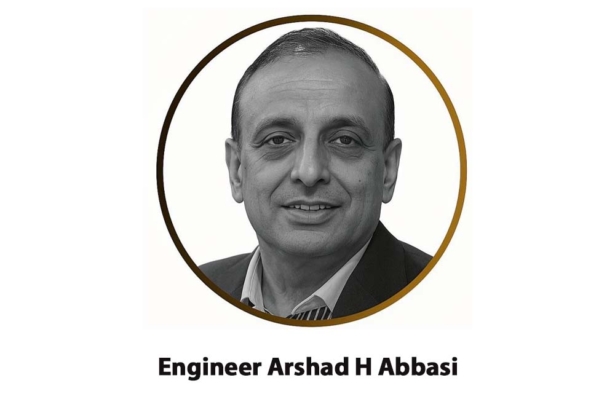
By Engineer Arshad H Abbasi
Dear Prime Minister, What Will Remain When You Leave?
Let me say first, as every honest critic should, that I am your greatest fan. I was your fan on 11 April 2022, when you took the oath, and I am your fan today, writing this with a handkerchief in one hand and a pen in the other. The handkerchief is for the tears of blood. The pen is for the truth, which I have kept in the drawer for four years and now take out with great regret.
Almost four years have passed since you first took charge, if we count generously and treat the caretaker interlude as a short tea break. Four years is a serious span. Roosevelt (1933 to1937) built a new economic order in less. Atatürk (1924 to 1928) rebuilt a state in about the same. Deng Xiaoping 1978–1982) opened the door of a nation of a billion people and walked them through it. I hoped, sir, that you would be all of them, and perhaps also Mandela (1990 to 1994) on weekends.
So I ask one gentle question, the sort a fan asks over tea: what will remain when you leave?
I do not ask what you have done. Everyone knows what you have done. You have worked harder than any prime minister in living memory. You have risen early, held meetings, formed committees, reviewed the reviews, and issued so many notices that the paper industry should send you a thank-you card. Nobody can accuse you of laziness. If governance were measured in hours, we would be a superpower and the clocks would be exhausted.
But governance is measured in results, and that is where my handkerchief comes in.
When the Interior Minister, and later the DG ISPR, said that governance in Pakistan had collapsed, I wept so loudly that even the Himalayas cried with me. The glaciers, I am told, have been melting faster ever since, though scientists blame other causes. I prefer my theory. When the alarm is raised from inside the house, a loyal fan has no choice but to cry, and a loyal fan with a pen has no choice but to write.
Consider your brigade of favourite bureaucrats, the loyal officers of the Pakistan Administrative Service who have followed you since your Lahore days. They are devoted men. But in reality, they are also the custodians of a system built by colonial rulers to collect revenue and keep order, a purpose it still serves with remarkable efficiency. The citizen who wants a certificate, a permit, a registration or a simple answer still meets the same iron wall, only now it has a fresh coat of paint and a WhatsApp group.
Here I must say something painful, sir, and I say it with trembling hands. Your mode of governance through the PAS bureaucracy has proven, in the eyes of many citizens, worse than the Raj itself. The colonial administrator at least had a purpose, however unjust, and a deadline set by London. Our modern version has inherited the powers of the Raj without its sense of urgency, and the arrogance of the Raj without even its paperwork discipline. The citizen, who was once a subject, is now a subject of a different kind: a subject of correspondence, pending forever.
Now consider your ministers, who are my second great sorrow. Take the Minister for Planning, Ahsan Iqbal, a man of great vision. His vision is so large that it has never fit inside a single year. We have been promised plans, frameworks, roadmaps and visions, each more beautifully printed than the last. I admire them as I admire fine calligraphy: with respect, and without expecting them to move. Pakistan has never lacked a plan. It has lacked a plan that survived contact with a bureaucrat. I once sent the Planning Ministry a humble proposal on energy reform and circular debt. It was received with great courtesy and has since entered the great silence that awaits all good ideas, where it keeps company with thousands of others.
Then there is the energy sector, where your Power and Petroleum ministers sit at the centre of the greatest family drama in the country. Circular debt is the one member of the household that never leaves. It grows quietly, it eats well, and it is passed from one government to the next like a precious heirloom nobody wants. Power plants are paid for electricity that was never used. Consumers pay for electricity they can barely afford. Petroleum prices rise and fall in a way that is explained to us every month by officials who seem to understand it much better than we do.
I do not say the ministers are idle. I am sure they are busy, in the way a ceiling fan is busy: always turning, always humming, and moving the same hot air from one corner of the room to another. If effort were electricity, our load shedding would be a distant memory.
And so, dear Prime Minister, I come back to my question. What legacy are you leaving?
If the answer is a good name for hard work, you have it already, and no one can take it from you. But history is a harsh examiner. It does not give marks for attendance. It asks what changed in the lives of ordinary people. Is the electricity bill lower? Is the tax system fairer? Is the courtroom faster? Is the officer at the counter more polite, or at least more honest? Does the citizen feel the state is a servant instead of a landlord?
When historians search for your legacy, I fear they will find a very large pile of files, a very busy calendar and a team that managed to look productive without disturbing anything. This is a rare talent. It is not, I am afraid, the talent of Roosevelt or Deng.
Please do not think I am asking you to leave. I am a cricket lover, and cricket lovers know that the nation shouts at the whole team when a match is lost, not only the captain. The captain at least turns up, sweats and takes the blame in the post-match interview. I only suggest that the captain look at the squad he has been carrying for years. Eleven players who have lost a long series together do not need a pep talk. They need a new batting order, and perhaps some fresh faces from the domestic circuit.
So here is my humble suggestion, offered with all the affection of a fan whose heart is slowly breaking.
My dear Prime Minister, when you leave your passion for the PAS bureaucracy, and I pray that day comes soon, fill your team with engineers equipped with AI. Look across the border, where a bureaucracy with the very same colonial DNA has begun to reform itself. India’s grievance portal, CPGRAMS, now uses AI to read, classify and route citizens’ complaints within seconds, and officials report very high disposal rates. The Income Tax Department’s Project Insight mines data to catch evaders without waiting for an inspector’s mood. Digital rails built on Aadhaar and UPI flag irregularities in real time. I do not claim their system is perfect, because no system run by humans is. But an officer who knows an algorithm is watching behaves remarkably well. Engineers do not ask for a file to be moved to the next table. They build the table out of existence.
It is time, sir, to change your whole team, so that 260 million people may get some relief in your era and not in someone else’s. Not a reshuffle in which the same officers swap chairs, like musical chairs with a guaranteed seat for everyone, but a real change: merit-based appointments, real accountability, measurable targets, and the devolution of power to elected local governments who can be voted out by the people they serve. Cricket teaches that you cannot win with the same eleven who lost the last ten matches.
Work six hours a day instead of eighteen. A leader who is everywhere has built a government that works nowhere without him. Shelve the Planning Commission as India did something similar in 2014, and while I do not admire everything across the border, a good idea has no passport.
And then, sir, take a day off. Come to Rawal Dam and go fishing. I will bring the bait and a spare rod. The fish are honest, patient and have no interest in your cabinet. I promise to mention circular debt no more than twice, and I will try to cry quietly, since the Himalayas have already cried enough for one season.
Because in the end, Prime Minister, the question is not whether you worked hard. We know you did. The question is whether the system you leave behind works at all when you are not there to supervise it. A true legacy is not what a leader does by himself. It is what continues after he has gone home.
You still have time. A match is never over until the last ball, and the crowd, however angry, still hopes to cheer. I remain your devoted fan, and my tears are real, even if I have been told that blood is no longer fashionable.
We welcome your contributions! Submit your blogs, opinion pieces, press releases, news story pitches, and news features to opinion@minutemirror.com.pk and minutemirrormail@gmail.com