Summary
- ISLAMABAD: The European Union wants to make legal travel and employment opportunities more accessible to Pakistanis, its migration chief has said, acknowledging that a nearly 50% Schengen visa refusal rate and difficulties securing appointments are creating frustration for genuine applicants.
- The commissioner said controlling irregular migration was essential to creating greater political support within Europe for legal migration opportunities.
- The visit highlighted a dual challenge for both sides: strengthening action against dangerous irregular migration while creating practical, accessible legal pathways for Pakistani students, skilled workers and other genuine travellers seeking opportunities in Europe.
ISLAMABAD: The European Union wants to make legal travel and employment opportunities more accessible to Pakistanis, its migration chief has said, acknowledging that a nearly 50% Schengen visa refusal rate and difficulties securing appointments are creating frustration for genuine applicants.
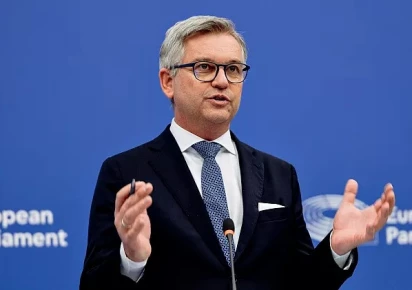
Magnus Brunner, the European Commissioner for Internal Affairs and Migration, made the remarks in an interview during his first visit to Pakistan, where discussions with senior officials focused on migration, border management, legal mobility and efforts to combat human smuggling.
Brunner said responsibility for improving the situation rested with both sides, calling for better access to legal migration channels and improvements in the quality of documents submitted with visa applications.
“We have to do a better job there as a European Union,” he said, describing the refusal rate as “too much”.
He also acknowledged that securing appointments could be frustrating for Pakistanis seeking to travel legally to Europe. Although visa decisions largely remain the responsibility of individual EU member states, he said the European Commission was working to improve coordination and make procedures quicker through its visa strategy.
During his visit, Brunner met President Asif Ali Zardari, Prime Minister Shehbaz Sharif, Deputy Prime Minister and Foreign Minister Ishaq Dar, Interior Minister Mohsin Naqvi and other officials.
Legal migration gains importance
Brunner said cooperation between Pakistan and the EU had helped reduce irregular migration, with the number of Pakistanis entering the bloc illegally falling by more than 50%, according to his assessment.
Pakistani officials separately reported a 64% decline in irregular migration to Europe over the preceding 18 months.
The commissioner said controlling irregular migration was essential to creating greater political support within Europe for legal migration opportunities.
He explained that European economies needed foreign workers because of ageing populations and labour shortages. Legal migration, he added, could help match available skills in countries such as Pakistan with employment needs across Europe.
However, Brunner acknowledged that the EU’s Talent Partnership with Pakistan had not yet delivered its full potential.
“We haven’t achieved enough, I think,” he said, adding that his visit was partly aimed at exploring ways to connect young Pakistanis with employment opportunities suited to their qualifications and skills.
He cited Italy as an example of a member state providing opportunities for foreign workers, while noting that other European countries could do more. He also praised Pakistan’s efforts to establish legal labour pathways with countries such as South Korea.
Warning against dangerous migration routes
Alongside efforts to expand legal opportunities, Brunner warned young Pakistanis against relying on smugglers to reach Europe.
He identified a particularly dangerous route running from Pakistan and Bangladesh through Gulf countries and Egypt to Libya, before crossing the Mediterranean towards Italy and Greece.
Many migrants have lost their lives along these routes, he said, stressing that the EU’s Eastern Corridor Initiative was intended to strengthen cooperation against irregular migration and human trafficking.
“Don’t put your life into the hands of the smugglers and the human traffickers because it’s very dangerous,” Brunner warned.
He urged young people to focus on education, acquiring relevant skills and pursuing lawful routes to Europe, cautioning that the prospects of obtaining asylum could be extremely limited.
Brunner also said cooperation under the EU-Pakistan readmission agreement was progressing, although the return rate for Pakistani nationals found to be staying illegally in the bloc stood at around 30%, leaving room for improvement.
Security and regional diplomacy
Beyond migration, the commissioner described counterterrorism and efforts to prevent radicalisation as shared priorities for Pakistan and the EU.
He also praised Islamabad’s diplomatic efforts to reduce tensions between Iran and the United States, saying Pakistan had demonstrated the importance of its role as an intermediary.
The visit highlighted a dual challenge for both sides: strengthening action against dangerous irregular migration while creating practical, accessible legal pathways for Pakistani students, skilled workers and other genuine travellers seeking opportunities in Europe.
We welcome your contributions! Submit your blogs, opinion pieces, press releases, news story pitches, and news features to opinion@minutemirror.com.pk and minutemirrormail@gmail.com