Summary
- European Union member states have opposed a proposed final agreement at the COP31 climate summit after negotiators failed to include an explicit reference to fossil fuels in the latest draft.
- Ireland’s Climate and Energy Minister Darragh O’Brien, whose country currently holds the rotating EU presidency, said the bloc would not support a final agreement that failed to mention fossil fuels.
- The latest version refers to a 2023 global agreement that called for a transition away from fossil fuels but does not explicitly name the energy sources.
European Union member states have opposed a proposed final agreement at the COP31 climate summit after negotiators failed to include an explicit reference to fossil fuels in the latest draft.
The EU presidency announced its objection on Sunday, arguing that any meaningful climate agreement must address the main source of global warming. The disagreement has deepened tensions at the summit, where nearly 200 countries have spent two weeks negotiating measures to tackle climate change.
Ireland’s Climate and Energy Minister Darragh O’Brien, whose country currently holds the rotating EU presidency, said the bloc would not support a final agreement that failed to mention fossil fuels.
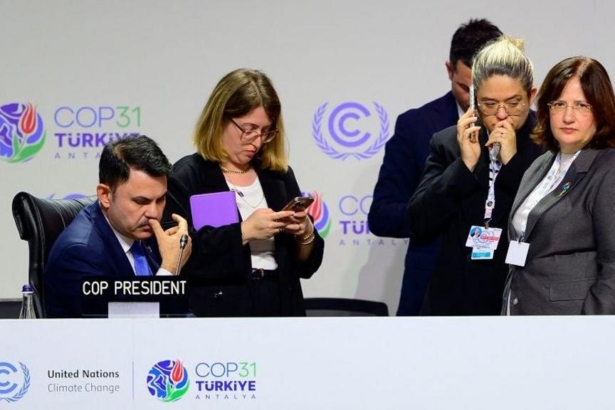
The latest proposal was presented by summit co-hosts Turkey and Australia after negotiations extended beyond the scheduled closing time. However, it failed to resolve disagreements over the future of coal, oil and gas.
Several countries, including EU members, have called for stronger commitments to move away from fossil fuels. Their position has faced resistance from oil-producing nations, particularly Saudi Arabia.
France described the proposed agreement as a step backwards. French Ecological Transition Minister Monique Barbut said the negotiations remained difficult and warned that time was running out to reach an acceptable outcome.
A German official also said oil-producing countries were strongly resisting efforts to secure stronger language on fossil fuels. Meanwhile, Antigua and Barbuda’s Environment Minister Michael Joseph expressed disappointment with the draft, saying it remained largely silent on the issue.
Earlier versions of the agreement had included a proposal for a faster transition away from fossil fuels. However, a revised draft released on Thursday removed direct references to coal, oil and gas.
The latest version refers to a 2023 global agreement that called for a transition away from fossil fuels but does not explicitly name the energy sources. It also retains support for expanding carbon capture and storage technology, which is promoted by parts of the fossil fuel industry but criticised by environmental groups over its cost and effectiveness.
The disagreement has also been shaped by rising energy prices and geopolitical tensions linked to the war in Iran. These pressures have made negotiations over future energy policies more complicated.
Despite the dispute, the proposed agreement includes a target to increase electricity’s share of global final energy consumption to 35 per cent by 2035. It also calls for wider use of clean energy as countries seek to reduce greenhouse gas emissions and strengthen energy security.
However, some countries have questioned whether the electrification target would lead to genuine emissions reductions without a clear commitment to renewable energy. Around one-third of global electricity is currently generated from coal, while natural gas accounts for another fifth.
Another major disagreement concerns the next assessment reports by the United Nations’ Intergovernmental Panel on Climate Change (IPCC). Saudi Arabia, India and Kenya have sought to delay the publication of the next reports, while several countries across Europe, Africa and the Pacific want them released in time for a global review of climate efforts in 2028.
The draft agreement also acknowledges concerns that global temperatures could exceed the 1.5-degree Celsius limit set under the Paris climate accord in the coming years.
Climate finance remains another unresolved issue. Developing countries have criticised wealthy nations over what they describe as insufficient support for tackling climate change and adapting to its effects. The removal of a proposed $120 billion climate adaptation target from the draft has added to their frustration.
The EU’s objection has further complicated efforts to secure consensus on the final agreement. With major disagreements remaining over fossil fuels, climate finance and scientific assessments, the outcome of the summit remains uncertain.
We welcome your contributions! Submit your blogs, opinion pieces, press releases, news story pitches, and news features to opinion@minutemirror.com.pk and minutemirrormail@gmail.com