Summary
- Thousands of people took to the streets of Lisbon on Saturday to protest against rising living costs, low wages and an increasingly severe housing crisis.
- They blamed rising prices, increasing fuel costs and expensive housing for making everyday life increasingly difficult.
- Although the Lisbon march remained largely peaceful, the growing number of demonstrations highlights the pressure facing European governments as households struggle with higher prices, stagnant purchasing power and increasingly expensive housing.
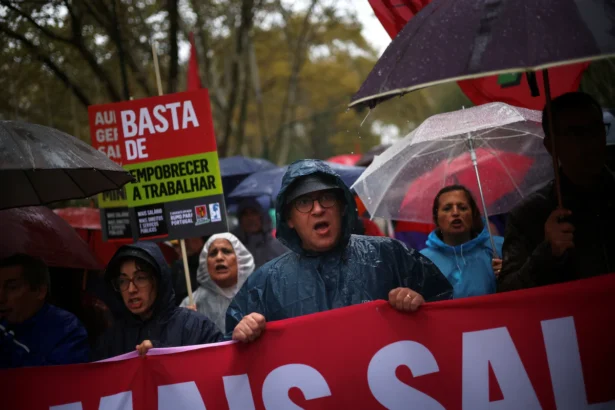
Thousands of people took to the streets of Lisbon on Saturday to protest against rising living costs, low wages and an increasingly severe housing crisis. Demonstrators marched through the Portuguese capital despite heavy rain, demanding urgent action to ease financial pressure on ordinary households.
The protest was organised by the General Confederation of Portuguese Workers (CGTP), the country’s largest trade union federation. It called on the government to increase wages and pensions, reduce the prices of essential goods and services, and introduce measures to make housing more affordable.
The CGTP described the turnout as involving many thousands of people. Protesters carried umbrellas and wore raincoats as they marched along two major avenues in central Lisbon. Police did not release an official estimate of the number of participants.
Many demonstrators said their earnings were no longer sufficient to cover basic household expenses. They blamed rising prices, increasing fuel costs and expensive housing for making everyday life increasingly difficult.
Manuel Gomes, a 44-year-old factory worker who joined the march, said workers were facing growing expenses despite putting in more effort. He argued that people were struggling to manage their daily needs and criticised the centre-right government’s response to the economic situation.
Gomes also highlighted the rising cost of diesel and petrol, along with increasing housing expenses. He said wages remained too low to keep pace with the growing cost of living and called for changes to government policies.
Economic figures underline some of the concerns raised by protesters. Portugal’s average annual earnings in 2025 were 37 per cent below the European Union average, according to Eurostat. Inflation also reached 3.8 per cent in October, largely driven by higher food and energy prices amid continuing tensions in the Middle East.
Housing affordability has emerged as another major concern across Portugal. Property prices have more than doubled since 2017, while rents for newly signed leases have nearly doubled over the same period. The sharp increase has placed particular pressure on younger people, many of whom are finding it increasingly difficult to afford independent accommodation.
Retired IT technician Luis Russo, 66, said he joined the demonstration to demand better wages and pensions. He also criticised speculation in the rental market, arguing that government policies appeared to favour powerful business interests rather than ordinary citizens.
Saturday’s march followed several weeks of growing public frustration over housing and economic pressures. Housing activists have organised tent camps in Lisbon and Porto to draw attention to the difficulties faced by people struggling to find affordable accommodation.
The demonstration also reflected a wider wave of public discontent across Europe, where rising household expenses and housing shortages have triggered protests and calls for government intervention.
Although the Lisbon march remained largely peaceful, the growing number of demonstrations highlights the pressure facing European governments as households struggle with higher prices, stagnant purchasing power and increasingly expensive housing.
We welcome your contributions! Submit your blogs, opinion pieces, press releases, news story pitches, and news features to opinion@minutemirror.com.pk and minutemirrormail@gmail.com