Summary
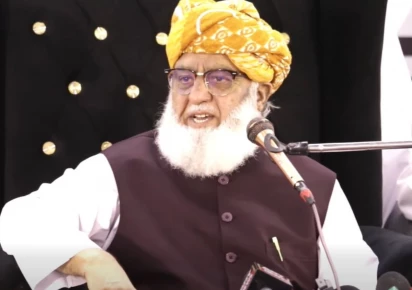
- LAHORE: Jamiat Ulema-e-Islam-Fazl (JUI-F) chief Maulana Fazlur Rehman has said the debate over provinces and administrative restructuring is essentially linked to the distribution of financial resources under the National Finance Commission (NFC) Award.
- Commenting on the possibility of new provinces, he said the country first needed to determine whether the existing political and security environment was suitable for such a major administrative exercise.
- The JUI-F chief expressed concern over the deteriorating security situation, particularly in the country’s two troubled provinces.
LAHORE: Jamiat Ulema-e-Islam-Fazl (JUI-F) chief Maulana Fazlur Rehman has said the debate over provinces and administrative restructuring is essentially linked to the distribution of financial resources under the National Finance Commission (NFC) Award.
Speaking during his visit to Lahore, Fazl maintained that the Constitution allows the provincial share in the NFC to be increased but not reduced. He also cautioned against discussing territorial or administrative divisions while the country continues to face serious security and governance challenges.
“When the house is on fire, there should be no talk of division,” the JUI-F chief said, describing the law and order situation as alarming.
Commenting on the possibility of new provinces, he said the country first needed to determine whether the existing political and security environment was suitable for such a major administrative exercise.
Fazl also clarified that JUI-F’s cooperation with the Pakistan Tehreek-e-Insaf (PTI) remained confined to parliamentary matters and did not constitute a broader political alliance.
He criticised what he described as growing federal interference in provincial affairs, particularly over natural resources. Fazl said the 18th Amendment had given provinces ownership of mineral resources and alleged that efforts were being made to undermine their constitutional rights over resources and revenues.
“There is neither peace, nor economy, nor democracy,” he said, while questioning the effectiveness of the country’s political and administrative system.
The JUI-F chief expressed concern over the deteriorating security situation, particularly in the country’s two troubled provinces. He said ordinary people were struggling to work, travel and earn a livelihood, while repeated security operations had failed to fully address the underlying problems.
Fazl urged the state to acknowledge its shortcomings instead of reacting negatively to criticism, arguing that the state ultimately derives its strength from the people.
Turning to the economy, he questioned how Pakistan could achieve meaningful development without peace and stability. Comparing Pakistan’s economic position with India, he cited India’s foreign exchange reserves and economic growth as evidence of the widening gap between the two countries.
He also criticised Pakistan’s dependence on international financial institutions, saying the country had limited control over its own economic and natural resources.
According to Fazl, the end of colonial rule had not completely eliminated the colonial system, with Pakistan continuing to face significant external economic constraints.
We welcome your contributions! Submit your blogs, opinion pieces, press releases, news story pitches, and news features to opinion@minutemirror.com.pk and minutemirrormail@gmail.com