

Summary
- ISLAMABAD: Pakistan’s Federal Board of Revenue (FBR) has introduced a benchmark of Rs195 for every 1,000 YouTube views for determining taxable income of social media creators, triggering concerns among content creators and tax practitioners over whether the formula accurately reflects their actual earnings.
- The rules reportedly allow creators to claim expenses up to 30 percent of gross revenue, while the remaining amount is treated as taxable income.
- The policy is intended to formalise Pakistan’s growing digital economy, but concerns remain that an inflexible benchmark could place additional pressure on smaller creators and encourage some participants to remain outside the formal tax system.
ISLAMABAD: Pakistan’s Federal Board of Revenue (FBR) has introduced a benchmark of Rs195 for every 1,000 YouTube views for determining taxable income of social media creators, triggering concerns among content creators and tax practitioners over whether the formula accurately reflects their actual earnings.
The procedure, notified on September 23, 2026, is aimed at bringing Pakistan’s rapidly expanding digital creator economy into the formal tax system. However, data reviewed by Minute Mirror suggests that the benchmark may sometimes exceed the revenue actually generated by creators.
Revenue gap highlighted by YouTube data
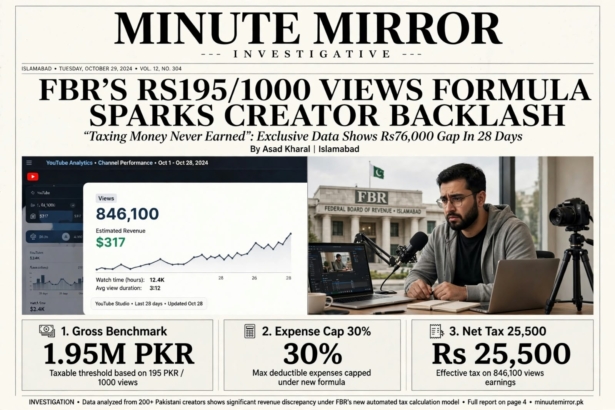
According to verified analytics from a Pakistani finance channel, the platform recorded 846,100 views during a 28-day period and generated approximately $317.09 in YouTube revenue, equivalent to around Rs89,000.
Under the FBR’s benchmark, however, the same number of views would translate into approximately Rs165,000 in assumed revenue. This creates a difference of about Rs76,000 between the actual revenue reported by YouTube and the benchmark amount.
A source associated with the channel said the actual earnings have to cover several operational expenses, including staff salaries and studio costs. The creator also pointed out that audience location and the proportion of Shorts views can significantly affect YouTube earnings.
According to the source, creators focused on entertainment and vlogging may receive even lower returns per 1,000 views than channels operating in higher-RPM categories such as finance.
How the FBR benchmark works
Officials familiar with the procedure said the benchmark is calculated by multiplying total views, expressed in thousands, by Rs195. If a creator’s actual earnings are lower, the taxpayer may be required to provide evidence supporting the lower amount.
The procedure also reportedly considers the higher amount between actual remittances received and the prescribed benchmark. In addition, products, gadgets and other benefits received free of cost through promotional arrangements may be treated as taxable income.
The rules reportedly allow creators to claim expenses up to 30 percent of gross revenue, while the remaining amount is treated as taxable income. Tax authorities may also seek access to a creator’s social media dashboard under relevant legal provisions.
Quarterly advance tax requirements have also been introduced for creators earning income through digital platforms.
Example of 10 million annual views
Under the benchmark, a creator receiving 10 million views in a year would have gross assumed revenue of Rs1.95 million.
After a 30 percent expense deduction of Rs585,000, taxable income would stand at Rs1.365 million. Applying the relevant non-salaried tax slab would result in a calculated tax of Rs123,000.
After adjustment of 5 percent bank withholding, amounting to Rs97,500, the remaining payable amount would be Rs25,500.
Tax practitioners, however, have questioned whether a 30 percent expense ceiling adequately reflects the costs involved in producing digital content. Equipment, software, electricity, internet services, editing, production and staff salaries can represent substantial expenses for established creators.
Calls for taxation based on actual earnings
Creators and tax experts have argued that YouTube Analytics and bank remittance records should be considered when determining taxable income.
They maintain that taxation should be based on revenue actually earned rather than a fixed assumption that may not reflect differences in audience location, content category or platform format.
The debate is not about whether the digital economy should be taxed, but whether the taxation mechanism accurately reflects the financial realities of creators.
The policy is intended to formalise Pakistan’s growing digital economy, but concerns remain that an inflexible benchmark could place additional pressure on smaller creators and encourage some participants to remain outside the formal tax system.
We welcome your contributions! Submit your blogs, opinion pieces, press releases, news story pitches, and news features to opinion@minutemirror.com.pk and minutemirrormail@gmail.com