Summary
- The evaluation programme proposed here develops the case for testing the reform package against observable outcomes. Tobias Haque, Jedah Ogweno, Aroub Farooq, Joao Morgado, Bilal Malaeb and Anais Scuitti, Strengthening Fiscal Federalism in Pakistan, World Bank, 2026, Executive Summary and sections 4.1, 4.3 and 4.4.
- See also the World Bank’s accompanying release of 1 July 2026, “Pakistan: Strengthening Fiscal Federalism to Drive Development.” These findings identify financing, allocation and implementation failures; the causal verdict on recentralisation in the article is the author’s assessment. World Bank, The Effects of Taxes and Transfers on Inequality and Poverty in Pakistan, 22 May 2025.
- It supplies a methodological reference here; the article does not present its estimates as measurements of Pakistan’s October 2026 position. Martin Grote and Jean-François Wen, “How to Design and Implement Property Tax Reforms,” IMF How To Notes 2024/006, 19 September 2024.
A government can meet its collection target while leaving the citizens poorer. It can transfer more money to a province while a village clinic remains without medicines. It can introduce a common tax portal while concentrating the power to delay refunds. Fiscal justice begins when these outcomes enter the assessment of reform. The receipt issued by the treasury cannot be its final certificate of success.
Part V argued for collecting together and answering locally. It also made a humble attempt to located our disagreement with Dr. Ehtisham Ahmad and Giorgio Brosio precisely: their recognition of subnational autonomy does not settle how Pakistan will protect it against administrative control.1 The next step is to make competing proposals answerable to evidence. The same standard must apply to the low-rate, predictable system that we have been advocating since long.2
Pakistan now has further evidence against reducing this debate to a verdict on provincial autonomy. The World Bank’s 2026 assessment describes the 2010 reforms as an important advance, while identifying failures in implementation. Federal expenditure did not adjust adequately after responsibilities were devolved; district spending continued to follow historical allocations rather than deprivation; local governments remained weak.3 These findings require scrutiny of decisions at every tier. They do not establish that returning authority to the centre would cure the failures.
The distinction matters politically. A province receiving resources is not the same thing as a deprived household receiving an effective service. Nor does a federal deficit establish that every provincial entitlement is excessive. Before prescribing another redistribution of powers, identify which expenditure remained at the wrong level, which government withheld funds and which communities were excluded. Otherwise, institutional failure becomes an excuse to reopen the constitutional bargain without correcting its implementation.
Our first test should follow the household. Estimate what families pay through direct taxes, general sales tax (GST), excises and other consumption burdens, then establish what they receive through cash transfers and subsidies. The World Bank’s 2025 fiscal-incidence study for Pakistan uses the ‘Commitment to Equity’ methodology to examine taxes and benefits together.4 This is the right kind of accounting for a debate too often confined to revenue totals. A household may receive assistance and still lose more through taxes embedded in necessities.
Education and health benefits must also be assessed, but their estimated monetary value should be shown separately from disposable cash. A classroom cannot pay a grocery bill; an allocated health budget does not prove that treatment was available.
Report poverty and inequality before and after fiscal interventions, using consistent poverty lines and prices. Disaggregate the results by province, rural and urban residence and household circumstances. National averages can conceal deprivation that fiscal policy ought to remedy.
The second test concerns our proposed tax structure. Low rates are not a promise that every reduction pays for itself. If a rate falls from 20 percent to 10 percent, the effective taxable base must double merely to preserve receipts, assuming other factors remain unchanged. That is arithmetic, not an estimate for Pakistan. Any proposal must disclose the initial revenue loss, the expected compliance response and the financing required during transition. Borrowing the shortfall indefinitely would undermine the promised relief.
Compare alternatives to common assumptions: the existing system; a broader base with lower rates and functioning input credits; and a package placing greater weight on ownership while protecting modest livelihoods. Estimate immediate effects first, then model behavioural responses separately. Publish conservative scenarios as well as favourable ones. Registration is not payment, declared turnover is not profit, and an expanding database is not evidence that previously untaxed wealth has begun contributing.
Research offers support for parts of this programme, alongside objections we must address. Martin Grote and Jean-François Wen’s International Monetary Fund (IMF) note supports broad property-tax bases at modest rates.5 Another IMF note, by Shafik Hebous, Alexander Klemm and Geerten Michielse, generally favours taxing actual capital returns over annual wealth stocks.6 There is no single foreign doctrine prescribing high rates on every base. Our case must explain why particular instruments fit Pakistan’s ownership patterns, valuation capacity and constitutional allocation of powers. Neither institutional prestige nor rejection of it supplies that explanation.
The third test follows the firm. Measure compliance hours, professional fees, duplicate notices and the time between a valid refund claim and payment. Publish net receipts alongside the stock and age of outstanding refund claims. An apparent collection improvement financed by retaining taxpayers’ working capital deserves a different verdict from improved compliance. For smaller enterprises, a modest tax accompanied by unpredictable demands may remain more burdensome than its statutory rate suggests.
In order to establish whether integration helps, record conditions before implementation and compare changes with suitable firms or jurisdictions awaiting the same reform. A difference-in-differences design compares these changes, rather than merely comparing final levels. Its credibility requires evidence that outcomes would otherwise have followed similar trends, and attention to selection and spillovers.7 Inflation, exchange-rate movements and sectoral shocks can also distort comparisons. Where these conditions cannot be defended, describe the observed change honestly; do not label it a proven reform effect.
The fourth test concerns neglected places. Equalisation should assess the cost of providing comparable basic services against revenue capacity measured under common assumptions. Actual low collection alone is an unsafe measure of need: it can reward failure to tax influential owners. Publish the assumptions for population, remoteness, deprivation and service costs, allowing provinces and citizens to challenge them. A transparent formula must explain why two districts receive different amounts.
Historical infrastructure deficits need a separate account. A district without a functioning hospital requires capital investment; an existing hospital needs staff, medicines and maintenance. Each capital project should identify the people served, construction and operating costs, completion milestones and responsibility for upkeep. Measure access and service reliability after completion. Money spent and buildings inaugurated cannot substitute for evidence that women can reach maternity care or children can drink safe water.
The assessment must also state what happens when a reform disappoints. Agree review dates and correction procedures before implementation. Protect essential services during any transition, and distinguish temporary adjustment costs from persistent failure. Citizens should not bear an experiment indefinitely because an institution is unwilling to acknowledge mistakes.
Finally, make power itself measurable. Report transfer delays, departures from agreed allocation rules, unresolved complaints and whether provincial and local representatives can obtain usable accounts. Preserve separate reporting for Zakat and Ushr, including eligibility and delivery to beneficiaries. Publish evaluation methods in advance and permit independent researchers to examine anonymised data. Governments should answer findings in their legislatures, including findings that embarrass them.
This is how our disagreement can become productive. Ehtisham and Brosio’s proposals, the government’s integration plans and our own alternatives should face the same questions: whose burden fell, whose entitlement became enforceable and whose living conditions improved? Pakistan needs a fiscal settlement that survives those questions. The citizen financing reform is entitled to evidence of its worth.
Endnotes
- Ikramul Haq, “Fiscal justice beyond the tax trap—V: Collecting together and answering locally,” Minute Mirror, October 23, 2026. See its discussion of Ehtisham Ahmad and Giorgio Brosio, Evolution of theory of fiscal federalism and context: From the classics to digital transformation, manuscript for the Jorge Martinez-Vazquez Festschrift, pp. 11 and 13–14.
- Huzaima Bukhari and Ikramul Haq, Towards Broad, Flat, Low-rate and Predictable Taxes, third revised edition, PRIME Institute, November 2024. The evaluation programme proposed here develops the case for testing the reform package against observable outcomes.
- Tobias Haque, Jedah Ogweno, Aroub Farooq, Joao Morgado, Bilal Malaeb and Anais Scuitti, Strengthening Fiscal Federalism in Pakistan, World Bank, 2026, Executive Summary and sections 4.1, 4.3 and 4.4. See also the World Bank’s accompanying release of 1 July 2026, “Pakistan: Strengthening Fiscal Federalism to Drive Development.” These findings identify financing, allocation and implementation failures; the causal verdict on recentralisation in the article is the author’s assessment.
- World Bank, The Effects of Taxes and Transfers on Inequality and Poverty in Pakistan, 22 May 2025. The study applies the Commitment to Equity methodology to taxes, social expenditures and subsidies. It supplies a methodological reference here; the article does not present its estimates as measurements of Pakistan’s October 2026 position.
- Martin Grote and Jean-François Wen, “How to Design and Implement Property Tax Reforms,” IMF How To Notes 2024/006, 19 September 2024. DOI: 10.5089/9798400288753.061. Its case for broad bases and modest rates concerns property taxation; it does not establish that every tax-rate cut will increase revenue. Source
- Shafik Hebous, Alexander Klemm and Geerten Michielse, “How to Tax Wealth,” IMF How To Notes 2024/001, 8 March 2024. DOI: 10.5089/9798400266881.061. The note distinguishes taxation of returns, wealth stocks and transfers, and generally prioritises strengthening capital-income taxation.
- Paul J. Gertler, Sebastian Martinez, Patrick Premand, Laura B. Rawlings and Christel M. J. Vermeersch, Impact Evaluation in Practice, second edition, Inter-American Development Bank and World Bank, 2016, chapter 7, pp. 129–142; chapter 9 on methodological challenges; and chapter 13 on credible evaluation. The comparisons described in this article are a proposed research design, not completed econometric estimates.
[To be continued]
_____________________________________________________
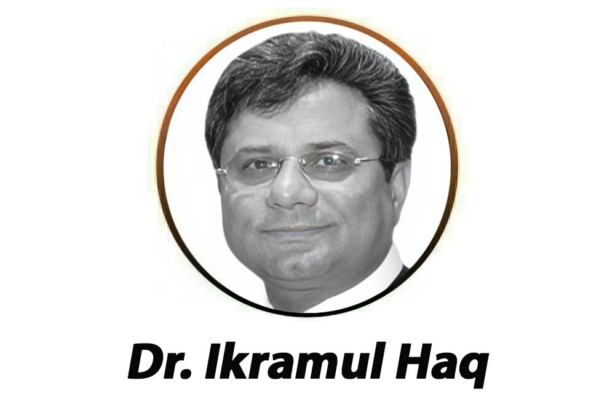
Dr. Ikramul Haq, Advocate Supreme Court, Adjunct Faculty at Lahore University of Management Sciences (LUMS), member Advisory Board and Visiting Senior Fellow of Pakistan Institute of Development Economics (PIDE), holds an LLD in tax laws. He was full-time journalist from 1979 to 1984 with Viewpoint and Dawn. He also served Civil Services of Pakistan from 1984 to 1996.
We welcome your contributions! Submit your blogs, opinion pieces, press releases, news story pitches, and news features to opinion@minutemirror.com.pk and minutemirrormail@gmail.com