
Summary
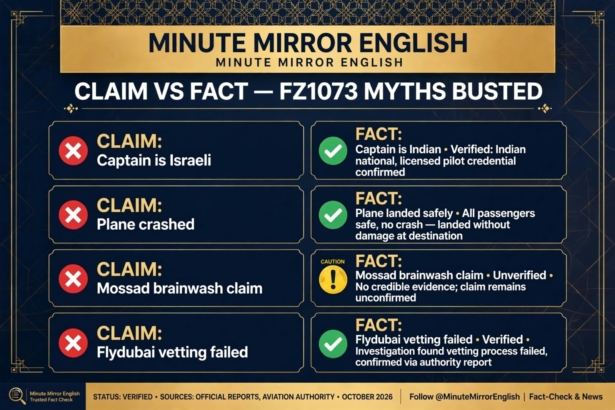
- ISLAMABAD: Serious questions have emerged over pilot vetting and aviation security after Flydubai Flight FZ1073, travelling from Dubai to Tel Aviv, was diverted to Saudi Arabia following a violent incident in the cockpit on September 30, 2026.
- Questions have consequently been raised over whether his previous security concerns were communicated to UAE authorities and whether existing licensing procedures are sufficient to identify security risks that may not appear in standard licence verification.
- The case has raised several questions for regional aviation authorities: whether pilot security information is adequately shared between countries, whether background checks go beyond licence and document verification, and whether additional safeguards are needed for personnel operating sensitive international routes.
ISLAMABAD: Serious questions have emerged over pilot vetting and aviation security after Flydubai Flight FZ1073, travelling from Dubai to Tel Aviv, was diverted to Saudi Arabia following a violent incident in the cockpit on September 30, 2026.
The Boeing 737 MAX 8 was carrying more than 170 people when the co-pilot allegedly attacked the Indian captain during the flight. The aircraft subsequently lost more than 16,000 feet in a rapid descent before passengers and crew intervened. Two off-duty pilots travelling on board eventually helped stabilise the aircraft, which made an emergency landing in Tabuk, Saudi Arabia.
The co-pilot has been identified in media reports as Hamam al-Hammami, an Omani national. Reports say he had previously been grounded while associated with Oman Air following concerns over alleged extremist views and material. However, the circumstances surrounding his employment by Flydubai, and what information was shared between aviation authorities, remain under investigation.
According to reports, al-Hammami had undertaken aviation-related training after leaving Oman Air and later joined Flydubai. Questions have consequently been raised over whether his previous security concerns were communicated to UAE authorities and whether existing licensing procedures are sufficient to identify security risks that may not appear in standard licence verification.
The incident has also highlighted a difficult security problem inside modern cockpits. Reinforced cockpit doors introduced after the September 11 attacks are primarily designed to prevent unauthorised people from entering the flight deck. They do not eliminate the threat posed by a person who is already authorised to be inside the cockpit.
In the FZ1073 incident, the captain reportedly suffered serious injuries but managed to open the cockpit door, allowing passengers and crew members to intervene. The attacker was eventually restrained, while the two off-duty pilots helped land the aircraft safely. The captain, Smit Machchhar, was later transferred for medical treatment and has been reported to be in stable condition.
The case has raised several questions for regional aviation authorities: whether pilot security information is adequately shared between countries, whether background checks go beyond licence and document verification, and whether additional safeguards are needed for personnel operating sensitive international routes.
The UAE Attorney General has ordered an investigation to establish the circumstances, motives and possible links to terrorist activity or prior planning. Israeli and Saudi authorities are also involved in the wider investigation.
Claims concerning extremist ideology, an alleged attempt to deliberately crash the aircraft and any possible foreign involvement remain subjects of investigation. Reuters has reported that initial inquiries have not established Iranian involvement, while authorities continue examining the motive and circumstances.
Flydubai has urged against premature speculation while the investigation continues. The incident nevertheless raises a broader aviation-security question: how effectively can airlines identify and share information about potential insider threats before an individual reaches the cockpit?
We welcome your contributions! Submit your blogs, opinion pieces, press releases, news story pitches, and news features to opinion@minutemirror.com.pk and minutemirrormail@gmail.com