Summary
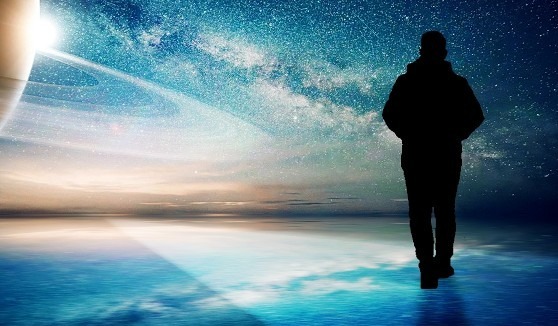
- The stars we see shining above us may look close together, but the universe is far bigger and more mysterious than we can imagine.
- The Sun is one of the stars in the Milky Way.
- The stars above us are also different from one another.
By Irum Naz
Have you ever looked at the night sky and wondered how big the universe really is?
The stars we see shining above us may look close together, but the universe is far bigger and more mysterious than we can imagine.
Most of the stars visible to the human eye are part of our own galaxy, the Milky Way. Even then, we can see only the brightest stars without using a telescope. Countless other stars remain invisible to us.
And the journey does not end there.
Our Milky Way is just one of billions of galaxies in the observable universe. Each galaxy contains billions, and sometimes even trillions, of stars. Scientists have also discussed the possibility that our universe could be one of many universes, an idea known as the multiverse. However, this remains a hypothesis and has not yet been proven.
Our own place in this huge universe is very small.
The Sun is one of the stars in the Milky Way. Eight planets orbit around it, including Earth — the planet we call home.
But the universe is not only about things that are very large. It also includes things that are incredibly small.
Everything around us is made of atoms. Atoms are tiny building blocks that make up all matter. Mountains, oceans, trees, animals and even the human body are made of atoms.
Atoms are made up of smaller particles, including electrons, protons and neutrons. Scientists have discovered that protons and neutrons are themselves made of even smaller particles called quarks.
As far as scientists know today, quarks are fundamental particles. We still do not know whether they are made of anything smaller. Finding answers to such questions remains an important goal of modern science.
The stars above us are also different from one another.
They come in different sizes, ages and colours. Their colour can tell scientists about their temperature. Cooler stars usually appear red, while hotter stars can appear blue. Our Sun is a yellow-white star with a surface temperature of about 5,800 Kelvin.
The hottest blue stars can have temperatures above 25,000 Kelvin and are among the brightest objects in the sky.
Closer to home, our Solar System is also full of fascinating objects. Apart from the eight planets, there are dwarf planets such as Pluto, millions of asteroids, comets and natural satellites.
The Moon, for example, is Earth’s natural satellite. It travels around Earth, just as our planet travels around the Sun.
Perhaps one of the biggest questions about the universe is whether life exists somewhere beyond Earth.
For centuries, people have wondered whether we are alone. When people hear the word “alien”, they often imagine creatures similar to humans. But if life exists somewhere else, it could be completely different from anything we know.
Scientists have discovered many planets with environments where humans could not survive. If life exists on some distant worlds, it may have developed in ways that are difficult for us to imagine.
So far, however, scientists have found no confirmed evidence of life beyond Earth.
Still, asking questions is an important part of science.
Every great discovery begins with curiosity. An idea may begin with imagination, but it becomes science when it can be tested through observation and experiments.
First, we imagine.
Then, we ask a question.
And finally, we try to find the answer.
That is how science moves forward.
The universe is vast, mysterious and full of questions waiting to be answered. From the smallest particles to the billions of galaxies spread across space, there is still so much left for humanity to discover.
Perhaps the next great discovery will begin with a simple question.
Have you ever imagined something and then tried to prove it?
If not, maybe today is a good day to start.
After all, every great discovery begins with curiosity.
We welcome your contributions! Submit your blogs, opinion pieces, press releases, news story pitches, and news features to opinion@minutemirror.com.pk and minutemirrormail@gmail.com