Summary
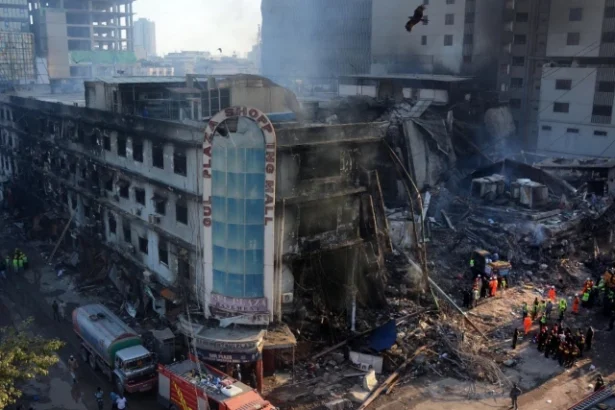
- KARACHI: Police on Saturday submitted a charge sheet in the Gul Plaza fire case, naming the shopping centre’s administration as responsible for the blaze and its president, Tanveer Pasta, as the main accused.
- According to a copy of the charge sheet available to The Express Tribune, Pasta, Joint Secretary Muhammad Ramzan, Naimatullah and Gul Plaza Association Vice President Ammar Ismail remained on bail, while another suspect, Amin, was absconding.
- The charge sheet raised questions over fire-safety arrangements at Gul Plaza, citing alleged negligence by the building’s administration and including statements about safety arrangements in the shops and the building itself.
KARACHI: Police on Saturday submitted a charge sheet in the Gul Plaza fire case, naming the shopping centre’s administration as responsible for the blaze and its president, Tanveer Pasta, as the main accused.
A fire at the Gul Plaza shopping mall in Karachi killed more than 70 people and injured over 20.
The Sindh government formed a single-member judicial commission, headed by Sindh High Court Justice Agha Faisal, on February 4 to determine the cause of the incident.
Investigating Officer Deputy Superintendent of Police Amir submitted the charge sheet before the Judicial Magistrate South on Saturday, while Pasta and other accused appeared in court.
According to a copy of the charge sheet available to The Express Tribune, Pasta, Joint Secretary Muhammad Ramzan, Naimatullah and Gul Plaza Association Vice President Ammar Ismail remained on bail, while another suspect, Amin, was absconding.
The name of 11-year-old Huzaifa was omitted from the list, with his charge sheet reportedly submitted separately in a juvenile case.
Police also submitted a list of 85 witnesses.
The charge sheet cleared government institutions of responsibility, stating that the Karachi Metropolitan Corporation, fire brigade and Civil Defence were not responsible for the tragedy.
Officials submitted various pieces of evidence, including CCTV footage, USB drives and NVR and DVR devices. A forensic report found no explosive material in the items examined and no signs of flammable liquid, the charge sheet said.
However, the report identified residual particles left behind by the fire in certain items.
The charge sheet raised questions over fire-safety arrangements at Gul Plaza, citing alleged negligence by the building’s administration and including statements about safety arrangements in the shops and the building itself.
The case was registered under Sections 285, 322, 337-H(ii), 427 and 436 of the Pakistan Penal Code. The court adjourned the hearing until September 9.
According to the judicial commission’s report, Gul Plaza continued to operate as a commercial building despite being hazardous and in violation of fire-safety requirements.
The commission concluded that responsibility could not be attributed to a single institution or government, pointing instead to a collective failure of systems responsible for identifying risks, enforcing safety rules, fighting fires and rescuing people during emergencies.
It found that the dangers at the plaza had been known well before the tragedy. Civil Defence inspections in 2024 and 2025 had identified a lack of fire-safety equipment, the presence of inflammable commercial material and deficiencies in exit routes.
The building’s management was also held responsible for failing to rectify known defects. Its regularised plan provided for 1,102 shops, while 1,153 shops were operating in the building.
The commission rejected the idea that the tragedy could be attributed to one department, institution or government, noting that legal powers, audit mechanisms, building-control authorities, firefighting services and emergency-response institutions had existed across different periods.
We welcome your contributions! Submit your blogs, opinion pieces, press releases, news story pitches, and news features to opinion@minutemirror.com.pk and minutemirrormail@gmail.com