Summary
- In 1964, Li created Mountains in Red (also translated as Thousands of Hills in a Crimsoned View or Wan Shan Hong Bian).
- Mountains in Red is now celebrated as an absolute pinnacle of modern Chinese art.
- Li Keran didn’t just paint the mountains red; he paved a bold, brilliant path forward for modern Chinese art.
In the mid-20th century, a dramatic transformation swept through the world of Chinese art. As the country navigated profound political and cultural shifts, traditional landscape painters faced a challenging dilemma. It was how to preserve centuries-old artistic practices while reflecting the spirit of a new era.
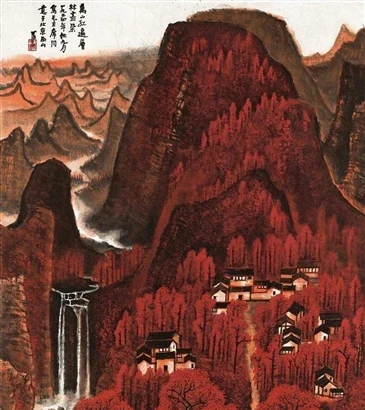
The answer was brilliantly realized by the visionary painter Li Keran (1907–1989). In 1964, Li created Mountains in Red (also translated as Thousands of Hills in a Crimsoned View or Wan Shan Hong Bian). It’s a breathtaking masterpiece that would forever change the trajectory of Chinese landscape painting (shanshui). The painting was inspired directly by the poetic imagery of Mao Zedong’s famous poem, Changsha, which describes a magnificent autumn view of crimson-colored forests along the Xiang River.
Li’s painting captures this poetic essence with a central mountain flanked by a cascading waterfall, twinned next to quiet white-walled houses that signal human presence. What makes this work extraordinary is its daring palette. Rather than relying on the muted, monochrome ink washes favored by classical scholars, Li flooded the paper with rich, saturated red pigment. This was a genius double-entendre: the crimson hues realistically represent the changing colors of autumn maple leaves, while also paying homage to the red of the Chinese Communist Party and the collective energy of the revolution. Li Keran’s journey to this innovative style was paved by a diverse education. Trained in both Western oil painting and traditional Chinese ink wash, he studied under pioneering masters like Lin Fengmian and Qi Baishi. This dual background allowed him to masterfully blend Western techniques with Chinese philosophy. Unlike classical Chinese painters who avoided harsh lighting, Li incorporated elements of chiaroscuro (light and shadow). By building up dense, repetitive layers of wet ink, he gave his mountains an unprecedented sense of three-dimensional weight and monumental scale. Even with heavy pigments, Li intentionally left strategic areas of the paper blank. This reflects the ancient Daoist concept of Qi (life force or breath), allowing the composition to breathe and ensuring the heavy, crimson cliffs remained harmonious rather than overwhelming.
Mountains in Red is now celebrated as an absolute pinnacle of modern Chinese art. Its journey through the art market is nothing short of legendary. Li Keran painted seven distinct versions of this composition between 1961 and 1964. Decades ago, during a time when art was valued more for its ideological message than its commercial worth, Beijing’s famous studio and art shop, Rong Bao Zhai, acquired the smallest version of the painting for a mere 80 yuan.
When China’s contemporary art market began to surge, the value of these mmasterpieces peaked. In 2000, Rong Bao Zhai sold that same small version for 5 million yuan. In June 2012, the largest of the seven versions sold at Poly Auction for a staggering CN¥293.25 million (US$46 million), setting an all-time personal auction record for the artist. In 2015, the smallest version, the very one once bought for 80 yuan fetched CN¥184 million (approx. US$26.8 million).
Today, Li Keran’s crimson landscapes are highly sought-after treasures. Several versions reside in elite public institutions like the China Academy of Art, while others continue to capture the imagination of the global art market. He fearlessly introduced vibrant color to a historically monochrome tradition. Li Keran didn’t just paint the mountains red; he paved a bold, brilliant path forward for modern Chinese art.
We welcome your contributions! Submit your blogs, opinion pieces, press releases, news story pitches, and news features to opinion@minutemirror.com.pk and minutemirrormail@gmail.com