Summary
- Today, this baby known globally as the Detmold Child stands as one of the oldest and most meticulously studied human mummies in existence.
- The path of the Detmold Child from an ancient South American grave to a European museum is a winding one.
- Today, back home at the Lippe State Museum, the Detmold Child serves as a quiet, haunting reminder of our shared human vulnerability.
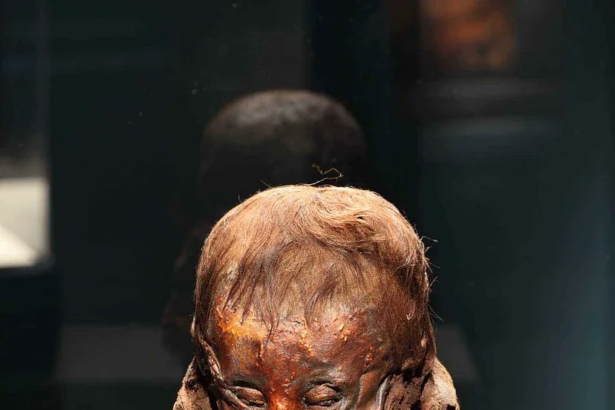
Thousands of years before the rise of the Roman Empire, and nearly three millennia before the birth of Egypt’s King Tutankhamun, an infant took its final breath in what is now modern-day Peru. Today, this baby known globally as the Detmold Child stands as one of the oldest and most meticulously studied human mummies in existence. Radiocarbon analysis dates the child’s life to approximately 4505–4457 BC. Through the lens of 21st-century medical technology, this tiny, naturally preserved individual has rewritten our understanding of prehistoric health and pediatric medicine. The path of the Detmold Child from an ancient South American grave to a European museum is a winding one. Decades ago, the mummy was donated privately to the Ethnological Museum in Witzenhausen, Germany. However, its survival was threatened in the late 1980s when staff noticed a spreading mold infestation on the delicate organic remains.
To save the priceless artifact, ownership was transferred in 1987 to the Lippisches Landesmuseum in Detmold, located in North Rhine-Westphalia, Germany. Expert conservators successfully halted the decay, stabilizing the infant’s remains and eventually naming the mummy after its new home city. The infant’s preservation occurred naturally, aided by the arid, stable environment of its original resting place in Peru. The child was discovered in a traditional Andean funerary position. The legs are drawn up tightly to the chest (hunched), with the arms gently folded over the torso and the eyes permanently closed. Wrapped in a linen-like shroud, the infant wore a single, flat, rectangular ornament carved from animal bone, strung like an amulet around its neck. This meticulous, reverent preparation indicates that despite its incredibly short life, the child was deeply cared for by its community.
For decades, the physical secrets of the Detmold Child remained locked away under its wrappings. That changed in 2010 when the mummy was entered into the German Mummy Project. Researchers paired up with cardiologists and imaging experts from the North Rhine-Westphalia Heart and Diabetes Centre in Bad Oeynhausen to perform a non-invasive, high-resolution CT (computed tomography) scan on the infant.
The results of the digital autopsy were both astonishing and tragic. The CT scans revealed that the child was between 8 and 10 months old at the time of death and suffered from a devastating congenital heart condition known as Hypoplastic Left Heart Syndrome (HLHS). In babies born with HLHS, the left side of the heart including the aorta, left ventricle, and mitral valve fails to develop properly. This prevents the heart from effectively pumping oxygen-rich blood to the rest of the body. Even with modern, highly advanced reconstructive surgeries, HLHS remains a complex condition to treat; in the ancient world, it was an absolute death sentence within the first year of life. The imaging also identified that the baby suffered from turricephaly, a condition where the skull develops a conical, towering shape. This was linked to a severe Vitamin D deficiency (commonly known as rickets when it affects skeletal development), which softened the skull bones. Already weakened by a failing heart and systemic vitamin deficiencies, the infant’s immune system was highly compromised. The medical team identified signs of a severe lung infection, likely pneumonia or tuberculosis. It was this acute pulmonary illness, combined with the underlying heart defect, that ultimately took the child’s life.
In the years following its medical breakthrough, the Detmold Child became a central figure in the global conversation surrounding paleopathology (the study of ancient diseases). The mummy was featured prominently in the highly publicized, three-year traveling exhibition Mummies of the World across the United States. While the exhibition drew millions of visitors, it also sparked healthy ethical debates regarding the display and repatriation of ancient human remains. Today, back home at the Lippe State Museum, the Detmold Child serves as a quiet, haunting reminder of our shared human vulnerability. Through its preservation, we are granted a rare, empathetic window into the physical struggles of an infant who lived and died six and a half millennia ago.
We welcome your contributions! Submit your blogs, opinion pieces, press releases, news story pitches, and news features to opinion@minutemirror.com.pk and minutemirrormail@gmail.com