Summary
- “No US Navy warship has been struck,” CENTCOM said, adding that Iranian attempts to attack US forces had failed.
- Washington said the attacks were carried out after Iranian forces attempted to target a US Navy vessel with ballistic missiles.
- A US official also said the Iranian attack had failed to cause significant damage and that all American personnel were safe.
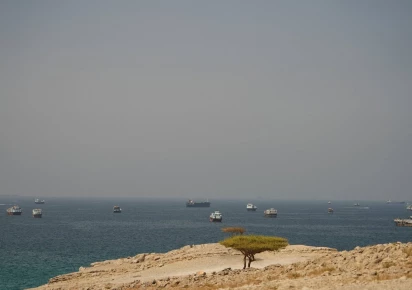
TEHRAN: Iran’s Islamic Revolutionary Guard Corps (IRGC) said on Wednesday that a restricted maritime zone would be extended from Chabahar into parts of the Gulf of Oman and the Arabian Sea.
The IRGC said the exact coordinates of the restricted area would be announced later.
The move comes as tensions between Iran and the United States continue to rise. The two sides have exchanged claims over attacks on military and commercial vessels in the region.
The IRGC said it had struck two US Navy destroyers operating in the Middle East. The US Central Command rejected the claim.
“No US Navy warship has been struck,” CENTCOM said, adding that Iranian attempts to attack US forces had failed.
The US military also claimed that its forces had destroyed 10 Iranian tankers during the past week.
The latest maritime warning follows an earlier statement by Mohsen Rezaei, secretary of Iran’s Supreme National Security Council. He had said Iran would establish a restricted zone outside the Strait of Hormuz.
The Strait remains at the centre of the escalating conflict. The strategically important waterway carries a major share of global oil shipments.
The IRGC said it had attacked 10 vessels on Wednesday. The vessels included two US ships and eight oil tankers that Tehran said were attempting to pass through an area it had declared prohibited and unsafe.
The developments followed US strikes on five Iranian oil tankers. Washington said the attacks were carried out after Iranian forces attempted to target a US Navy vessel with ballistic missiles.
US Secretary of State Marco Rubio warned that Washington would continue responding to Iranian attacks on American naval assets.
Iran also claimed responsibility for a ballistic missile strike on a military base near Al Azraq in Jordan that is used by US forces.
Jordan said its air defences intercepted 18 of the 20 missiles. The remaining two landed in unpopulated areas, according to Jordanian authorities. No casualties were reported.
A US official also said the Iranian attack had failed to cause significant damage and that all American personnel were safe.
The conflict has also raised concerns across the region. Saudi Arabia condemned what it described as Iran’s continued attacks on Jordan and said it supported measures taken by Amman in response.
Iran has previously targeted US interests and regional allies during the conflict. It has also issued warnings concerning oil tankers operating from ports in Kuwait and Bahrain.
A maritime security source separately reported that a liquefied natural gas tanker was damaged at the Emirati port of Khor Fakkan. The responsibility for the incident remained unclear.
The growing attacks have disrupted a period of relative calm and increased pressure on global energy markets. Oil prices climbed again on Wednesday, with Brent crude approaching $100 a barrel amid concerns over shipping through the Strait of Hormuz.
Attacks by Yemen’s Iran-aligned Houthi movement on Saudi Arabian energy interests have added to fears of further disruption to regional oil supplies.
South Korea faces pressure over Hormuz deployment
The growing crisis has also triggered debate in South Korea over possible military involvement in protecting shipping through the Strait of Hormuz.
Civic, labour and religious groups in Seoul urged President Lee Jae Myung’s government on Wednesday to reject any US request for South Korean troops or warships to be deployed to the strategic waterway.
The groups warned that military participation could make South Korea a direct party to the conflict.
Several lawmakers joined the protest outside the Sejong Centre for the Performing Arts. Demonstrators later marched towards the presidential office and announced plans for another protest on Saturday.
Seoul is currently assessing the security situation. South Korea’s Defence Ministry said it had sent an assessment team to the United Arab Emirates but stressed that the mission did not mean a decision had been made to deploy military forces.
US President Donald Trump had earlier called on South Korea and several other countries to send warships to help secure the Strait of Hormuz.
We welcome your contributions! Submit your blogs, opinion pieces, press releases, news story pitches, and news features to opinion@minutemirror.com.pk and minutemirrormail@gmail.com