
Summary
- ISLAMABAD: An annual survey has revealed that 627 government schools across Khyber Pakhtunkhwa are currently non-functional, highlighting see in the province’s education system, particularly in merged districts.
- The figures show that around 65% of all non-functional government schools are located in the merged districts, underlining the educational difficulties faced by communities in these areas.
- With 627 schools currently non-functional, the survey presents a major challenge for the provincial government and highlights the need for immediate measures to ensure that children across both settled and merged districts have access to uninterrupted education.
ISLAMABAD: An annual survey has revealed that 627 government schools across Khyber Pakhtunkhwa are currently non-functional, highlighting see in the province’s education system, particularly in merged districts.
The findings have raised concerns over the continued lack of access to education for children living in remote, tribal and mountainous areas. Despite the merger of the former Federally Administered Tribal Areas (FATA) with Khyber Pakhtunkhwa, several districts continue to face administrative, staffing and infrastructure-related challenges that are preventing government schools from operating.
According to the survey, the problem is significantly more severe in the merged districts, where 411 government schools have been reported as non-functional. In comparison, 216 schools are closed in the settled districts of the province.
The figures show that around 65% of all non-functional government schools are located in the merged districts, underlining the educational difficulties faced by communities in these areas.
The situation is particularly concerning because schools in remote districts often serve as the only accessible source of formal education for local children.
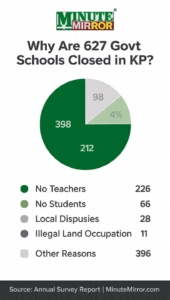
The survey identifies the absence of teachers as the leading reason behind school closures. A total of 226 schools, or 36% of all non-functional schools, have been classified as closed because teachers are not available.
Another 66 schools, representing 11%, have no students enrolled. Meanwhile, 28 schools, or 4%, are affected by local disputes, while 11 schools, equivalent to 2%, are facing issues related to illegal occupation of school land.
The remaining 296 schools, or 47%, are non-functional for other reasons, including inadequate infrastructure, damage to buildings and security-related concerns.
The figures suggest that while teacher shortages remain the most prominent single factor, a combination of administrative, social, infrastructure and security problems is contributing to the wider education crisis.
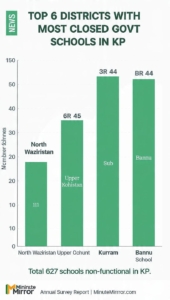
The closure of schools is concentrated in several southern and mountainous districts. North Waziristan has the highest number, with 111 non-functional schools, followed by Upper South Waziristan with 99.
Other severely affected areas include Upper Kohistan with 68 schools, Kurram with 53, Sub-Division Bannu with 45, and Bannu district with 44.
Five of the six most affected areas are merged districts, indicating the scale of the challenges faced by the former FATA region.
The closure of hundreds of government schools means that thousands of children are potentially being deprived of regular classroom education. The impact is expected to be particularly significant for girls and primary-school-age children, who may have fewer alternative educational opportunities in remote communities.
The findings also raise questions about teacher deployment, monitoring of non-functional schools and the pace of educational development in merged districts.
The KP Elementary & Secondary Education Department has yet to announce a comprehensive province-wide strategy for reopening all non-functional schools and addressing the shortage of teachers.
Education experts believe that restoring teacher availability, resolving local disputes, improving school infrastructure and strengthening security arrangements will be essential to bringing the affected institutions back into operation.
With 627 schools currently non-functional, the survey presents a major challenge for the provincial government and highlights the need for immediate measures to ensure that children across both settled and merged districts have access to uninterrupted education.
We welcome your contributions! Submit your blogs, opinion pieces, press releases, news story pitches, and news features to opinion@minutemirror.com.pk and minutemirrormail@gmail.com