Summary
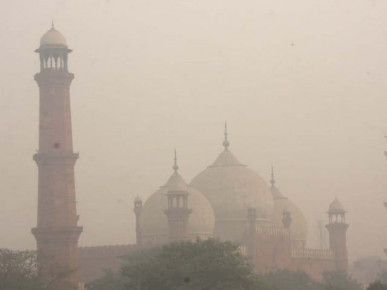
- Lahore’s air quality deteriorated to hazardous levels on Monday, with the Air Quality Index (AQI) crossing 530 as thick pollution continued to affect several cities across Punjab.
- The initiative found that average PM2.5 levels across 26 monitoring locations declined by 27 per cent in October 2026 compared with the same month last year.
- Punjab Senior Minister Marriyum Aurangzeb had earlier presented figures showing that Lahore’s average US AQI for PM2.5 stood at 180.5 in October 2026.
Lahore’s air quality deteriorated to hazardous levels on Monday, with the Air Quality Index (AQI) crossing 530 as thick pollution continued to affect several cities across Punjab.
According to air quality monitoring platform IQAir, Lahore recorded an AQI of 535 at 8am. The concentration of fine particulate matter, known as PM2.5, reached 343 micrograms per cubic metre.
PM2.5 particles are particularly dangerous because they can penetrate deep into the lungs and enter the bloodstream, increasing the risk of serious health problems.
The worsening situation was not limited to Lahore. Several other Punjab cities also recorded alarming pollution levels. Gujranwala topped the list with an AQI of 606, while Lahore ranked second at 509 in one monitoring update. Faisalabad and Multan both recorded 310, followed by Sialkot at 260. Peshawar ranked sixth nationally with an AQI of 216.
Subsequent hourly readings showed further fluctuations, with Gujranwala’s AQI reaching 675 and Lahore recording 535. The changing figures highlighted the severity of the pollution crisis across the province.
A sharp increase in agricultural fire detections across Punjab has emerged as another major concern. Satellite data analysed by environmental monitoring website HamariHawa showed that Nasa detected 13,241 fire spots in Pakistani Punjab between October 1 and 29.
In comparison, 3,158 fire spots were recorded in Indian Punjab during the same period. This means the number of detections in Pakistan’s Punjab was more than four times higher.
Around 92 per cent of the detected fires in Pakistani Punjab were located on agricultural land and were likely linked to the burning of crop residue.
The final week of October accounted for approximately half of the monthly detections, with 6,655 fire spots recorded. October 29 alone saw 1,327 detections.
Okara reported the highest number of fire spots at 2,144, followed by Gujranwala with 1,011 and Nankana Sahib with 1,003.
Smoke from agricultural fires, combined with emissions from vehicles and industrial activity, adds to the pollution burden. Weather conditions such as weak winds and atmospheric inversions can also trap polluted air close to the ground.
Weather played a major role in October improvement
Meanwhile, a separate analysis by the Pakistan Air Quality Initiative (PAQI) has questioned claims that Lahore experienced its cleanest October in five years.
The initiative found that average PM2.5 levels across 26 monitoring locations declined by 27 per cent in October 2026 compared with the same month last year.
However, after adjusting for weather conditions, the improvement was estimated at only four per cent. The analysis suggested that a deeper nighttime atmospheric mixing layer helped pollutants disperse, contributing significantly to the lower readings.
The remaining improvement was linked to a combination of government measures, changes in agricultural burning and other pollution sources. However, the analysis did not establish the exact contribution of individual factors.
Despite the reported improvement, PM2.5 concentrations remained above Pakistan’s prescribed daily limit on every day of October.
PAQI’s November 1 forecast also warned of another increase in pollution. It projected PM2.5 concentrations to reach 149 micrograms per cubic metre by November 4, around 49 per cent higher than October’s average.
Punjab Senior Minister Marriyum Aurangzeb had earlier presented figures showing that Lahore’s average US AQI for PM2.5 stood at 180.5 in October 2026. This was lower than 204.6 in October 2025 and 213 in October 2024.
Her figures also showed that Lahore did not record an AQI above 300 during October, unlike previous years.
However, the latest PAQI assessment suggests that favourable weather conditions played a substantial role in the improvement. With pollution levels rising again in November, agricultural burning and emissions from transport and industry remain major challenges for authorities.
We welcome your contributions! Submit your blogs, opinion pieces, press releases, news story pitches, and news features to opinion@minutemirror.com.pk and minutemirrormail@gmail.com