Summary
- Published in 1991, it challenged the country’s political and social elites by exposing domestic violence, feudal politics, and patriarchy, particularly in her marriage to Mustafa Khar, a prominent political figure and feudal lord of the era who had served both as the chief minister and the governor of Punjab.
- The memoir is not merely a recounting of private violence or political spectacle, nor does it suggest that authoritarian household cultures are emblematic of Pakistan as a whole.
- Therefore, the memoir is an ideal account of Pakistan’s feudal political class in general and of Mustafa Khar in particular.
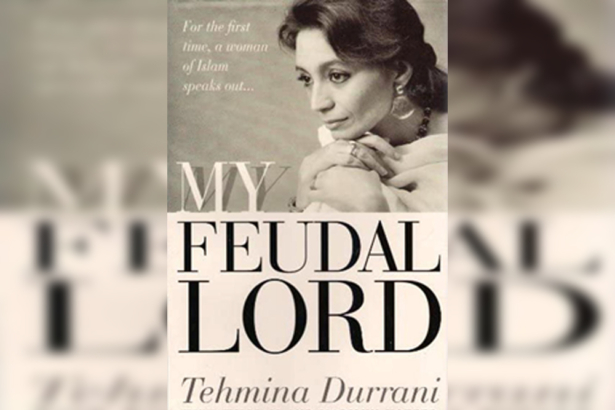
Undoubtedly, Tehmina Durrani’s My Feudal Lord is one of Pakistan’s most read and debated memoirs. Published in 1991, it challenged the country’s political and social elites by exposing domestic violence, feudal politics, and patriarchy, particularly in her marriage to Mustafa Khar, a prominent political figure and feudal lord of the era who had served both as the chief minister and the governor of Punjab. The memoir is not merely a recounting of private violence or political spectacle, nor does it suggest that authoritarian household cultures are emblematic of Pakistan as a whole. The author’s note clarifies that the book addresses more than an unhappy marriage; it highlights the fundamental flaws in the feudal value system.
The memoir remains a seminal feminist work, a political autobiography, and one of Pakistan’s most debated texts. It continues to spark discussions about power, gender, class, morality, and the truthfulness of autobiographical writing, fueled by its critique of severe family violence and its engagement with broader societal issues.
What I appreciate most about My Feudal Lord is its emphasis on personal suffering and systemic oppression. Durrani does not want domestic violence to be merely a private tragedy. She states, “It is the natural consequence of a feudal society that is based on hierarchy, unquestioned authority, and inequality between men and women.” Mustafa Khar is portrayed not only as a domestic tyrant but also as the embodiment of political power invading the home. The memoir examines how authoritarian political culture is reproduced within the intimate relationship.
That fact is clearly established in the first few chapters. Durrani juxtaposes the “fame” of the Lahore political class with the “respectability” of the political elite. Her story illustrates that morality is not a certainty conferred by money, education, or power. Yet privilege can be used to create opportunities to perpetrate abuse behind a façade of carefully constructed images.
The memoir has also become a significant historical document on Pakistan’s post-independence elite. Through her encounters, readers are introduced to the lives of prominent families, provincial politics, the Pakistan People’s Party under Zulfikar Ali Bhutto, and the remaining feudal networks in Pakistan. Historians cannot rely on all personal recollections as evidence, but the book reveals the political culture of an age of patronage, personality cults, and elite privilege.
Durrani is also credited with breaking a strong social taboo. When this memoir was being written, domestic violence in Pakistan’s political sphere was rarely discussed. It broke the rule that family business should never be played out in public and that men of substance should not be either. It sparked more discussion of women’s rights, domestic violence, and the overhaul of Pakistani laws. Critics of the memoir concede that it has helped advance the public conversation about gender-based violence.
But this book is too important to ignore without critical examination, given its literary and political worth. My Feudal Lord is an imaginary reconstruction of history and does not represent facts in their entirety. The story is told predominantly from the author’s perspective, leaving little for the reader to check or challenge. The memoir is therefore a witness, not a history in the full sense of the word. The reader must decide what is “true according to the author” and what is “true according to the facts.”
Secondly, it lacks psychological depth. Mustafa Khar is often portrayed as a one-dimensional character, driven by lust for power, narcissism, and cruelty. Indeed, the social, political, and cultural environment that shapes the personalities in the story is not explored in sufficient depth, though it could have been. The memoir is so focused that at times it is about a person rather than the issues.
Class struggle is also discussed. Durrani, a member of the privileged class within the Pakistani aristocracy, opposes and criticizes feudal oppression. She attacks elite culture more than her class position. Servants, peasants, and rural communities are often portrayed as side characters or actors in the memoir. Much of the criticism of feudalism, therefore, is limited to the immoral conduct of individual feudal lords and lacks a structural critique of land ownership, economic inequality, and state institutions.
Another problem is that memoirs tend to be somewhat moralistic. There is some ambiguity, but mostly the characters are either victims or villains. A dichotomous approach is more emotional and degrades the story’s analytic quality. Recent studies on domestic violence have recognized that abusive relationships are complex, involving emotional, social, economic, and/or institutional factors, and cannot be simply classified.
There are contradictions in the memoir that can be explored without necessarily undermining its reliability. In the memoir, Durrani is portrayed as weak, yet she is actually very strong. At times she serves her husband; at other times she enjoys considerable independence in resisting him, in her relationship with him, and, finally, in publishing an internationally influential memoir. These images are not mutually exclusive (as in the case of abused persons with agency in some contexts), but the story offers little to suggest this.
Another paradox is that the author attacks feudal privilege in the Pakistani context while acknowledging her social background in Pakistan’s privileged classes. The memoir is critical of feudalism, but not so much of the benefits of money, family, and networking.
Therefore, the memoir is an ideal account of Pakistan’s feudal political class in general and of Mustafa Khar in particular. Academicians have largely agreed on the impact of feudal patronage on Pakistani politics. The political economy of Pakistan is far more complex than the memoir suggests, as today’s research has shown. The military establishments, the bureaucracy, industrial capital, urban political parties, and religious institutions are other major factors of influence. Therefore, concluding that Pakistan failed to become democratic because of ‘feudalism’ is a reductionist approach to Pakistan’s political history.
Similarly, although the memoir’s success lies in highlighting the violence of patriarchy, later scholarship argues that this violence extends beyond the feudal family to urban, middle-class, and professional environments. Thus, the structural problem is broader than the particular social world described in the memoir.
The most significant contradiction in the memoirs lies between the memoir’s morality and Durrani’s later public life. My Feudal Lord is a strong attack on patriarchy, the elite, and politics. Yet in her later years, Durrani was linked to Pakistan’s political establishment through her marriage to the politician Shahbaz Sharif. Critics have questioned this link, baffled by how it aligns with the memoir’s no-holds-barred critique of the political elite culture.
This can be called a dilemma or a complexity in a person’s life. But it did not make what happened in the memoir any more credible, which is not right, especially since they made their own decisions. “Testimony of abuse shall be considered in isolation in life-related decisions. Meanwhile, public intellectuals, who interpret and expand on certain moral and political values, are always subject to some degree of questioning about the consistency of their public and private views and their writing.”
My Feudal Lord is one of the most debated and contested non-fiction works in Pakistan. It brought to light the close relationship between gender-based violence, feudal power, and political privilege, and initiated a national dialogue on the issue. But it is an autobiography and should be read as such, not as an uncritical acceptance of fact. It does not always reach the level of historical and sociological fact, but it has methodological and historical weaknesses alongside great literary value. The real power of the book is that it makes the reader think about questions relevant to the history of feudalism, to questions of patriarchy and justice, memory and power, and to life in the broader political and social spheres.
Mazhar Abbas, author of “The Aftermath of the Bangladesh Liberation War of 1971: Enduring Impact (Routledge, 2024),” has a PhD in history from Shanghai University. He is a lecturer at GCU, Faisalabad, and a research fellow at PIDE, Islamabad. He can be contacted at mazharabbasgondal87@gmail.com. His X-handle is @MazharGondal87.
We welcome your contributions! Submit your blogs, opinion pieces, press releases, news story pitches, and news features to opinion@minutemirror.com.pk and minutemirrormail@gmail.com