Summary
- You need the full information on taxes paid on inputs to offset those on outputs… Any presumptive tax, or exemption, breaks the value chain and leads to cumulative taxation of business-to-business transactions… What Pakistan has is a reversion to excise-mode production taxation—this damages investment, exports and fails to raise revenues”— Professor Ehtisham Ahmad Few observations could better explain the predicament of Pakistan’s sales tax system than those of Professor Ehtisham Ahmad, one of the world’s leading authorities on value-added taxation (VAT).
- Unlike income tax, where an exemption ordinarily relieves income from taxation, a VAT “exemption” usually means that the supplier cannot recover input tax.
- Presumptive taxation of retailers, extensive special procedures, the continued expansion of the Third Schedule to the Sales Tax Act, 1990, numerous reduced rates, sector-specific treatments and widespread departures from ordinary input tax adjustment have fragmented the architecture upon which VAT depends.
“The VAT is self-policing. You need the full information on taxes paid on inputs to offset those on outputs… Any presumptive tax, or exemption, breaks the value chain and leads to cumulative taxation of business-to-business transactions… What Pakistan has is a reversion to excise-mode production taxation—this damages investment, exports and fails to raise revenues”— Professor Ehtisham Ahmad
Few observations could better explain the predicament of Pakistan’s sales tax system than those of Professor Ehtisham Ahmad, one of the world’s leading authorities on value-added taxation (VAT). In a few sentences, he identifies both the genius of VAT and the reason why Pakistan’s version has progressively ceased to function as one.
VAT was never designed merely to collect tax. It was designed to generate information. Every taxable purchase becomes another taxpayer’s taxable sale. Every invoice becomes evidence for another invoice. Input tax paid by one business becomes output tax collected by another. The system is therefore “self-policing”. It simultaneously creates an audit trail for indirect taxation and a rich database for direct taxation. Properly administered, VAT becomes one of the strongest foundations of a modern digital economy. Pakistan has gradually dismantled that foundation.
Ehtisham Ahmad makes another observation that deserves careful attention in Pakistan. In modern VAT legislation, the term “exemption” is itself misleading. Unlike income tax, where an exemption ordinarily relieves income from taxation, a VAT “exemption” usually means that the supplier cannot recover input tax. Modern VAT systems therefore increasingly describe such supplies as “input-taxed” rather than exempt, because the tax does not disappear; it becomes embedded in business costs and is ultimately passed through prices. Misunderstanding this distinction leads policymakers into serious conceptual errors.
Pakistan’s legislation continues to use VAT terminology loosely, often borrowing concepts from income taxation without appreciating their very different economic consequences. Professor Ehtisham attempted to correct these conceptual weaknesses as far back as 2009. Unfortunately, those efforts were never fully reflected in Pakistan’s legislative framework. The consequences are now visible throughout the sales tax system.
The theoretical justification for VAT has always rested upon one uninterrupted value chain. Pakistan has deliberately broken that chain through successive amendments to the Sales Tax Act, 1990.
Presumptive taxation of retailers, extensive special procedures, the continued expansion of the Third Schedule to the Sales Tax Act, 1990, numerous reduced rates, sector-specific treatments and widespread departures from ordinary input tax adjustment have fragmented the architecture upon which VAT depends. The irony is striking.
For years, proposals developed by Pakistani experts for a simpler and broader consumption tax were criticised because they allegedly departed from internationally accepted VAT principles. Yet successive Finance Acts have themselves progressively moved Pakistan away from those very principles.
Retailers with turnover up to Rs. 200 million now pay a presumptive tax based on turnover rather than participating fully in the invoice-credit chain. Large segments of wholesale and retail trade remain outside meaningful electronic integration. At the same time, Third Schedule goods increasingly resemble production-stage taxation, with manufacturers collecting tax on printed retail prices before goods even enter the wholesale and retail markets.
Ehtisham Ahmad correctly describes this evolution as “a reversion to excise-mode production taxation”. This observation is profoundly important. Excise taxation and VAT are fundamentally different philosophies. Excise concentrates collection at production. VAT distributes taxation across the entire value chain. Excise provides limited commercial information.
VAT generates continuous documentation. Excise is generally imposed on selected commodities. VAT is intended to be broad-based and economically neutral. Pakistan now attempts to operate both systems simultaneously. The result is predictable.
Manufacturers bear the overwhelming compliance burden. Genuine exporters continue struggling with delayed refunds. Fake and flying invoices periodically emerge. Input tax adjustments require increasingly complex verification. Meanwhile, millions of businesses remain outside effective documentation. Even more revealing is the contradiction between the statutory rate and the effective burden.
Pakistan today imposes one of the highest standard GST rates in Asia at 18 percent. Yet the effective incidence is substantially lower because exemptions, input-taxed supplies, reduced rates, special procedures, informality and administrative fragmentation have eroded the tax base. Instead of broadening the base, governments have repeatedly increased the nominal rate imposed upon the shrinking documented sector. The predictable consequence has been greater incentives for evasion, higher production costs, inflationary pressures and weaker competitiveness.
Successful Asian economies chose a different path. Japan did not build prosperity through high consumption tax rates. It first established strong institutions, reliable accounting, widespread documentation and exceptionally high voluntary compliance. Its Consumption Tax functions because the surrounding economic institutions function.
Singapore adopted an equally pragmatic approach. It introduced GST at a modest rate and increased it gradually as administrative capacity and taxpayer confidence matured. Simplicity, predictability and broad coverage remained more important than immediate revenue maximisation.
Malaysia offers another valuable lesson. It demonstrated that governments must remain willing to redesign consumption taxes when practical experience exposes weaknesses. Tax systems should serve economic development rather than ideological attachment to any particular model.
The common thread linking these successful Asian experiences is unmistakable. None treated tax policy as an exercise in copying international fashions. Each designed a consumption tax suited to its constitutional arrangements, administrative capability and stage of economic development. Pakistan should do the same. The objective should not be to abolish VAT. Nor should it be to preserve a legal fiction that no longer resembles genuine VAT.
The objective should be to restore the essential principles that made VAT successful in the first place: a broad base, moderate rates, an uninterrupted invoice-credit mechanism, minimal departures from neutrality, strong information generation and administrative simplicity. Such a reform would also complement Pakistan’s constitutional federalism.
After the Constitution (Eighteenth Amendment) Act 2010, fragmented administration of goods and services taxation has become one of the greatest obstacles to documentation and investment. The solution, however, is not recentralisation. It is harmonisation through constitutional institutions such as the Council of Common Interests [Article 153 of the Constitution] and the National Economic Council [Article 156 of the Constitution]. A federalised National Tax Authority [Reform the reformers—IV: Tax reforms or constitutional engineering? Minute Mirror, July 4, 2026] jointly run by the federation and provinces could administer a harmonised VAT while fully respecting provincial fiscal autonomy.
Pakistan therefore faces a historic choice. It may continue preserving an increasingly fragmented hybrid that combines the complexity of VAT with many characteristics of excise taxation. Alternatively, it may finally undertake what successive reform commissions, indigenous scholars and internationally respected experts have repeatedly advocated: designing a broad-based, low-rate, constitutionally harmonised VAT that restores the information chain, encourages voluntary compliance, minimises litigation and supports investment, exports and long-term economic growth.
Ehtisham Ahmad ends with an observation that policymakers should ponder carefully. After four decades of VAT operations, he finds it regrettable that these basic principles remain poorly understood. Pakistan’s reform agenda should therefore begin not with another commission, another software platform or another increase in tax rates. It should begin with rediscovering the first principles of sound consumption taxation that the country itself has gradually forgotten.
[To be continued]
____________________________________________________________________
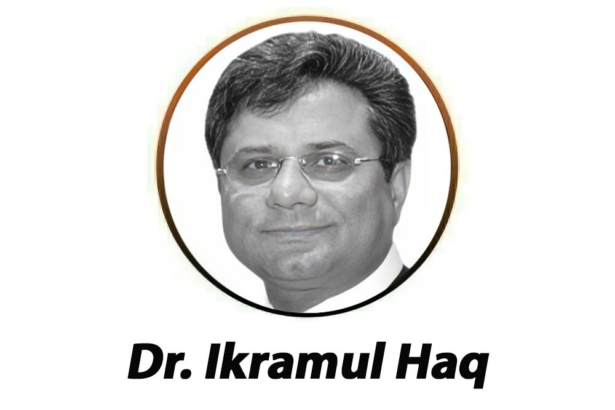
Dr. Ikramul Haq, Advocate Supreme Court, Adjunct Faculty at Lahore University of Management Sciences (LUMS), member Advisory Board and Visiting Senior Fellow of Pakistan Institute of Development Economics (PIDE), holds an LLD in tax laws. He was full-time journalist from 1979 to 1984 with Viewpoint and Dawn. He also served Civil Services of Pakistan from 1984 to 1996.
We welcome your contributions! Submit your blogs, opinion pieces, press releases, news story pitches, and news features to opinion@minutemirror.com.pk and minutemirrormail@gmail.com