Summary
- More than 100 Nepalese citizens are also reported missing.
- Chinese state media have reported at least three deaths in Tibet, while 265 people remain missing.
- Nepalese police officers, army personnel and power workers are also among those reported missing.
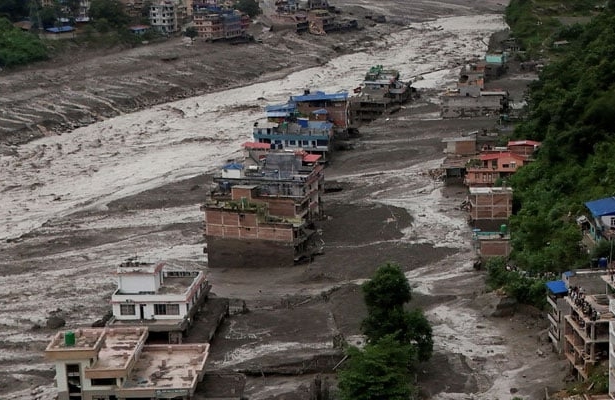
More than 150 people have been killed after a powerful flash flood and mudslide swept through areas along the Nepal-Tibet border, leaving hundreds of people missing and causing widespread destruction.
The disaster struck the Bhotekoshi River region in Nepal’s Rasuwa district, an area frequently visited by tourists, trekkers and religious pilgrims. Floodwaters carrying huge amounts of mud and debris surged through settlements, damaging homes, roads and bridges.
Nepalese authorities say hundreds of people remain unaccounted for. Many of those missing are tourists who were travelling through the region towards Tibet. Nepal’s tourism authorities have reported missing nationals from several countries, including more than 100 Indians, 54 Americans, 34 Australians and 33 Britons. More than 100 Nepalese citizens are also reported missing.
The disaster has also affected the Chinese side of the border. Chinese state media have reported at least three deaths in Tibet, while 265 people remain missing. Dramatic footage from a border crossing showed a huge wall of water and mud rushing towards buildings as people attempted to escape.
Nepalese police officers, army personnel and power workers are also among those reported missing. Rescue teams have been working to reach isolated communities and search for survivors.
The scale of the destruction has made rescue operations extremely difficult. Roads and bridges have been washed away, while thick mud and debris have blocked access to several locations. Helicopters have been used to evacuate survivors and transport injured people to hospitals.
Families have gathered at hospitals in Kathmandu and other areas, waiting for information about relatives who remain missing. Survivors have described terrifying scenes as floodwaters suddenly entered homes and swept away people and belongings.
One survivor, 68-year-old Keshav Prasad Baral, said he watched helplessly as his wife was swept away by the flood. He was later rescued by helicopter after spending several hours trapped in his home.
The cause of the disaster was initially unclear. Authorities first considered whether an earthquake had triggered the flooding. However, the US Geological Survey later said its analysis indicated that the seismic energy was generated by a massive landslide rather than an earthquake.
Nepalese meteorological officials are investigating whether a large amount of ice collapsed from a mountain and triggered the landslide. Scientists are also examining other possible factors, including sudden drainage from glacial lakes, river blockages and recent rainfall.
Climate change is known to be contributing to glacier melt in the Himalayan region. However, scientists have cautioned that it is too early to establish whether climate change directly contributed to this particular disaster.
The affected region is also an important pilgrimage route. It provides access to religious destinations including Lake Mansarovar near Mount Kailash in Tibet and Gosaikunda Lake in Nepal. Thousands of visitors travel through the region during the pilgrimage season.
Nepal has launched a major emergency response. The government has sent relief supplies to affected areas using army vehicles. The supplies include blankets, mosquito nets, solar lights, solar panels and sleeping bags.
International support is also being offered. India has pledged humanitarian assistance, while the United States and European Union have said they are ready to help. Britain, Canada, Australia and other countries are working with Nepalese authorities to establish the whereabouts of their citizens.
The United Nations has also expressed solidarity with those affected. UN Secretary-General António Guterres said he was saddened by the loss of life and widespread destruction. UN agencies are mobilising personnel and emergency supplies to support Nepal’s response.
The World Health Organization has dispatched essential medical supplies, medicines and multipurpose tents. It is also monitoring potential public-health risks and supporting disease surveillance and access to healthcare.
We welcome your contributions! Submit your blogs, opinion pieces, press releases, news story pitches, and news features to opinion@minutemirror.com.pk and minutemirrormail@gmail.com