Summary
- Nepal resumed search and rescue operations on Saturday after a temporary suspension caused by poor weather, as authorities continued efforts to locate nearly 3,000 people missing after a devastating flood that killed hundreds and caused widespread destruction in the Himalayan region bordering Tibet.
- At least 669 people were killed in Nepal, while seven others died in China’s Tibet region.
- Authorities said around 2,426 people remain missing in Nepal, while another 554 are unaccounted for in Tibet’s Gyirong County.
Nepal resumed search and rescue operations on Saturday after a temporary suspension caused by poor weather, as authorities continued efforts to locate nearly 3,000 people missing after a devastating flood that killed hundreds and caused widespread destruction in the Himalayan region bordering Tibet.
The disaster, triggered by the collapse of a glacier, sent a powerful torrent of rocks, ice, mud and debris through mountain river systems on Wednesday. At least 669 people were killed in Nepal, while seven others died in China’s Tibet region. The flooding destroyed homes, bridges, roads, power infrastructure and other facilities, leaving communities struggling to cope with the aftermath.
Authorities said around 2,426 people remain missing in Nepal, while another 554 are unaccounted for in Tibet’s Gyirong County. At least 540 foreign nationals are among those missing, many of them Indian Hindu pilgrims who had travelled to the region.
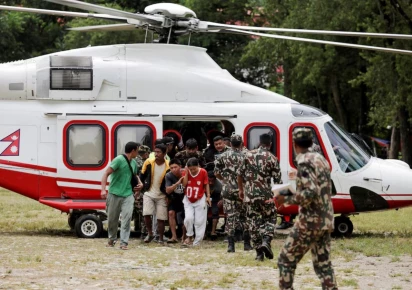
Search operations in Nepal were briefly halted because of rain and dense fog but resumed later in the afternoon after weather conditions improved. A police officer in the badly affected Rasuwa district said helicopters had also returned to the area to support rescue efforts.
Rescue activities had also been suspended on Friday after a lake formed near the Nepal-China border began overflowing into the Lhende Khola and Trishuli rivers. By Saturday, officials said the immediate danger had decreased, with parts of the lakebed becoming visible. Satellite imagery indicated that the water level was gradually falling.
However, officials warned that flood risks would remain until both upstream lakes had completely drained.
The disaster has also created serious challenges in identifying victims. Authorities said some recovered bodies had decomposed to the point that visual identification was no longer possible. In Chitwan district, officials said DNA samples would be collected before unidentified bodies were buried following completion of legal procedures, partly because of concerns over health risks and potential disease outbreaks.
In Kathmandu, relatives of missing people gathered outside Maharajgunj Medical Campus, where several bodies had been taken. Families searched through photographs displayed around the facility in the hope of identifying their loved ones.
The disaster has also affected foreign nationals. Families of 91 Malaysian citizens listed as uncontactable in Nepal and Tibet have been waiting for information. Malaysia’s Foreign Ministry said verification and search operations were continuing.
For survivors, the crisis is only beginning. Saraswati Ghale, 43, said her home had been completely destroyed. She recalled running uphill as floodwaters struck, describing the ground as shaking as though an earthquake had occurred.
Nepal’s Finance Minister Swarnim Wagle estimated that rebuilding the country could cost between $4 billion and $5 billion, although he stressed that the figure remained preliminary as authorities continued assessing the full extent of the damage.
Nepal has requested specialised international assistance, particularly for rescuing people trapped in tunnels, restoring damaged bridges and communication networks, identifying bodies and conducting DNA testing. Indian tunnel experts have arrived, while China has also sent specialists.
India has delivered around 60 tons of relief supplies, including food, medicines, blankets and water-purification tablets, and has offered disaster-response personnel, prefabricated bridges and technical teams.
Meanwhile, Chinese rescuers continued searching for more than 500 missing people in Gyirong. Teams reached the worst-hit border complex despite destroyed roads, using ropes to cross forests and steep cliffs while searching through mud and rubble for survivors.
We welcome your contributions! Submit your blogs, opinion pieces, press releases, news story pitches, and news features to opinion@minutemirror.com.pk and minutemirrormail@gmail.com