Summary
- LONDON/ASIA: Global financial markets witnessed a sharp turnaround on Wednesday as oil prices declined and Asian stock indices surged following a reported peace agreement between the United States and Iran, easing fears of prolonged geopolitical instability.
- The Strait of Hormuz, one of the world’s most critical oil chokepoints, had seen heightened tensions in recent weeks, raising concerns over global energy supply.
- During the crisis, international agencies estimated a reduction of nearly 14 million barrels per day in global oil flow, intensifying volatility in energy markets.
LONDON/ASIA: Global financial markets witnessed a sharp turnaround on Wednesday as oil prices declined and Asian stock indices surged following a reported peace agreement between the United States and Iran, easing fears of prolonged geopolitical instability.
According to Arab media reports, Brent crude oil fell by 2.3%, settling at around $77.73 per barrel after previously climbing above $81 amid heightened tensions. The decline reflects renewed optimism in global supply stability after weeks of uncertainty.
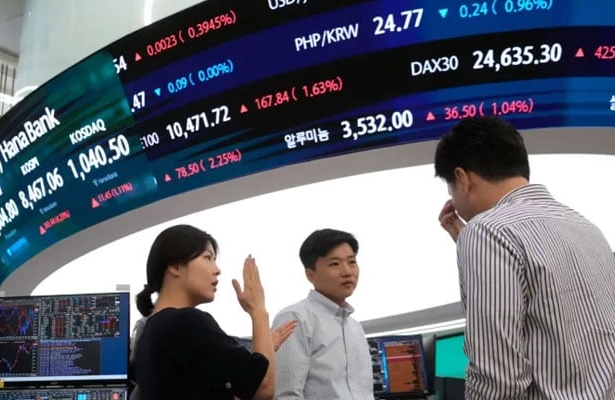
The easing of tensions triggered a strong positive reaction across Asian equity markets. Japan’s Nikkei 225 and South Korea’s KOSPI index both reached record levels, rising by 2% and 1.7% respectively, as investor confidence returned to risk assets.
Taiwan’s stock market also posted gains of 1.3%, while Hong Kong’s Hang Seng index moved in the opposite direction, slipping by 1.7% amid mixed regional sentiment.
In the United States, stock futures rose by up to 1.3%, indicating expectations of a stronger opening in upcoming trading sessions as global risk appetite improved.
Market analysts linked the rally to reports of a US–Iran understanding that includes the reopening of the Strait of Hormuz and easing of maritime restrictions. However, shipping industry sources have cautioned that conditions remain uncertain, and operational risks in key transport routes have not been fully eliminated.
The Strait of Hormuz, one of the world’s most critical oil chokepoints, had seen heightened tensions in recent weeks, raising concerns over global energy supply. During the crisis, international agencies estimated a reduction of nearly 14 million barrels per day in global oil flow, intensifying volatility in energy markets.
The newly reported agreement, reportedly facilitated through diplomatic channels involving regional mediation, including efforts attributed to Pakistan’s leadership, has been welcomed by investors as a short-term stabilising factor.
However, experts warn that while markets are responding positively, long-term stability will depend on sustained diplomatic engagement and the full implementation of trade and maritime security guarantees.
Economic observers note that although the agreement has eased immediate pressure on oil prices and boosted equities, underlying geopolitical risks have not fully disappeared.
For now, traders are cautiously optimistic, with markets pricing in reduced conflict risk but still closely monitoring developments in the Middle East.
We welcome your contributions! Submit your blogs, opinion pieces, press releases, news story pitches, and news features to [email protected] and [email protected]