Summary
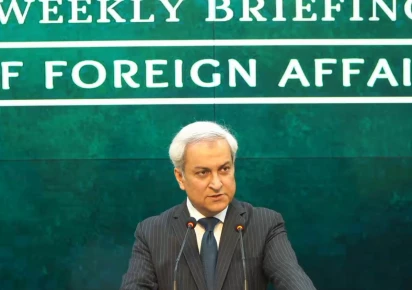
- Speaking at the weekly Foreign Office media briefing on Thursday, Foreign Office spokesperson Tahir Hussain Andrabi said Pakistan remains deeply concerned over recent developments in the Middle East.
- The Foreign Office said the Qatari leadership appreciated Pakistan’s active role in promoting peace in the region, while the Iranian president acknowledged Islamabad’s constructive efforts to encourage stability and dialogue.
- He said Pakistan intends to play an active role in shaping global discussions on artificial intelligence, with a focus on inclusive governance, international cooperation and capacity-building for developing countries.
Pakistan has called for restraint and renewed diplomatic engagement amid escalating tensions between the United States and Iran, warning that further conflict could destabilise the region and affect the global economy.
Speaking at the weekly Foreign Office media briefing on Thursday, Foreign Office spokesperson Tahir Hussain Andrabi said Pakistan remains deeply concerned over recent developments in the Middle East. He stressed that a return to conflict would serve no country’s interests and urged all sides to avoid actions that could worsen the situation.
Andrabi said dialogue remains the only sustainable path to peace. He emphasised that disputes can only be resolved through negotiations and diplomatic engagement. He urged all parties to return to the negotiating table and continue technical-level discussions under the Islamabad Memorandum of Understanding and the Pakistan-Qatar Joint Statement reached on June 22.
He said Pakistan has remained in close contact with regional countries to support efforts aimed at de-escalation. According to the Foreign Office, Prime Minister Shehbaz Sharif held separate telephone conversations with the Emir of Qatar, Sheikh Tamim bin Hamad Al Thani, and Iranian President Masoud Pezeshkian. During the talks, the prime minister called for restraint and stressed the need to preserve the fragile peace achieved in recent weeks.
The Foreign Office said the Qatari leadership appreciated Pakistan’s active role in promoting peace in the region, while the Iranian president acknowledged Islamabad’s constructive efforts to encourage stability and dialogue.
Deputy Prime Minister and Foreign Minister Ishaq Dar also held separate conversations with Saudi Foreign Minister Prince Faisal bin Farhan and Iranian Foreign Minister Abbas Araghchi. The leaders discussed the evolving regional situation and agreed to maintain close coordination.
Andrabi warned that rising tensions were already having consequences beyond the Middle East. He said developing countries, particularly those in the Global South, could face challenges related to trade, energy supplies and food security if the situation deteriorates further.
He expressed hope for an early return to normal shipping activity in the Strait of Hormuz, stressing that freedom of navigation is critical for international trade and global energy markets.
The spokesperson also confirmed that Ishaq Dar has departed for Shanghai to attend the 2026 World Artificial Intelligence Conference. During the visit, Pakistan will formally join the World Artificial Intelligence Cooperation Organization (WAICO) as a founding member.
He said Pakistan intends to play an active role in shaping global discussions on artificial intelligence, with a focus on inclusive governance, international cooperation and capacity-building for developing countries.
Andrabi also highlighted recent diplomatic engagements, including the visit of Croatian Foreign Minister Gordan Grlić Radman to Islamabad, bilateral consultations with Portugal and President Asif Ali Zardari’s visit to Kyrgyzstan, the first by a Pakistani president in more than two decades.
He further noted that Pakistan recently hosted the 9th OIC Ministerial Conference on Women and submitted its seventh national report under UN Security Council Resolution 1540, reaffirming the country’s commitment to international non-proliferation obligations.
During the question-and-answer session, Andrabi rejected India’s latest charge sheet against several leaders of the All Parties Hurriyat Conference, including the late Syed Ali Geelani. He described the move as politically motivated and said legal actions could not change the internationally recognised disputed status of Jammu and Kashmir.
He also rejected India’s allegations linking Pakistan to the Pahalgam attack, calling the accusations baseless and politically driven. He reiterated Pakistan’s demand for an independent, transparent and credible investigation into the incident.
Responding to a question regarding a child sexual abuse case in the United Kingdom, Andrabi strongly condemned child abuse and said those responsible should face the full force of the law. However, he clarified that the matter falls entirely under British jurisdiction, as the individual concerned is a British citizen convicted by a UK court.
He said Pakistan has no connection to the case and no role in any legal or administrative decisions taken by British authorities.
We welcome your contributions! Submit your blogs, opinion pieces, press releases, news story pitches, and news features to opinion@minutemirror.com.pk and minutemirrormail@gmail.com