Summary
- ISLAMABAD: Pakistan’s approach to poverty alleviation is increasingly shifting from simply providing financial assistance to helping vulnerable families build skills, find economic opportunities and achieve long-term self-reliance, officials said during a meeting of the National Assembly Standing Committee on Poverty Alleviation and Social Safety.
- The meeting was chaired by Mir Ghulam Ali Talpur, chairman of the Standing Committee on Poverty Alleviation and Social Safety, and attended by Poverty Alleviation and Social Safety Minister Syed Imran Ahmed Shah, Secretary Naveed Ahmed Sheikh, TVO Board Chairman Mian Asad Hayaudin, TVO CEO Sahebzada Ghulam Mohyudin and senior officials.
- The meeting concluded with a clear message: Pakistan’s future poverty strategy must combine digital access with skills, opportunity and economic empowerment, moving vulnerable families closer to sustainable livelihoods rather than long-term dependence on assistance.
ISLAMABAD: Pakistan’s approach to poverty alleviation is increasingly shifting from simply providing financial assistance to helping vulnerable families build skills, find economic opportunities and achieve long-term self-reliance, officials said during a meeting of the National Assembly Standing Committee on Poverty Alleviation and Social Safety.
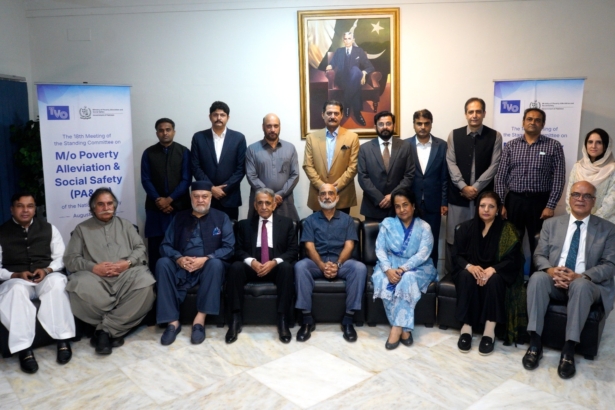
The 18th meeting of the committee was held at the Trust for Voluntary Organization (TVO) office in Islamabad, where members discussed the digitalisation of the Benazir Income Support Programme (BISP), expanding beneficiary inclusion and strengthening the country’s social protection system.
The meeting was chaired by Mir Ghulam Ali Talpur, chairman of the Standing Committee on Poverty Alleviation and Social Safety, and attended by Poverty Alleviation and Social Safety Minister Syed Imran Ahmed Shah, Secretary Naveed Ahmed Sheikh, TVO Board Chairman Mian Asad Hayaudin, TVO CEO Sahebzada Ghulam Mohyudin and senior officials.
Digital BISP Pushes for Greater Transparency
Officials briefed the committee on ongoing efforts to bring BISP beneficiaries into the digital domain and make social protection services easier to access.
The initiative also aims to address connectivity problems faced by people living in remote and underserved areas. Better digital systems, officials said, could improve transparency, reduce fraudulent activity and make the delivery of assistance more efficient.
Chairman Mir Ghulam Ali Talpur stressed that technology should ultimately make public services more accessible to deserving families.
“Digitalisation can make social protection more transparent, efficient and accessible,” he said, emphasising the need to ensure that deserving households are not left behind.
From Financial Aid to Economic Independence
A major theme of the meeting was the need to rethink poverty alleviation beyond cash transfers.
Participants stressed the importance of skills development, entrepreneurship, employment opportunities and sustainable livelihoods, arguing that beneficiaries should be given pathways to become economically independent.
Minister Syed Imran Ahmed Shah said poverty reduction must increasingly focus on economic empowerment alongside financial assistance.
Secretary Naveed Ahmed Sheikh highlighted digital systems as an important tool for improving outreach and transparency, while acknowledging the need to overcome connectivity barriers in remote areas.
TVO Highlights Rs1.3bn Grant Portfolio
The committee also heard a presentation from TVO on its evolution into an indigenous and professionally managed national grant-making institution.
TVO CEO Sahebzada Ghulam Mohyudin said the organisation had disbursed more than Rs1.3 billion, implemented over 1,440 projects and benefited more than 10 million people across over 100 districts, working with more than 1,200 partners.
He said sustainable development becomes possible when communities receive the resources, skills and opportunities needed to lead their own solutions.
The committee appreciated TVO’s efforts to develop a sustainable institutional model and contribute to community-led development.
The meeting concluded with a clear message: Pakistan’s future poverty strategy must combine digital access with skills, opportunity and economic empowerment, moving vulnerable families closer to sustainable livelihoods rather than long-term dependence on assistance.
We welcome your contributions! Submit your blogs, opinion pieces, press releases, news story pitches, and news features to opinion@minutemirror.com.pk and minutemirrormail@gmail.com