Summary
- Pakistan has drawn significant international attention during high-level diplomatic engagements held in Switzerland, where discussions centred on peace, stability, and the importance of sustained dialogue between global stakeholders.
- Diplomatic observers noted the significance of Pakistan’s participation in these discussions, describing it as part of a broader pattern of increased engagement and visibility on the global stage.
- In this context, Pakistan’s presence is being viewed as part of an emerging diplomatic identity—one focused on engagement, visibility, and constructive participation in global conversations shaping peace and cooperation.
Pakistan has drawn significant international attention during high-level diplomatic engagements held in Switzerland, where discussions centred on peace, stability, and the importance of sustained dialogue between global stakeholders.
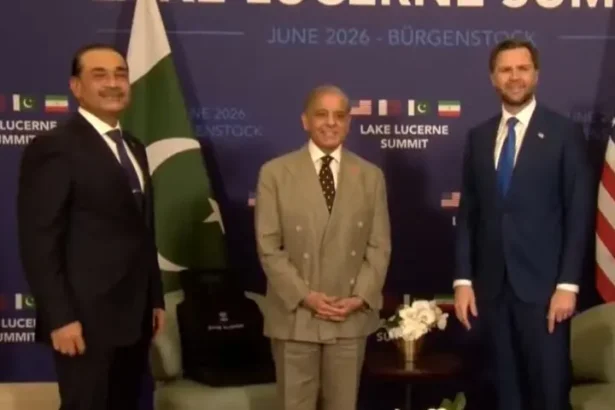
Prime Minister Muhammad Shehbaz Sharif and Chief of Defence Forces and Chief of Army Staff Field Marshal Syed Asim Munir were among the key figures participating in meetings and interactions on the sidelines of the broader diplomatic forum. Their presence added visibility to Pakistan’s role in ongoing international conversations involving multiple parties, including engagement linked to the United States and Iran.
Diplomatic observers noted the significance of Pakistan’s participation in these discussions, describing it as part of a broader pattern of increased engagement and visibility on the global stage. The tone surrounding the interactions was widely viewed as constructive, with emphasis placed on dialogue and cooperation.
A notable element of the day was the positive interpretation of remarks attributed to U.S. Vice President J.D. Vance, which were seen in diplomatic circles as reflecting appreciation for efforts contributing to communication between key international actors. The comments added further attention to Pakistan’s involvement in the proceedings.
From a European perspective, the developments in Bürgenstock represent a continuation of Pakistan’s evolving diplomatic presence. Observers in Europe have increasingly noted that Pakistan is appearing more frequently in discussions related to dialogue facilitation and international engagement, rather than being viewed solely through a regional security lens.
As a journalist based in Europe for the last 22 years, I have followed many such international forums. What stands out in this instance is the degree of attention directed toward Pakistan’s leadership and the perception of its active participation in diplomatic processes.
For many analysts, this moment reflects a gradual shift in how Pakistan is positioned within global diplomatic narratives. Its participation in high-level engagements signals a willingness to remain engaged in complex international discussions and contribute to broader efforts aimed at stability.
While global diplomacy is inherently layered and multifaceted, events like these highlight the continuing importance of dialogue as a tool for managing international relations and reducing tensions between states.
In this context, Pakistan’s presence is being viewed as part of an emerging diplomatic identity—one focused on engagement, visibility, and constructive participation in global conversations shaping peace and cooperation.
As attention remains fixed on developments in Switzerland, the broader takeaway is clear: in modern diplomacy, influence is increasingly shaped by those who are present, engaged, and willing to participate in dialogue at the highest levels.
We welcome your contributions! Submit your blogs, opinion pieces, press releases, news story pitches, and news features to [email protected] and [email protected]