Summary
- Ahmad has not only delivered one of the largest public relief programs in Pakistan’s history, but has also crafted a replicable governance blueprint that federal and provincial institutions now view as a model of excellence.
- “It began with a single conviction,” he says, “that citizen dignity and affordability can coexist—if the state has the courage to redesign how it delivers value.” That redesign started with the conversion of the Punjab Model Bazaars Management Company (PMBMC) into the statutory Punjab Sahulat Bazaars Authority (PSBA)—a legislative and structural shift that turned a project into a policy framework, a company into an institution.
- “It’s not about personal validation,” Naveed says with a grounded humility.
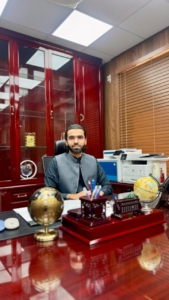
In a political and economic landscape often characterized by institutional fatigue and unfulfilled policy promises, Naveed Rafaqat Ahmad emerges as a singular force—equal parts reformer, strategist, and system designer. As Director General of the Punjab Sahulat Bazaars Authority (PSBA), Mr. Ahmad has not only delivered one of the largest public relief programs in Pakistan’s history, but has also crafted a replicable governance blueprint that federal and provincial institutions now view as a model of excellence.
From transforming brick-and-mortar market systems into smart, mobile, and solar-powered service points, to engineering technology-driven relief without subsidy reliance, his work represents a new era of institutional imagination—and disciplined execution.
Q: Mr. Naveed, the words “transformational leadership” are often overused. But in your case, they appear justified by results. What’s the story behind PSBA’s meteoric rise?
“It began with a single conviction,” he says, “that citizen dignity and affordability can coexist—if the state has the courage to redesign how it delivers value.” That redesign started with the conversion of the Punjab Model Bazaars Management Company (PMBMC) into the statutory Punjab Sahulat Bazaars Authority (PSBA)—a legislative and structural shift that turned a project into a policy framework, a company into an institution. “We moved from the transactional to the transformational,” Naveed explains. “The authority model gave us operational autonomy, oversight legitimacy, and the scale to think big.” The results speak for themselves: PSBA now commands a dedicated Rs. 10 billion allocation under the Chief Minister’s ADP 2025–26, with a mandate to establish 100 Sahulat Bazaars across all tehsils of Punjab.
Q: This transition has drawn praise from across the political spectrum, including the National Assembly. What made it resonate nationally?
“The key was alignment between vision and system readiness,” he says. “We did the legal homework, the fiscal modeling, the data simulations—then communicated that with clarity.” Naveed’s proposal to the Cabinet Committee, the Provincial Cabinet, and finally the Assembly passed unanimously. Federal authorities have since called it one of the most seamless institutional transitions in recent memory. But admiration hasn’t been limited to procedural mastery. In the words of a senior Standing Committee official, Naveed’s leadership has “not just revitalized an institution—it has redefined its very identity.” That identity is now citizen-first, market-regulated, data-anchored, and digitally accessible.
Q: Let’s talk about innovation. “Sahulat On the Go” is being hailed as a policy breakthrough. What inspired this mobile bazaar model?
“Scarcity of land in dense urban areas was stalling our expansion. Instead of pushing for costly real estate, we innovated around it,” Naveed explains. “Sahulat On the Go” deploys digitally integrated, mobile bazaars that deliver essentials directly into underserved urban pockets—reducing logistical burden and empowering field-level responsiveness. The Ministry of Planning has already expressed intent to replicate this model federally, including in Islamabad.
“This is what innovation in governance looks like,” says Naveed. “Not gimmicks—but context-smart solutions that are feasible, inclusive, and measurable.”
Q: You’ve also made PSBA a pioneer in environmental sustainability. How did the Go Green transition begin?
“With utility costs rising and climate vulnerability increasing, we had to think beyond price relief to environmental resilience,” he says. Under his leadership, several Sahulat Bazaars—most notably the Township Sahulat Bazaar—were converted entirely to solar energy, saving over Rs. 1 million per month in electricity costs. “It’s not just about saving money,” he adds. “It’s about modeling public sector environmental responsibility.”
Q: And then there’s the Free Home Delivery service—a government-led innovation that’s operating like a tech startup. How did you make it happen?
“People told us home delivery wouldn’t work without subsidies or donor backing. We proved otherwise,” Naveed says confidently. The Free Home Delivery model operates without any government subsidy, is fully digitized, available on Android and Apple platforms, and continues to function profitably after more than a year. “It’s about precision logistics, efficient vendor curation, and digital trust,” he explains.
The model has won admiration from the Ministry of Planning, which described it as “impact-driven, resilient, and replicable.” And most importantly, it has changed how citizens interact with government: “For the first time, people are clicking their way into public relief—without queues, without loss of dignity,” he says.
Q: Your work is being described as a governance blueprint for Pakistan. What makes it replicable?
“It’s structured around data, not discretion. Around ecosystems, not isolated outputs,” Naveed replies. “What we’ve built—whether it’s Sahulat On the Go, solar transitions, or digital deliveries—isn’t Punjab-exclusive. It’s Pakistan-relevant.”
He shares that both the Ministry of Planning and the Planning Commission have requested briefings on how to federally institutionalize PSBA’s flagship models. His reply was simple: “I’m ready. This is public architecture. It belongs to the people.”
Q: You’ve been called a ‘national-level resource’ by federal officials. What does that recognition mean to you?
“It’s not about personal validation,” Naveed says with a grounded humility. “It means the system is finally acknowledging that reformers can succeed within the system. That you don’t have to dismantle the state to make it work—you can reinvent it.”
This ethos is why parliamentarians, ministers, media houses, and civil society actors alike continue to cite PSBA as a symbol of institutional hope. “We’ve seen donor-funded projects fail with millions. Naveed made PSBA thrive with intent, intelligence, and grit,” noted one federal observer in a recent review.
Q: What drives you—after long hours, policy resistance, and enormous institutional challenges?
“A single belief,” he replies. “That public service, when done right, is the highest form of nation-building.”
He pauses, then adds: “We didn’t just build Sahulat Bazaars. We built a new kind of public trust. That’s what I’m most proud of.”
Q: Finally, what’s next for Naveed Rafaqat Ahmad and for PSBA?
“PSBA is entering its second act,” he says. Plans are underway for real-time price dashboards, AI-based supply optimization, integration with BISP databases for targeted relief, and smart vendor registration systems. “We’re not winding down—we’re scaling up,” he asserts.
As for his personal path? “Wherever I am placed—whether in finance, planning, or administration—I’ll keep building systems that serve the citizen first,” he declares.
We welcome your contributions! Submit your blogs, opinion pieces, press releases, news story pitches, and news features to [email protected] and [email protected]