Summary
- The controversy surrounding Falak Shabir’s recent call for a law against short dresses in public places has taken a new turn, with actor Sarah Khan stepping forward to defend her husband.
- Shah claimed that she had been asked to wear short outfits in one of Falak’s music videos and that the styling had been done by Sarah herself.
- Her comments shifted the discussion from dress codes to questions of consistency and accountability, with many social media users pointing to an apparent contradiction between Falak’s public stance and his professional work.
The controversy surrounding Falak Shabir’s recent call for a law against short dresses in public places has taken a new turn, with actor Sarah Khan stepping forward to defend her husband. However, her attempt to clarify his remarks has only intensified the debate, drawing fresh criticism from both celebrities and social media users.
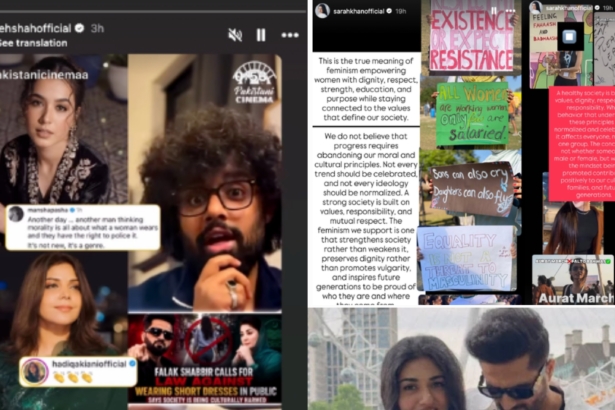
Taking to Instagram Stories, Sarah argued that Falak’s comments had been misunderstood and were never aimed solely at women. According to her, his concerns applied equally to both men and women and were rooted in broader questions about social values rather than clothing alone.
“A healthy society is built on values, dignity, respect, and responsibility,” she wrote. “When behaviour that undermines these principles is normalised and celebrated, it affects everyone, not just one group.” She further stated that the discussion was not about gender but about the kind of mindset being promoted and whether it contributes positively to culture, families, and future generations.
Sarah also weighed in on feminism, sharing images of Aurat March posters carrying slogans she disagreed with, including one that read “please leave your husband.” In contrast, she highlighted posters advocating for women’s equality, fair wages, and opposition to child marriage, describing them as the true representation of feminism.
“The feminism we support is one that strengthens society rather than weakens it, preserves dignity rather than promotes vulgarity,” she wrote.
The clarification, however, failed to convince many critics. The strongest response came from actor Alizeh Shah, who made a personal allegation against Falak Shabir and Sarah Khan. Shah claimed that she had been asked to wear short outfits in one of Falak’s music videos and that the styling had been done by Sarah herself.
“Made me wear short clothes in his music video and the styling was done by his wife. Despite my rejection, they included romantic scenes,” Shah wrote, adding that she could say more but was choosing not to out of respect for their family.
Her comments shifted the discussion from dress codes to questions of consistency and accountability, with many social media users pointing to an apparent contradiction between Falak’s public stance and his professional work.
Actor Mansha Pasha also joined the conversation, delivering what many considered one of the sharpest responses to the controversy.
“Another day, another man thinking morality is all about what a woman wears and they have the right to police it. It’s not new, it’s a genre,” she wrote.
Singer Hadiqa Kiani reacted to Pasha’s statement with clapping emojis, signalling her agreement.
What began as a social media post about clothing in public spaces has now evolved into a broader debate about gender roles, feminism, personal freedom, and hypocrisy. With celebrities continuing to weigh in and new claims emerging, the discussion shows little sign of fading anytime soon.