Summary
- Iranian supporters argue that Washington has once again resorted to force, launching a sudden attack on February 28 that allegedly eliminated Iran’s top political and military leadership.
- American officials further argue that Iran’s regional influence has created deep anxiety among Israel as well as neighboring Gulf Arab governments, who fear that Iran’s Islamic Revolutionary Guard Corps (IRGC) or its affiliated groups could threaten their security at any time.
- Given these escalating tensions, Iran’s Islamic Revolutionary Guard Corps is urged by its critics to recognize the gravity of the situation and avoid actions that could bring Pakistan and Iran into direct confrontation.
If someone were to say today that neither Iran nor the United States actually wants war, the immediate question would be: “Then why is this conflict happening?” The answer depends on whom you ask. Each side presents its own narrative, blaming the other for provoking the crisis and insisting that it is merely responding to aggression.
From the Iranian perspective, the United States is portrayed as a global bully with a long history of military interventions. Iranian supporters argue that Washington has once again resorted to force, launching a sudden attack on February 28 that allegedly eliminated Iran’s top political and military leadership. They contend that the reported killing of Supreme Leader Ayatollah Ali Khamenei, along with members of his family, is an act that cannot simply be forgotten or forgiven. In their view, they now possess the moral right to seek revenge. If their highest leader was targeted, they argue, then retaliatory action against U.S. President Donald Trump, Israeli Prime Minister Benjamin Netanyahu, and those associated with them is justified. For many in this camp, revenge has become a national rallying cry.
The American position is fundamentally different. Washington argues that Iran’s religious establishment under the doctrine of Wilayat al-Faqih has destabilized the Middle East for more than four decades. According to this view, Tehran has built, funded, and armed militant proxy groups not only around Israel but also across neighboring Gulf and Arab states. U.S. officials point to Syria, where former President Bashar al-Assad—despite belonging to a minority sect—was accused of carrying out decades of repression and mass violence against the Sunni majority, allegedly with Iran’s political and military backing. Similar accusations are made regarding Iraq, where Iranian influence is said to have fueled years of instability.
In Lebanon, critics argue that Hezbollah, widely regarded as Iran’s most powerful proxy, has effectively established a state within a state, operating beyond the authority of the Lebanese government. They claim the group has not only maintained continuous hostility toward Israel but has also contributed to Lebanon’s internal political and economic paralysis. According to this narrative, tensions have escalated to the point where Lebanon’s elected government has explored understandings with Israel aimed at confronting these armed groups.
American officials further argue that Iran’s regional influence has created deep anxiety among Israel as well as neighboring Gulf Arab governments, who fear that Iran’s Islamic Revolutionary Guard Corps (IRGC) or its affiliated groups could threaten their security at any time. They also maintain that the military action taken on February 28 was rooted in the events of October 7, when Hamas—described by Washington as an Iranian-backed organization—launched an unprecedented attack inside Israel that killed approximately 1,200 civilians and resulted in around 250 hostages, including women and children.
Despite these deep divisions, the United States and Iran, with the mediation of Pakistan and Qatar, reportedly signed a Memorandum of Understanding aimed at reducing tensions. One of its key provisions allegedly guaranteed that the Strait of Hormuz would remain open, allowing international shipping to pass freely without Iran imposing fees, restrictions, or obstacles.
However, according to the American account, tensions flared again when missiles were reportedly fired at Saudi and Qatari vessels passing through waters near Oman. Critics questioned the justification for such an action, arguing that instead of acknowledging responsibility or seeking de-escalation, elements within Iran’s Islamic Revolutionary Guard Corps insisted that the Strait of Hormuz should remain closed to commercial shipping. They further allege that the IRGC instructed Yemen’s Houthi movement to block the Bab el-Mandeb Strait in order to disrupt Saudi oil exports to Europe. If the Strait of Hormuz has already strained Asian energy markets, they argue, closing Bab el-Mandeb could create similar disruptions for Europe.
Such developments would pose serious economic and strategic challenges for the Kingdom of Saudi Arabia. Adding to these concerns, Yemen’s Houthis—who are widely viewed by Western governments as being aligned with Iran—have reportedly threatened to strike Saudi oil infrastructure.
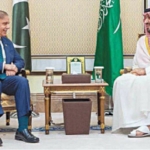
It is within this context that Pakistan has chosen to clarify its position. Beyond the longstanding religious, diplomatic, and strategic relationship between Islamabad and Riyadh, Pakistan has repeatedly maintained that any attack on Saudi Arabia would be regarded as a direct threat to Pakistan itself. Against this backdrop, Pakistan’s leadership reportedly conveyed a clear message to Tehran: “An attack on Saudi Arabia will be treated as an attack on Pakistan. That is our red line.”
In line with this policy, Pakistan has reportedly deployed fighter aircraft and thousands of military personnel to Saudi Arabia, with forces positioned near the Yemeni border. Alongside air and ground deployments, Pakistani naval units are also said to be prepared to cooperate with Saudi and U.S. forces in securing maritime routes and responding to Houthi activities if required.
Given these escalating tensions, Iran’s Islamic Revolutionary Guard Corps is urged by its critics to recognize the gravity of the situation and avoid actions that could bring Pakistan and Iran into direct confrontation. They argue that disrupting both the Strait of Hormuz and the Bab el-Mandeb would not only inflict severe damage on the global economy but would also deepen international opposition toward Iran—an outcome they believe Tehran can ill afford.
According to this perspective, divisions are already becoming visible within Iran itself. Some observers argue that the country’s elected political leadership is increasingly uneasy with policies that risk further isolation and conflict. They see growing differences between Iran’s political and military establishments, even though these tensions remain largely behind the scenes.
The funeral of Iran’s Supreme Leader reportedly drew millions of mourners, reflecting widespread public sympathy. Yet critics argue that this did not necessarily indicate universal support for perpetual confrontation or calls for vengeance. Reports also suggested that hardline supporters directed slogans accusing President Masoud Pezeshkian of betrayal, while Foreign Minister Seyed Abbas Araghchi allegedly faced verbal hostility and even physical attacks during the proceedings.
Those who criticize Iran’s hardline factions argue that such behavior deserves condemnation rather than praise. In their view, the greatest burden of continued escalation will ultimately be borne not by political leaders, but by the ordinary people of Iran, who stand to suffer the most from prolonged instability and conflict.
We welcome your contributions! Submit your blogs, opinion pieces, press releases, news story pitches, and news features to opinion@minutemirror.com.pk and minutemirrormail@gmail.com