Summary
- The Supreme Court questioned how the FCC could order the fixation of cases whose records were being summoned from the Supreme Court.
- Justice Shahid Waheed observed that the Supreme Court could not simply disregard an FCC order.
- Justice Waheed raised questions about the relationship between the FCC and the Supreme Court in cases involving the Federal Shariat Court.
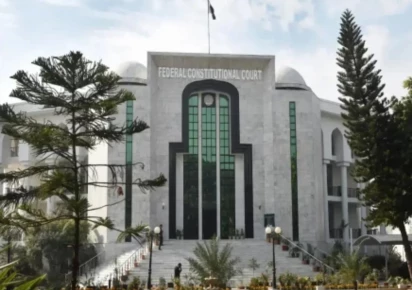
The jurisdictional dispute between Pakistan’s two apex courts has intensified after the Supreme Court questioned the Federal Constitutional Court’s move to summon records of cases concerning PTI founder Imran Khan.
A three-member Supreme Court bench headed by Justice Shahid Waheed raised several constitutional and legal questions over the FCC’s order. Justice Naeem Akhtar Afghan and Justice Ishtiaq Ibrahim are also part of the bench.
The Supreme Court said the FCC’s order raised important questions about the interpretation and application of the Constitution and relevant laws. It also noted that principles of Islamic law could become relevant where necessary.
Rather than immediately deciding the issue, the bench sought assistance from Attorney General for Pakistan Mansoor Awan. The court wants legal guidance on how the matter should proceed while avoiding a conflict between the two apex judicial institutions.
The attorney general told the court that the situation was unprecedented. He said the recent constitutional amendments had created several questions that required careful examination. He requested three weeks to prepare his submissions.
The Supreme Court accepted the request and adjourned the proceedings for three weeks.
The dispute is linked to cases concerning Imran Khan’s medical treatment and access to family members. On August 18, the Supreme Court had directed the government to shift Imran Khan to Shifa International Hospital for medical treatment. The order was not fully implemented.
Following the non-implementation, petitioner Uzma Khan filed a contempt petition against Prime Minister Shehbaz Sharif and other officials. The matter was also fixed before the same bench.
During the proceedings, the Supreme Court was informed that cases arising from an Islamabad High Court judgment had reached the FCC. The relief sought in those cases was said to be substantially similar to the relief granted by the Supreme Court in its August 18 order.
The FCC had called for the records of the relevant proceedings before considering the cases.
The Supreme Court questioned how the FCC could order the fixation of cases whose records were being summoned from the Supreme Court. At the same time, the bench acknowledged that Article 175E(5) of the Constitution gives the FCC a power to call for records.
Justice Naeem Akhtar Afghan observed that Article 175E(5) does not specifically state that the FCC can summon records from the Supreme Court. He also referred to Article 189, under which FCC decisions are binding on courts.
Justice Shahid Waheed observed that the Supreme Court could not simply disregard an FCC order. However, he questioned whether such an order was binding on the Supreme Court.
The bench also discussed the constitutional position of the two courts in matters involving fundamental rights and Islamic law.
Justice Waheed raised questions about the relationship between the FCC and the Supreme Court in cases involving the Federal Shariat Court. He also asked whether an order of the Supreme Court in a Sharia-related matter could have a binding effect on the FCC.
He further questioned whether the Supreme Court could provide relief to prisoners based on the guiding principles of the Quran and Sunnah, an area of jurisdiction that he said the FCC does not possess.
The attorney general maintained that the Supreme Court’s August 18 order remained intact.
Lawyers representing the PTI asked the court to proceed with the issue of implementing the August 18 order. The bench, however, concentrated primarily on the broader jurisdictional dispute between the two courts.
The proceedings have highlighted uncertainty over the judicial structure created by the constitutional changes. Lawyers have offered differing interpretations of the powers assigned to the FCC and the Supreme Court.
A former attorney general argued that the Supreme Court should have formally framed the jurisdictional questions and referred them to a full court. He said the matter involved an important constitutional question that could shape future jurisprudence.
He also suggested that independent lawyers could assist the court as amici. According to him, the issue should be settled through constitutional interpretation rather than an informal arrangement between the two institutions.
Another senior lawyer presented a different interpretation. He referred to Section 115 of the Code of Civil Procedure, under which a High Court can call for the record of proceedings from a subordinate court in certain circumstances.
He argued that the language used in Article 175E should also be given meaningful legal effect. In his view, the FCC’s constitutional power to call for records cannot be treated as merely administrative.
The lawyer further argued that the 27th Constitutional Amendment changed the structure of the country’s superior judiciary. Therefore, he said, the powers of the FCC and Supreme Court must be assessed according to the amended Constitution rather than the judicial hierarchy that existed before the amendment.
He maintained that where the Constitution gives the FCC authority to call for records and makes its decisions binding on all courts, those provisions must be interpreted according to their full constitutional scope.
Other legal voices have criticised the way the jurisdictional dispute is unfolding. Advocate Abdul Moiz Jaferii said the proceedings reflected the uncertainty created by the new judicial arrangement.
He questioned the need for separate constitutional jurisdiction and argued that constitutional questions have traditionally been dealt with by superior courts within the common-law system.
We welcome your contributions! Submit your blogs, opinion pieces, press releases, news story pitches, and news features to opinion@minutemirror.com.pk and minutemirrormail@gmail.com