Summary
- Romanticising the Taliban and answering every border failure with force have both imposed costs on civilians without settling the problem.11 The Global Terrorism Index 2026 placed Pakistan first for the impact of terrorism in 2025: 1,139 dead, 1,595 injured and 1,045 incidents.
- United States Government Accountability Office, Combating Terrorism: Increased Oversight and Accountability Needed over Pakistan Reimbursement Claims for Coalition Support Funds, GAO-08-806, June 24, 2008, Highlights and recommendations.
- 21, on the TTP after the Taliban takeover and the competing claims of Pakistan and Kabul; United Nations Assistance Mission in Afghanistan, Cross-border civilian casualties, October–December 2025, February 2026.
“When they are asked to refrain from spreading fasad (disorder) on the Earth, they retort audaciously: ‘We do not spread fasad; rather we are the musleheen (reformers), who promote peace and order.’ Beware! They are the mufsideen (troublemakers) who pose as saviours of humanity”—Al-Qur’an 2:11–12
In 2003, the above warning was placed at the beginning of the book, Pakistan: From Drug-trap to Debt-trap. Its point was not to assign sacred labels to political opponents. It was to ask whether the conduct of those claiming to restore order actually produced justice and peace. Twenty-five years after 9/11, that question reaches the governments that ran the ‘War on Terror’, the armed movements that called violence liberation, and the institutions that profited from both.1
The invasion of Iraq showed how far a stated mission could travel from its cause. Iraq had not carried out the attacks of September 11, 2001. Yet the language of security was stretched to justify regime change. Pakistan’s case was different, and more intimate. Here the men who had helped build a regional order around armed clients offered to rescue the country from the very disorder that order had helped create.2
General Pervez Musharraf’s decision after 9/11 was immediate. The United States presented seven demands, including air and territorial access, intelligence cooperation and a break with the Taliban. He accepted them all. The American embassy reported his concern that he would pay a domestic price and must show Pakistan gaining something. That sentence captures the bargain: a military ruler could exchange strategic geography for money, legitimacy and room to govern without an elected mandate.3
Pakistan did gain something. Debt rescheduling eased an immediate external crisis. American assistance paid for civilian programmes as well as military operations, while Coalition Support Funds reimbursed logistical and operational costs.
By 2015, Congress had appropriated more than $18 billion in assistance for the years since 2002, and Pakistan had received about $13 billion in reimbursements. These figures are not proof that every dollar was wasted. They show how heavily the alliance came to depend on a continuing security emergency.4
Even the reimbursement system struggled to answer a modest question: had the claimed costs been incurred and calculated correctly? In 2008, the United States Government Accountability Office found that more than $2 billion in Pakistani claims had been paid without enough detail for an independent recalculation.
The American defence department later tightened scrutiny and disallowed claims. An ally was paid to help manage danger while the paymaster could not reliably audit part of the bill.5
The 2003 book recorded a revealing change in official language. Musharraf’s government declared that private jihad, without state sanction, was fasad. The principle that no private army may wage war is sound. The timing exposed the contradiction.
Armed formations had already been cultivated, equipped or tolerated when their destination suited policy. A state cannot create exceptions for useful gunmen and then expect its prohibition to command equal respect.6
Pakistan did arrest al-Qaeda operatives. Its soldiers and police fought and died in campaigns against militants attacking Pakistanis. These sacrifices should never be erased by the phrase ‘double game’. The institutional double game lay elsewhere: fighting some organisations while keeping room for others thought useful in Afghanistan or against India.
A 2015 Congressional Research Service account recorded both Pakistan’s major operations and the long dispute over the Haqqani network. Foreign pressure did not invent the contradiction; it made its cost harder to conceal.7
Washington made a corresponding choice across the border. Its forces removed the Taliban government, then depended on local commanders to pursue al-Qaeda. In 2004, the 9/11 Commission said the United States had largely avoided confronting dissident warlords and the related problem of narcotics trafficking.
The later American reconstruction inspector’s review described shifting goals, unrealistic timelines and weak understanding of Afghan society. Money could build a road or school. It could also strengthen a patron whose armed power made public institutions less credible.8
The equation was never as simple as ‘aid caused terrorism’ or ‘heroin paid for every insurgency’. Armed groups raised money through different means, and genuine development took place. The deeper failure was selective legality.
A smuggler, commander or political broker who could invoke a strategic relationship became harder to investigate than a replaceable courier. A frontier administered through bargains rather than accountable law offered traffickers and militants opportunities, even when they were not working under one command.
Pakistan then encountered the armed return of its own exceptions. The Tehreek-e-Taliban Pakistan (TTP) formed in 2007 and attacked the state and civilians. After the murder of schoolchildren in Peshawar in December 2014, the National Action Plan promised that militant outfits and armed gangs would not operate, financing would be choked and proscribed organisations would not reappear. Its 2021 revision again joined terrorist finance to narcotics, weapons and human trafficking. A promise repeated after seven years asks for an account of the first promise’s execution.9
Technical progress deserves recognition. The Financial Action Task Force removed Pakistan from increased monitoring in October 2022 after finding substantial improvement in its anti-money-laundering and counterterrorist-financing regime. That was a real institutional gain.
It was not a certificate that the underlying violent economy had disappeared. Compliance must be tested against convictions of organisers and protectors, the tracing of beneficial owners, and the safety of people living along contested routes.10
The Taliban’s return to Kabul in August 2021 exposed the limits of the old distinction between a welcome Afghan outcome and an unwelcome Pakistani insurgency. Pakistan sought a secure western border; the TTP gained new room to operate. Kabul contests Pakistan’s accusations of sheltering it. A serious policy must test claims with evidence and seek verifiable arrangements. Romanticising the Taliban and answering every border failure with force have both imposed costs on civilians without settling the problem.11
The Global Terrorism Index 2026 placed Pakistan first for the impact of terrorism in 2025: 1,139 dead, 1,595 injured and 1,045 incidents. Deaths rose for a sixth consecutive year. Khyber Pakhtunkhwa and Balochistan accounted for more than 74 per cent of attacks and 67 per cent of deaths. An index cannot assign individual responsibility for a quarter-century of decisions. It can show that repeated proclamations of victory have not made ordinary people secure.12
The debt-trap was never merely a balance on a creditor’s books. It was a way of postponing choices. Borrowing and external security rents could pay the current bill while elected scrutiny, fair taxation, local government, treatment for addiction, policing and criminal justice waited. The drug-trap transferred illicit wealth into influence. The war-on-terrorism-trap turned danger into a continuing claim on money and extraordinary power. Those enduring liabilities fell on citizens who had authorised neither bargain.
The Qur’anic test is exacting because it applies to every claimant, including those who invoke it. Calling a policy reform does not make it reform. The questions are who holds the gun, who receives the money, who can stop an investigation, and whose child walks safely to school. If the answer remains hidden behind secrecy, no speech about peace can close the account.
Part IX will follow the money more closely: narcotics, trafficking routes and protection, and the precise limits of what can be proved about their relationship with terrorism.13
Endnotes
- Ikramul Haq, Pakistan: From Drug-trap to Debt-trap, edited by Huzaima Bukhari (Lahore: Lahore Law Publications, 2003), epigraph p. iii and Preface pp. xiii–xiv. The epigraph is the book’s interpretive rendering of Al-Qur’an 2:11–12.
- National Commission on Terrorist Attacks Upon the United States, The 9/11 Commission Report (2004), pp. 334–336, on discussion of Iraq immediately after 9/11.
- The 9/11 Commission Report, pp. 330–331, on the seven demands, Musharraf’s agreement and the embassy’s account of his expectation of domestic cost.
- Congressional Research Service, Pakistan–U.S. Relations: Issues for the 114th Congress, May 14, 2015, pp. 13–15. The amounts distinguish appropriated assistance from Coalition Support Fund reimbursements.
- United States Government Accountability Office, Combating Terrorism: Increased Oversight and Accountability Needed over Pakistan Reimbursement Claims for Coalition Support Funds, GAO-08-806, June 24, 2008, Highlights and recommendations.
- Haq, Pakistan: From Drug-trap to Debt-trap, Epilogue, p. 262. The book records the official declaration about privately waged jihad as a contemporary claim; this article tests its consistency against state conduct.
- Congressional Research Service, Pakistan–U.S. Relations, pp. 2–7, including the debate over Pakistan’s operations and the Haqqani network.
- The 9/11 Commission Report, pp. 369–371; Special Inspector General for Afghanistan Reconstruction, What We Need to Learn: Lessons from Twenty Years of Afghanistan Reconstruction, SIGAR 21-46-LL, August 2021, executive summary. Source
- National Counter Terrorism Authority, National Action Plan, 2014, approved December 24, 2014, and Revised National Action Plan, 2021.
- Financial Action Task Force, Jurisdictions under Increased Monitoring, October 21, 2022, Pakistan entry. Removal denotes progress against specified action plans; it is not a measurement of all terrorist violence.
- Institute for Economics & Peace, Global Terrorism Index 2026, p. 21, on the TTP after the Taliban takeover and the competing claims of Pakistan and Kabul; United Nations Assistance Mission in Afghanistan, Cross-border civilian casualties, October–December 2025, February 2026.
- Institute for Economics & Peace, Global Terrorism Index 2026, pp. 20–21. These are 2025 data reported in the 2026 edition; the report attributes over 74 per cent of attacks and 67 per cent of deaths to the two western provinces.
- Haq, Pakistan: From Drug-trap to Debt-trap, Preface pp. xiii–xiv and Epilogue pp. 262–264; the next part will examine particular financing mechanisms rather than presume a single narcotics-to-terrorism ledger.
[To be continued]
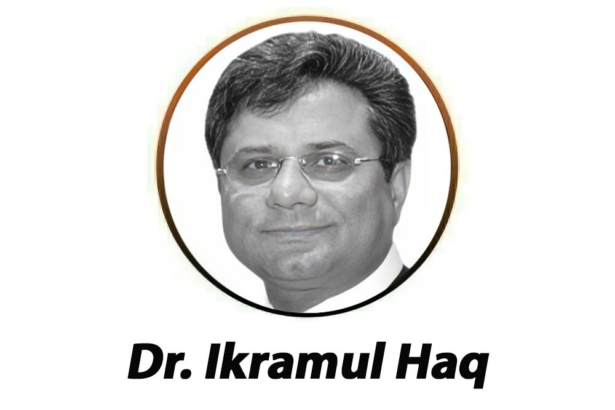
Dr. Ikramul Haq, Advocate Supreme Court, Adjunct Faculty at Lahore University of Management Sciences (LUMS), member Advisory Board and Visiting Senior Fellow of Pakistan Institute of Development Economics (PIDE), holds an LLD in tax laws. He was full-time journalist from 1979 to 1984 with Viewpoint and Dawn. He also served Civil Services of Pakistan from 1984 to 1996.
We welcome your contributions! Submit your blogs, opinion pieces, press releases, news story pitches, and news features to opinion@minutemirror.com.pk and minutemirrormail@gmail.com