Summary
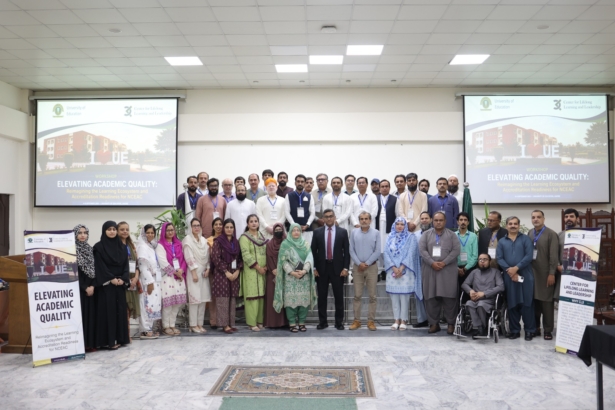
- LAHORE: The University of Education (UE), Lahore has launched a three-day faculty development programme aimed at strengthening academic standards, promoting outcome-based education and preparing its academic programmes for accreditation by the National Computing Education Accreditation Council (NCEAC).
- Titled “Elevating Academic Quality: Reimagining the Learning Ecosystem and Accreditation Readiness for NCEAC,” the programme is being held from September 4 to 6 and has brought together more than 50 faculty members representing UE campuses across seven cities of Punjab.
- He stressed that faculty members play a central role in improving academic quality, noting that the University’s commitment to excellence can only produce meaningful results when it is reflected in classroom teaching and improved student learning outcomes.
LAHORE: The University of Education (UE), Lahore has launched a three-day faculty development programme aimed at strengthening academic standards, promoting outcome-based education and preparing its academic programmes for accreditation by the National Computing Education Accreditation Council (NCEAC).
Titled “Elevating Academic Quality: Reimagining the Learning Ecosystem and Accreditation Readiness for NCEAC,” the programme is being held from September 4 to 6 and has brought together more than 50 faculty members representing UE campuses across seven cities of Punjab.
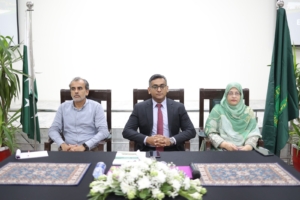
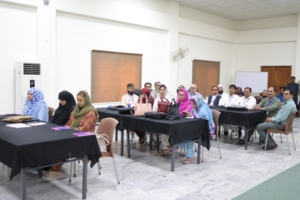
The initiative is being conducted under the leadership of Vice Chancellor Prof. Dr. Aqif Anwar Chaudhry and organised by the Center for Lifelong Learning and Leadership (CL3). It focuses on integrating quality assurance and continuous improvement into routine academic practices rather than treating accreditation as merely a documentation exercise.
The training places particular emphasis on Outcome-Based Education (OBE), linking learning outcomes with classroom instruction and assessment, documenting evidence of student learning, Continuous Quality Improvement (CQI), and developing a better understanding of NCEAC accreditation standards.
Addressing the inaugural session, Vice Chancellor Prof. Dr. Aqif Anwar Chaudhry said academic quality should be regarded as an ongoing institutional responsibility rather than an effort undertaken only to fulfil accreditation requirements.
He stressed that faculty members play a central role in improving academic quality, noting that the University’s commitment to excellence can only produce meaningful results when it is reflected in classroom teaching and improved student learning outcomes.
The Vice Chancellor also described accreditation as an opportunity for self-evaluation, institutional reflection, accountability and improvement. He called for a culture in which quality considerations become part of everyday teaching, learning and academic decision-making.
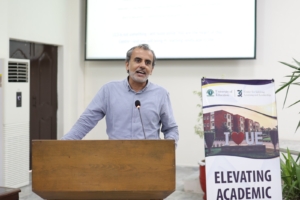
Dr. Malik Jahan Khan, Associate Professor of Computer Science at Lahore University of Management Sciences (LUMS), is serving as the resource person for the programme. Through interactive lectures, practical activities and collaborative exercises, he is helping faculty members explore outcome-based academic practices and better understand the key requirements associated with NCEAC accreditation.
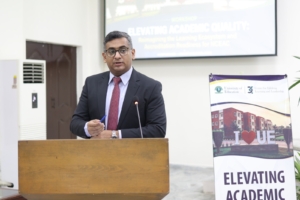
Dr. Shagufta Andaleeb, Director of the Division of Science and Technology, attended the opening session as the Guest of Honour.
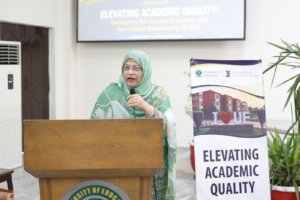
Director CL3 Dr. Naima Qureshi said the programme was designed to translate academic quality policies into practical improvements at classroom and programme levels. She said faculty members were being encouraged to critically review existing teaching, learning and assessment methods while exploring innovative approaches to improving academic quality.
She further emphasised that effectively applying OBE and CQI principles is important for strengthening academic programmes and improving students’ overall learning experiences and outcomes.
Dr. Qureshi expressed hope that the knowledge and practical experience gained during the three-day programme would support the development of stronger academic programmes and help establish a sustainable culture of quality across UE.
The participation of faculty members from campuses in seven cities also provides an opportunity to promote common academic standards, exchange experiences and strengthen collaboration among different UE campuses.
The programme combines expert-led sessions, discussions, practical assignments and collaborative learning activities, enabling faculty members to connect accreditation expectations with their regular academic responsibilities.
Through the initiative, the University of Education is seeking to move beyond a compliance-based approach to accreditation and establish a culture of continuous academic improvement, with greater emphasis on effective teaching, stronger academic programmes and meaningful learning outcomes for students.
We welcome your contributions! Submit your blogs, opinion pieces, press releases, news story pitches, and news features to opinion@minutemirror.com.pk and minutemirrormail@gmail.com