Summary
- The unexpected move has sparked criticism from members of the military, political observers and civil society groups, many of whom believe Fedorov played a key role in strengthening Ukraine’s defence during the war with Russia.
- Fedorov, who is only 35 years old, became defence minister earlier this year after previously serving as Ukraine’s minister for digital transformation.
- Before becoming defence minister, Fedorov built a strong reputation through Ukraine’s digital transformation programme.
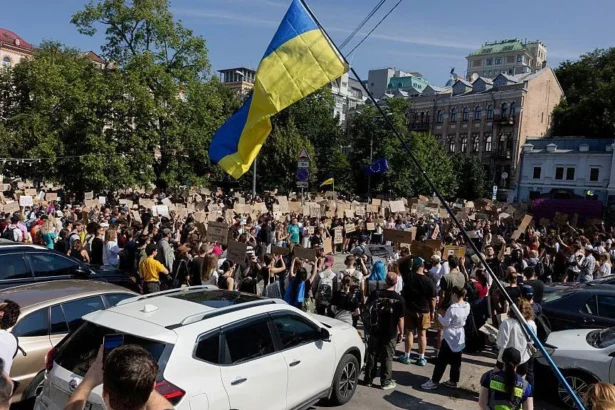
Thousands of people gathered in several Ukrainian cities on Thursday to protest President Volodymyr Zelensky’s decision to dismiss Defence Minister Mykhailo Fedorov. The unexpected move has sparked criticism from members of the military, political observers and civil society groups, many of whom believe Fedorov played a key role in strengthening Ukraine’s defence during the war with Russia.
In central Kyiv, large crowds gathered carrying signs supporting the former minister and calling on the government to reverse its decision. Protesters chanted slogans and accused the leadership of weakening the country’s war effort at a critical stage of the conflict. Similar demonstrations were also reported in other cities, with many participants describing Fedorov’s removal as a serious mistake.
The controversy follows reports of long standing disagreements between Fedorov and Ukraine’s Commander in Chief Oleksandr Syrskyi. During a press conference on Thursday, Fedorov confirmed that he had recommended replacing Syrskyi as well as Chief of the General Staff Andrii Hnatov. President Zelensky later acknowledged that tensions between the Defence Ministry and the military leadership had become a persistent problem affecting cooperation at several levels.
Fedorov said he had accepted Zelensky’s decision not to replace Syrskyi and had tried to continue working with the military leadership. However, he claimed many of the reforms and initiatives proposed by his ministry were blocked before they could be implemented. He accused Syrskyi of creating divisions instead of focusing on finding new military strategies to counter Russian forces more effectively.
In response, Syrskyi issued a brief statement saying he remained focused on leading Ukraine’s defence and developing an effective military strategy. He also wished Fedorov success in the future but did not directly respond to the criticism.
Fedorov, who is only 35 years old, became defence minister earlier this year after previously serving as Ukraine’s minister for digital transformation. During his short time at the Defence Ministry, he earned praise for introducing reforms aimed at reducing corruption, improving military procurement and using technology to strengthen battlefield decision making. His efforts to modernise Ukraine’s defence system won support from many soldiers and defence experts.
Parliament is expected to consider candidates for the defence ministry in the coming days. Interior Minister Ihor Klymenko has been mentioned as a possible successor, although President Zelensky said no final decision had yet been made. The dismissal is part of a broader government reshuffle that also saw Serhiy Koretsky approved as Ukraine’s new prime minister after the resignation of Yuliia Svyrydenko.
Fedorov revealed that Zelensky had invited him to remain in government as an adviser, but he declined the offer. Despite his disappointment, he said he was not acting against the president and believed Zelensky would eventually make the right decision after listening to public opinion.
Many soldiers have openly criticised the dismissal. One serviceman told reporters he joined the military because he trusted Fedorov’s vision for reform and believed very few people within the armed forces supported his removal. Others said they feared the decision could slow efforts to modernise Ukraine’s military while the war continues.
Among the protesters was 31 year old Maria Lavrynets, who said many of her friends had died in the conflict and believed Fedorov’s work had helped improve the morale and effectiveness of Ukrainian troops. She argued that the public had a responsibility to defend officials who were delivering positive results.
Before becoming defence minister, Fedorov built a strong reputation through Ukraine’s digital transformation programme. After Russia launched its full scale invasion in 2022, he helped establish the volunteer IT Army of Ukraine to carry out cyber operations against Russian targets. He later led successful fundraising campaigns for military drones and introduced digital systems that rewarded Ukrainian units for destroying enemy equipment.
His ministry also played an important role in expanding Ukraine’s drone programme and supporting recent military operations targeting Russian positions in occupied Crimea. Following his dismissal, Fedorov said he would continue serving Ukraine by promoting innovation and developing new methods to strengthen the country’s defence.
Several of his former advisers and military colleagues praised his leadership, while some announced their own resignations in protest. Drone commander Pavlo Yelizarov stepped down from his position in the Ukrainian Air Force, describing Fedorov’s dismissal as a serious setback for Ukraine’s national defence at a time when the country remains locked in a difficult war with Russia.
We welcome your contributions! Submit your blogs, opinion pieces, press releases, news story pitches, and news features to opinion@minutemirror.com.pk and minutemirrormail@gmail.com