Summary
- The person who once asked for access is now the one being quoted.
- Those who turned away saying “no time” will one day stand in the same line whispering: “Sahab, plz meri sun le.” Power is not permanent.
- All those who once turned a deaf ear to people begging for help, one day find themselves in the same line, asking the same question: “Sahab, plz meri sun le.” Power moves.
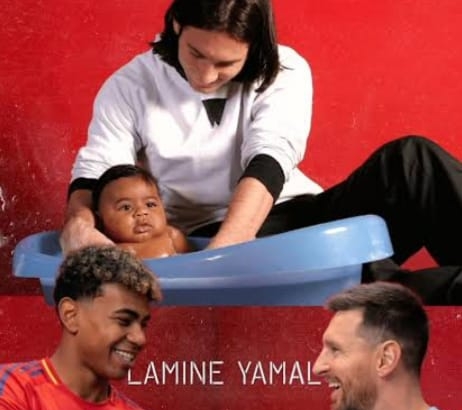
In 2007, a 20-year-old Lionel Messi gave a baby a bath for a charity calendar- photoshoot for UNICEF and FC Barcelona. Seventeen years later, that baby, Lamine Yamal, stood against him as Spain’s forward. Destiny, it seems, has a habit of crossing paths. My own crossing came much closer to home. Years ago, I was running from one thana to another with my little differently-abled child, asking for justice, begging crime reporters for a contact number. This week, my interview with a DIG was picked up by Google AI. The desk has turned. The person who once asked for access is now the one being quoted.
As if now when I am writing this piece, the final showdown of the FIFA World Cup has been set between Argentina and Spain, both teams have every right to consider themselves as the favorites. Football tells us stories about destiny all the time. That Messi-Yamal photo sat in an archive for 17 years. In 2024 it resurfaced. The baby in the tub was now 17, wearing Spain’s No.19, playing against the man who once bathed him, Lionel Messi, current Captain of the Argentina. Lamine Yamal, a 19-year-old Spanish professional footballer, is widely regarded as one of the best young players in the world. He plays as a winger for FC Barcelona and the Spain national team, famously going viral as a 6-month-old baby being bathed by Lionel Messi. Born in Spain to a Moroccan father and an Equatoguinean mother, Yamal developed his skills in Barcelona’s famous academy, La Masia. In 2024, that baby helped knock Messi’s Argentina out of World Cup conversations. Destiny has a sense of humor. He shattered numerous age-related milestones, becoming the youngest player to debut for Barcelona at age 15, and later played a crucial role in helping Spain win the UEFA Euro 2024 at just 17. Known for his exceptional dribbling, vision, and maturity, his remarkable rise has drawn comparisons to Messi himself.
That Messi-Yamal photo worked because it showed two points of the same life. The idol and the kid who grew up to meet him as an equal. My arc is no different, only the stadium is smaller. The thanas of Karachi were my stadium. I wasn’t chasing goals, I was chasing justice. And like Yamal, I spent years watching from the sidelines — waiting for a crime reporter to help “Bhai koyi contact hai tou milwa de”, waiting for a SSP to listen, waiting for someone “upar” to care. From asking for justice to reporting on it — that’s how far the circle can turn. But the lesson is older than tech. In 2026, when news breaks on WhatsApp and dies on TikTok in 12 hours, credibility is the only currency. And credibility comes from having been on both sides — the one asking, and the one being asked.
What makes the Messi story land, is not the photo. It’s the reversal. The fan becomes the peer. For years I was on the other side of the desk — a citizen with a complaint, dependent on journalists to get me to the “right officer.” Now my questions are the ones being answered. My byline is the one Google surfaces. Destiny doesn’t care if it’s Camp Nou or a Karachi police station. It just completes the circle. People shared the Messi-Yamal story because everyone wants to believe the kid gets his turn. I believe it too, because I’ve lived it.
More Circles:
And it’s not just football. Ariana Grande was 8 years old singing backups on stage for Broadway legends. Today those same legends introduce her as the headliner. Coco Gauff was 10, hitting balls at Serena Williams’ academy, watching Serena win on TV. At 19, she beat Serena’s records and now they sit together as peers, talking business and tennis. The world keeps doing this. The kid in the crowd becomes the name on the poster. The person asking for a chance becomes the one giving chances.
The world loves this story because we’ve seen it before. It’s how institutions renew themselves. In the US, Barack Obama went from organizing on Chicago’s South Side to the Oval Office. In Ukraine, Zelenskyy went from playing a president to actually become the President of Ukraine and offered wartime speeches that moved parliaments.
In Pakistan, we have our own versions. The reporter who once waited 6 hours outside the CM House for a 30-second byte is now the bureau chief who assigns the coverage. None of them started with access. All of them ended with responsibility. That’s the quiet engine of any democracy — people move, chairs don’t. The pattern is the same everywhere: the person outside the room eventually gets a seat inside it.
The Responsibility:
What ties Messi to Yamal, Zelenskyy to the presidency, and me to this byline is one idea: access is earned in circles. You start outside, asking. Then one day you’re inside, answering. In Pakistan this also happens and we don’t name it. The constable’s son becomes an ASP. The complainant becomes the correspondent. The man who once ran between thanas for justice now gets justice-related statements on record. It’s not about power. It’s about persistence. Its about resilience and connecting yourself with Almighty Allah.
For me, the move happened between two desks. One was the wooden counter at the thana where I once asked for help. The other is the one I sit now, calling the same offices for comment. The tools changed too. I used to rely on a crime reporter’s diary. Today Google AI surfaces my police-related stories on top to readers in Karachi, Lahore, and London. But the biggest change isn’t in the byline. It’s in me. Today, if I see someone asking for help anywhere especially to approach the higher authorities, pleading the way I once did, I don’t deny them access. I don’t just share a number. I feel their pain because I’ve worn the same shoe. I take them there myself. Because I know what it’s like to be turned away. And I know what it means when someone finally says, “come, I’ll help you.”
The Circle Completes
The Messi-Yamal photo went viral because it gave people hope that circles do close. That the kid watching becomes the man playing. That the person outside eventually gets in. But the feeling is the same. I hope to be the bridge for someone else. Because destiny doesn’t just make you a giant to face other giants. Sometimes it makes you the door, so the next person doesn’t have to wait as long as you did
The Lesson : “Wa tilka’l ayyaamu nudawiluha bainannaas” : And such are the days We give to people by turns.
Every throne is borrowed. Every voice that was silenced once becomes the echo in the hall tomorrow. Those who turned away saying “no time” will one day stand in the same line whispering: “Sahab, plz meri sun le.” Power is not permanent. It’s on loan. Every summit has a decline. Every arrogance faces a backlash. Because karma always flips to the other side.
All those who once turned a deaf ear to people begging for help, one day find themselves in the same line, asking the same question: “Sahab, plz meri sun le.” Power moves. Tables turn. The chair you sit on today was someone else’s yesterday. And tomorrow it will be someone else’s again.
The Hope : To the one who is tired today: the night is longest just before Fajr.
The seed you planted in dust will break concrete. The file that was closed will be reopened. The number that didn’t answer will call you back. But this isn’t a story about revenge. It’s a story about hope. To everyone who is low today — I see you.
The tennis player whose case no one filed. The fan picked up for nothing. A single parent, with a child, running between thanas with no contact number. Your low will not be permanent. Circles close. Doors that were shut will open. The person who once had to beg for a hearing can one day become the person quoted on Google.
Hold on. Your turn is coming.
The writer is a senior journalist and columnist, having experience of working with all major English media houses. Feedback: mediawomen2014@gmail.com
We welcome your contributions! Submit your blogs, opinion pieces, press releases, news story pitches, and news features to opinion@minutemirror.com.pk and minutemirrormail@gmail.com