Summary
- So the question Pakistan must now ask is not why young people are becoming critical of the Army.
- People are increasingly separating the Army as a national defence institution from the military establishment as a political power.They can love the soldier and question the general.
- That is not necessarily a threat to the Army.If handled wisely it could become an opportunity for the institution to recover something far more valuable than,fear,Respect,because fear can make people obey.Only respect makes people salute.
There was a time in Pakistan when the uniform of the Pakistan Army carried an almost extraordinary emotional value. People did not merely respect their soldiers. They admired them. Soldiers returning from the borders were welcomed with pride. Officers were treated with exceptional respect. In many parts of the country people would salute soldiers when they passed by. The Army was seen not only as an institution of national defence but as a symbol of sacrifice discipline honour and patriotism.
For generations the dream of many young Pakistani men was to wear that uniform. Young boys grew up imagining themselves becoming officers. Families proudly encouraged their sons to appear for the military selection process. Increasingly young women also aspired to join the armed forces and serve the country as officers. The military academies carried enormous prestige and being selected for the Pakistan Army was considered an achievement not only for an individual but for the entire family.
This was not simply manufactured loyalty. There was genuine affection for the institution. Pakistan’s wars and national crises reinforced the image of soldiers as defenders of the country. The ordinary Pakistani citizen generally saw the soldier standing at the border rather than the soldier standing inside a political confrontation. So the question Pakistan must now ask is not why young people are becoming critical of the Army. The deeper question is what happened to the affection and admiration that once existed between the institution and society.
How did admiration turn into suspicion? How did respect begin turning into fear?
And how did fear eventually begin turning into defiance?
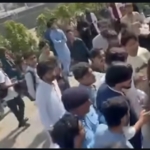
The recent incident at Sarhad University is significant precisely because it represents this changing psychology. According to reports circulating from the campus a serving lieutenant colonel became involved in a confrontation with students. Videos and reports allege that students were beaten with a stick and that shots were fired into the air. The incident generated an unusually strong reaction from students and has subsequently led to an inquiry and action against the officer.
The incident itself will have to be investigated properly and responsibility established according to law. But the reaction of the students deserves attention because it reflects something much bigger than one confrontation.
A generation that once regarded the military uniform with awe is increasingly willing to question the person wearing it. That is a profound psychological transformation.
Pakistan’s civil military relationship has been changing for several years. The political crisis that began around the removal of Imran Khan in 2022 and the subsequent confrontation between the state and Pakistan Tehreek e Insaf created an unprecedented level of political polarisation. Arrests political restrictions allegations of enforced disappearances restrictions on media political cases and the events surrounding May 9 created an atmosphere in which a large part of society began questioning the role of the military in politics.
Whether every allegation made by political actors is correct is another matter. What cannot be denied is that the perception of the institution has changed among a significant section of the population. And perception is political power. The most important change may have taken place among the young.
Today’s Pakistani youth did not grow up in the information environment of previous generations. They have smartphones, social media independent digital channels and access to information that cannot easily be controlled by television networks or official statements. They record events themselves. They circulate videos themselves. They challenge official narratives themselves.
A young Pakistani who sees an incident involving a uniformed officer no longer has to wait for the evening news to decide what happened. The video can reach millions before the official version appears. This has fundamentally altered the relationship between authority and society.
For decades fear was an important element of political control in Pakistan. People knew that certain institutions possessed extraordinary power and therefore chose their words carefully. Journalists, politicians, students activists and ordinary citizens often understood that there were subjects about which it was safer not to speak. But fear has a limit.
When fear is combined with prolonged political frustration it can eventually produce the opposite of what those in power expect. It can produce defiance.
A citizen may remain silent for years because he is afraid. But if he begins to believe that silence will not protect him from arrest, humiliation , economic pressure or political persecution then the calculation changes.
He may begin to think that there is nothing left to lose.That is the point at which fear begins to disappear. This does not mean that Pakistanis have suddenly stopped respecting their Army. That would be an oversimplification. Millions of Pakistanis continue to respect soldiers and recognise the sacrifices made by military personnel defending the country’s borders. The distinction that is emerging is much more important.
People are increasingly separating the Army as a national defence institution from the military establishment as a political power.They can love the soldier and question the general.
They can respect the uniform and still demand accountability from the person wearing it.
They can believe in national defence while opposing military interference in political affairs.
That distinction could become one of the most important political developments in Pakistan’s future.
The problem for any powerful institution is that authority cannot survive indefinitely on coercion alone. It requires legitimacy.
A soldier may be able to command obedience because he carries a weapon. But an institution earns lasting respect because citizens believe that its power is being exercised fairly and constitutionally. This is where the real crisis lies.
The danger is not necessarily that Pakistan’s Army is losing its military strength. It remains one of the country’s most powerful institutions. The danger is that it may be losing some of the emotional legitimacy that once came almost automatically with the uniform. That loss is much harder to reverse.
Once a child stops seeing a soldier as a hero and begins seeing him primarily as an instrument of political authority the relationship between society and the institution changes fundamentally. This is why incidents involving students are particularly sensitive.
Universities are where Pakistan’s future is being shaped. The students sitting in those classrooms will become lawyers journalists judges civil servants businessmen academics politicians and perhaps soldiers themselves.
If they develop the belief that authority is above accountability then the country inherits a culture of confrontation.
If instead they learn that even the most powerful institution must answer to the law then Pakistan has an opportunity to rebuild its democratic foundations. The response to incidents such as Sarhad University therefore matters enormously.
If an officer is accused of misconduct the investigation must be transparent. If the officer is found responsible he should face the law. If students have committed violence they should also face the law.
The principle must be identical for everyone. The uniform cannot provide immunity. The student protest cannot provide immunity either. Only the Constitution and the law should determine responsibility. Pakistan now stands at an important crossroads.
The decline of fear can become a democratic awakening or it can become a dangerous descent into violence.
If young people lose fear but gain faith in constitutional institutions then the country can emerge stronger. If they lose fear but also lose faith in courts, parliament elections, media and law then anger can turn into street justice and institutional confrontation.That is the real danger.
The solution is therefore not to restore fear.The solution is to restore trust. Pakistan does not need a population that is afraid of its Army. It needs a population that respects its Army because it believes that the institution respects the Constitution and the people.
There was a time when Pakistani families dreamed of seeing their children in military uniform because that uniform represented honour sacrifice and service to the nation.
The question before the institution today is how to make that uniform represent those things again.The answer cannot be censorship. It cannot be intimidation.It cannot be political engineering.
And it cannot be forced. It has to be accountability, discipline, professionalism and constitutional restraint.
Perhaps this is the real message coming from Pakistan’s universities today. The younger generation is not necessarily rejecting the soldier. It is rejecting the idea that the uniform should place anyone beyond questioning.
That is not necessarily a threat to the Army.If handled wisely it could become an opportunity for the institution to recover something far more valuable than,fear,Respect,because fear can make people obey.Only respect makes people salute.
Urooj Raza Sayyami.
We welcome your contributions! Submit your blogs, opinion pieces, press releases, news story pitches, and news features to opinion@minutemirror.com.pk and minutemirrormail@gmail.com