Summary
- The events began with separate complaints and allegations on August 21 and culminated on August 24 in a confrontation at Sarhad University’s Rawat campus, where a serving Army officer was reportedly involved in an altercation with students and allegedly fired shots into the air.
- At the same time, police are investigating allegations against students involved in the campus confrontation.
- Police must determine whether students attacked or threatened Dr Aina, the Army officer or any other individual.
ISLAMABAD: A series of incidents reported over three days in Islamabad and Rawat has triggered questions about institutional accountability, harassment complaints, student protests, alleged mob violence and the use of force.
The events began with separate complaints and allegations on August 21 and culminated on August 24 in a confrontation at Sarhad University’s Rawat campus, where a serving Army officer was reportedly involved in an altercation with students and allegedly fired shots into the air.
The Pakistan Army has confirmed that the officer was taken into military custody and that a strict inquiry and court-martial proceedings have been initiated.
At the same time, police are investigating allegations against students involved in the campus confrontation. Universities are also conducting internal inquiries into earlier complaints and administrative decisions.
The events have generated competing narratives on social media. Some posts have focused on alleged harassment and the treatment of a female faculty member, while others have questioned the officer’s decision to enter the campus armed and his alleged use of a firearm.
Because several allegations remain under investigation, the circumstances surrounding the incidents cannot yet be treated as conclusively established.
The first complaints
On August 21, a handwritten complaint was reportedly submitted to the Station House Officer of DHA Police Station in Islamabad by Dua Atta.
The complaint alleged that an 18-year-old individual, identified as Abuwan Khan, had threatened and verbally abused her over the telephone.
According to the complaint, the individual allegedly visited her residence, banged on the door and continued to use abusive language. The complainant also alleged that her father was threatened when he returned home.
The complaint requested police intervention to prevent any further incident.
As of August 25, there was no publicly confirmed information that an FIR had been registered in the matter. The complaint was reportedly under investigation.
A separate dispute at SUIT
Another development surfaced on the same day involving the Superior University Islamabad campus.
A written apology attributed to Dr Jadon Khan Afridi, described as Head of Allied Health Sciences, was circulated. The letter was addressed to Dr Ana Atta and expressed an apology for what the writer described as inappropriate behaviour.
The document has circulated online, but the university has not publicly issued a detailed statement confirming the circumstances surrounding the letter.
Social media users have attempted to connect the individuals mentioned in the SUIT material with people involved in the later Sarhad University dispute. However, those identities and connections have not been independently established by official statements from the institutions concerned.
Leaked faculty WhatsApp conversation


A WhatsApp conversation described as belonging to the “Faculty SUIT Islamabad” group has also circulated.
The conversation contains allegations by Dr Ana Atta concerning interactions between faculty members, students and university administrators.
In the messages, Atta alleged that students were being used in disputes between adults and accused Dr Jadon Khan of involving students in conflicts with faculty members.
She referred to several students by name and alleged that they had been involved in incidents surrounding meetings and administrative disputes.
The messages also referred to a meeting near the campus director’s office and raised questions about whether students had been called without proper permission.
Other allegations in the conversation included claims that rumours about the university’s registration had been circulated and that fee vouchers had allegedly been collected from students.
A lecturer identified as Dr Jawad Azam responded in the conversation, stating that he had not been the class teacher of one of the students mentioned and had not interacted with him.
The leaked conversation provides one side of an internal dispute. Its authenticity, full context and the accuracy of the allegations would require independent verification.
Developments at Sarhad University
The dispute later moved to Sarhad University’s Rawat campus.
According to reports, Dr Jadoon Khan, a former head of the Allied Health Sciences department, had been suspended following allegations that included corruption and harassment of female students.
Dr Aina was subsequently appointed to a leadership position in student affairs.
A complaint concerning alleged harassment was reportedly filed against Dr Jadoon. Police were also contacted through the emergency helpline.
The suspension reportedly led to protests by students who demanded his reinstatement.
According to accounts circulating about the August 24 incident, Dr Aina went to the campus area where students were protesting.
Reports allege that tensions escalated and that a student grabbed her by the collar and threatened her. These allegations remain subject to investigation.
Arrival of the Army officer
Dr Aina’s husband is described as a serving lieutenant colonel in the Pakistan Army.
According to police accounts cited in connection with the incident, he arrived at the university after being contacted by his wife. Reports state that he had initially come to the area to drop off his daughter.
The situation allegedly became tense after remarks or catcalls directed toward the family.
An altercation subsequently took place.
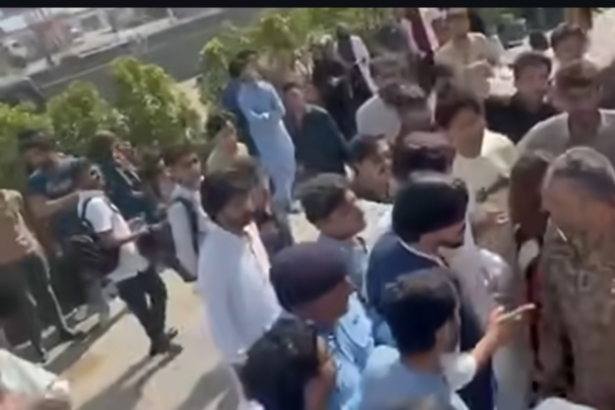
Videos circulating online appear to show a group of students surrounding the officer and a physical confrontation. Other footage has been interpreted as showing pushing and the officer falling or being surrounded.
Police sources have alleged that the officer fired shots into the air during the confrontation.
The exact sequence of events, including what happened immediately before the firing, remains a matter for investigators to establish.
Students identified by police
Police have reportedly identified 37 students through available video footage for questioning or investigation in connection with the incident.
Authorities have alleged that some individuals were involved in assaulting the officer and others. Claims have also surfaced regarding the use of punches, elbows and iron rods.
One student was reportedly arrested from a hostel and was alleged to have played a leading role in the protests supporting the suspended faculty member.
However, allegations against individual students must be established through investigation and due legal process.
Army orders inquiry
The Pakistan Army’s media wing, the Inter-Services Public Relations (ISPR), said the officer had been taken into military custody.
According to the statement, a strict inquiry and court-martial proceedings were initiated.
The Army also emphasised its policy of accountability and stated that misuse of official authority or weapons would not be tolerated.
The military inquiry is expected to determine whether the officer breached military discipline or relevant laws by entering the campus with a weapon and allegedly firing it.
The proceedings will also have to establish the circumstances that led to the confrontation.
Police investigation
Islamabad Police have said that the facts surrounding the incident are still being established.
Police sources have described the officer’s reaction as an emotional response to alleged catcalling involving his daughter.
Authorities have urged caution against drawing conclusions before the investigation is completed.
The police are reportedly reviewing available videos and other forensic material to determine the involvement of individuals present at the scene.
Statements from witnesses and those directly involved are also expected to form part of the investigation.
University inquiries
Sarhad University has reportedly constituted an internal inquiry committee and is cooperating with law enforcement agencies.
The university’s investigation is expected to examine the events leading to the confrontation, the student protest, the presence of the suspended faculty member and the response of campus administration.
Questions have also been raised about whether sufficient security arrangements were in place and why tensions were allowed to escalate.
The earlier dispute at SUIT has generated separate questions about workplace conduct, administrative procedures and the handling of harassment complaints.
Competing narratives
The incident has produced sharply different interpretations.
One narrative focuses on the alleged harassment and intimidation of a female faculty member. Supporters of this position argue that the original complaint and alleged assault should not be overshadowed by the subsequent firing incident.
Another narrative focuses on the Army officer’s conduct and questions whether he had the authority to enter the campus armed or respond to the confrontation by allegedly firing his weapon.
A third line of discussion concerns the role of students and whether a campus protest was allowed to escalate beyond peaceful demonstration.
Social media has further complicated the situation. Hashtags supporting the officer have circulated, while other users have criticised his alleged use of force.
Claims have also circulated linking student activists with political organisations and portraying certain individuals as organisers of the protest. These claims have not been independently established and should not be treated as facts without evidence.
Four investigations need to be separated
Legal and institutional questions arising from the incident fall into several distinct areas.
First is the harassment inquiry. Allegations against Dr Jadoon need to be investigated through the relevant university and legal mechanisms.
Second is the alleged assault at the campus. Police must determine whether students attacked or threatened Dr Aina, the Army officer or any other individual.
Third is the alleged use of a firearm. The military and relevant civilian authorities must establish whether the officer violated military discipline or criminal law by allegedly firing into the air.
Fourth is institutional responsibility. Universities need to determine whether their procedures were followed when handling complaints, suspending faculty, managing protests and protecting staff and students.
These issues should be investigated separately rather than being combined into a single narrative.
Questions for institutions
The events have raised several questions for university administrators and law enforcement agencies.
Why was a protest allowed to develop near sensitive administrative areas?
Were appropriate security arrangements in place?
How was the original harassment complaint handled?
Was the suspended faculty member permitted to participate in or lead a campus protest?
Why did the confrontation escalate despite the presence of university officials?
Why did an armed military officer enter the campus?
And could stronger institutional intervention have prevented the confrontation?
The answers to these questions will depend on evidence collected by the relevant authorities.
What happens next
The Army’s court-martial and inquiry process will determine the officer’s responsibility, if any, under military law.
Police will continue examining video footage, witness statements and other evidence before determining the appropriate legal action against students or other individuals.
The universities are expected to complete their internal inquiries into the harassment allegations and administrative decisions.
The earlier DHA complaint may also lead to further legal proceedings if investigators find sufficient evidence.
For now, the competing claims remain under investigation.
The events of the past few days demonstrate how quickly disputes involving harassment allegations, student protests and institutional failures can escalate into serious confrontations.
The central issue now is not which narrative dominates social media, but whether the relevant institutions can establish the facts through transparent investigations.
Any person accused of harassment, assault, intimidation or misuse of force should be judged on evidence and through due process.
We welcome your contributions! Submit your blogs, opinion pieces, press releases, news story pitches, and news features to opinion@minutemirror.com.pk and minutemirrormail@gmail.com