Summary
- A 29-year-old doctoral student, Neha Bora, has emerged as a prominent figure in India’s growing youth protest movement, drawing attention through her speeches, repeated detentions and calls for government accountability.
- Her rise comes as student activists and young demonstrators raise concerns over alleged electoral irregularities, examination paper leaks and unemployment.
- Bora’s growing prominence reflects wider frustration among sections of India’s youth over several issues, including alleged examination paper leaks, limited employment opportunities and police action against demonstrators.
A 29-year-old doctoral student, Neha Bora, has emerged as a prominent figure in India’s growing youth protest movement, drawing attention through her speeches, repeated detentions and calls for government accountability. Her rise comes as student activists and young demonstrators raise concerns over alleged electoral irregularities, examination paper leaks and unemployment.
Bora, the national president of the All India Students’ Association (AISA), was among several activists detained over the weekend as authorities moved to prevent demonstrations led by the youth group known as the Cockroach Janta Party. The protesters are demanding the removal of India’s chief election commissioner, alleging widespread irregularities in voter records that they say have undermined the electoral process.
The Election Commission has denied favouring any political group, while the ruling Bharatiya Janata Party (BJP) has accused its opponents of attempting to discredit legitimate electoral procedures.
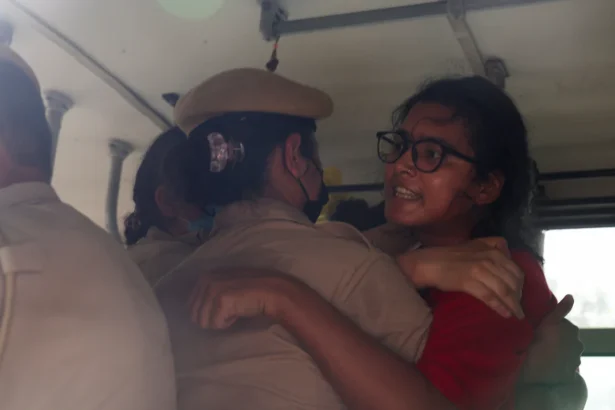
Despite her detention, Bora urged demonstrators to continue their protest. After police blocked their route to Jantar Mantar, a designated protest site in New Delhi, she called on supporters to gather at Dilli Haat, a craft market in the capital.
“Dilli Haat becomes Jantar Mantar today,” she wrote on social media before joining the demonstrators. Police subsequently detained her alongside other activists. However, she continued encouraging protesters through a video message recorded during her detention.
“I am in detention. The movement is not,” she said, urging supporters to continue demonstrating even if authorities prevented them from gathering at their planned locations. She was released later that day.
Bora’s growing prominence reflects wider frustration among sections of India’s youth over several issues, including alleged examination paper leaks, limited employment opportunities and police action against demonstrators. Her speeches, delivered in Hindi and English, frequently focus on constitutional rights, social inequality and the need for greater accountability from public institutions.
Born in the Himalayan state of Uttarakhand, Bora spent much of her childhood moving between places because her father served in the Indian Army. She later studied at Delhi University before beginning doctoral research at Jawaharlal Nehru University’s School of Arts and Aesthetics.
Her political journey began gradually rather than through an immediate decision to enter activism. As an undergraduate, she joined a theatre group, where she learned to understand people with different backgrounds and perspectives. She has said that theatre helped her recognise the experiences and circumstances that shape people’s beliefs and behaviour.
A significant turning point came during protests against India’s citizenship law in 2019 and 2020. Critics of the legislation argued that it discriminated against Muslims. Bora said the student demonstrations of that period showed her how ideas explored through books, films and documentaries could translate into collective political action.
She attracted wider attention during protests in July over alleged examination paper leaks. Joining other student activists, she called for the education minister’s resignation and criticised the government’s response to demonstrators. Videos of her speeches at Jantar Mantar subsequently circulated widely online, increasing her public profile.
Since then, Bora has become a regular presence at demonstrations in New Delhi. Her repeated detentions during protests demanding the resignation of Chief Election Commissioner Gyanesh Kumar have further raised her visibility among student activists.
Bora believes the current demonstrations cannot be explained by political ideology alone. She argues that years of accumulated frustration and disappointment have encouraged young people to speak out, while growing confidence has helped sustain their participation.
“Fear is infectious, of course. But hope is also infectious,” she said, describing the sense of possibility motivating demonstrators.
We welcome your contributions! Submit your blogs, opinion pieces, press releases, news story pitches, and news features to opinion@minutemirror.com.pk and minutemirrormail@gmail.com