Summary
- BEIJING: The five-day World Humanoid Robot Games have begun in Beijing, bringing together humanoid robots to compete in sporting events as well as tasks designed to replicate real-world working environments.
- On Saturday, two humanoid robots reportedly completed the 100-metre sprint in times faster than Usain Bolt’s human world record of 9.58 seconds.
- However, he stressed that the long-term importance of humanoid robots would depend on their ability to solve genuine problems in real-world environments.
BEIJING: The five-day World Humanoid Robot Games have begun in Beijing, bringing together humanoid robots to compete in sporting events as well as tasks designed to replicate real-world working environments. The event, which started on Saturday, highlights China’s growing ambitions in robotics and artificial intelligence.
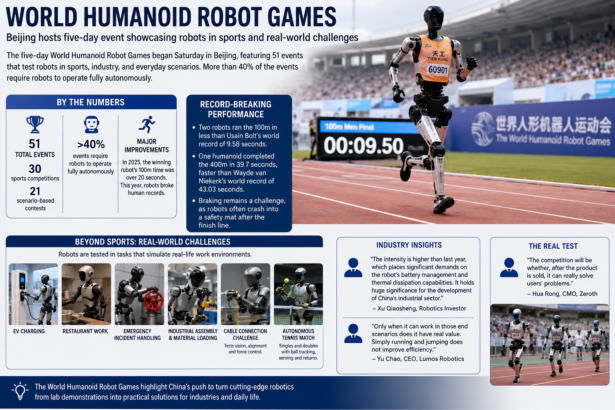
The games feature **51 events**, including 30 competitions based on traditional human sports and 21 scenario-based challenges. These practical contests are designed to test how robots perform in environments similar to factories, restaurants, offices and emergency situations. According to Huawei, a technology partner of the event, more than 40 percent of the competitions require robots to operate completely autonomously without direct human control.
The sporting events have already produced striking results. On Saturday, two humanoid robots reportedly completed the 100-metre sprint in times faster than Usain Bolt’s human world record of 9.58 seconds. The improvement was significant compared with last year, when the fastest robot took more than 20 seconds to finish the race.
However, the robots still faced difficulties with controlling their movement after reaching the finish line. Several machines struggled to stop and crashed into a thick safety mat positioned a few metres beyond the finish line.
Another humanoid robot, using the same model as the 100-metre champion, completed the 400-metre race in **39.7 seconds**. That time was considerably faster than South African athlete Wayde van Niekerk’s human world record of 43.03 seconds.
Robotics investor and spectator Xu Qiaosheng said this year’s competition was more demanding than the previous edition. He noted that the increased intensity placed greater pressure on robots’ battery management and ability to control heat generated during operation. According to Xu, the event could have major implications for the development of China’s industrial robotics sector.
Beyond speed and athletic performance, many competitions are focused on practical capabilities. Robots are being tested on their ability to recognise objects, position their hands and bodies accurately, apply controlled force and recover from mistakes without human assistance.
Lumos Robotics Chief Executive Yu Chao said the games could contribute to improvements in robotic hardware while giving companies an opportunity to demonstrate their technologies. However, he stressed that the long-term importance of humanoid robots would depend on their ability to solve genuine problems in real-world environments.
The games therefore include challenges such as electric-vehicle charging, restaurant operations, emergency response, industrial assembly and material loading. A cable-connection challenge, for example, requires robots to combine visual recognition with precise mechanical alignment and force control.
Beijing-based robotics startup Galbot is also scheduled to demonstrate an autonomous humanoid tennis match. The robots will attempt both singles and doubles matches while performing tasks such as tracking the ball, serving and returning shots.
For Hua Rong, chief marketing officer of robotics company Zeroth, the most important test will begin after the competition ends. She said the true measure of success will be whether commercially available robots can genuinely solve customers’ problems once they are deployed.
The World Humanoid Robot Games thus go beyond entertainment. While spectacular races and sports demonstrations attract public attention, the event is ultimately aimed at testing whether humanoid robots can move from impressive demonstrations to practical tools capable of improving productivity and efficiency in everyday industries.
We welcome your contributions! Submit your blogs, opinion pieces, press releases, news story pitches, and news features to opinion@minutemirror.com.pk and minutemirrormail@gmail.com