Summary
- NEW DELHI: Chinese President Xi Jinping arrived in New Delhi on Saturday for a crucial BRICS summit, where wars, energy insecurity and global trade tensions are expected to dominate discussions while his visit also signals a cautious thaw in relations between China and India.
- His visit is being closely watched because it is his first trip to India since 2019 and comes as Beijing and New Delhi attempt to stabilise relations following years of tension.
- Iranian President Masoud Pezeshkian also arrived in New Delhi and held talks with Modi.
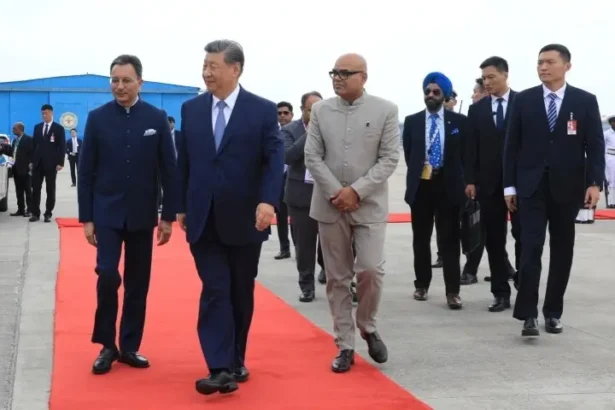
NEW DELHI: Chinese President Xi Jinping arrived in New Delhi on Saturday for a crucial BRICS summit, where wars, energy insecurity and global trade tensions are expected to dominate discussions while his visit also signals a cautious thaw in relations between China and India.
Xi received a red-carpet welcome after arriving in the Indian capital, where soldiers formed an honour guard and traditional performers greeted the Chinese leader. His visit is being closely watched because it is his first trip to India since 2019 and comes as Beijing and New Delhi attempt to stabilise relations following years of tension.
The two-day gathering brings together leaders and senior officials from the expanded 11-member BRICS grouping at a time when the bloc faces deep differences over major international conflicts.
The wars in the Middle East and Ukraine, energy security and continuing turbulence in global trade are expected to dominate the summit agenda. However, Xi’s meetings with Indian Prime Minister Narendra Modi are likely to receive equal attention as the two Asian powers seek to manage their long-running disputes.
China-India thaw under pressure
Relations between Beijing and New Delhi deteriorated sharply after a deadly military confrontation along their disputed Himalayan border in 2020.
Since then, both sides have gradually taken steps to improve ties, including restoring flights, easing visa arrangements and increasing high-level diplomatic contacts. China said on Friday that it was ready to strengthen communication with India, expand cooperation and properly manage differences.
Yet the fundamental territorial dispute remains unresolved.
China and India continue to maintain significant military deployments along their roughly 3,500-kilometre high-altitude frontier, with mistrust also fuelled by economic tensions and strategic competition.
Xi and Modi were expected to hold face-to-face talks on Saturday. Analysts say border stability is likely to be among the most important issues on their agenda.
Pradeep Taneja, a China-India expert at the University of Melbourne, said the two governments were seeking an “early and substantial harvest” on the border question, while warning that military tensions could not easily coexist with ambitions for stronger economic and people-to-people ties.
The atmosphere around Xi’s visit has also highlighted unresolved political sensitivities. Dozens of Tibetans protested in New Delhi on Friday, opposing the Chinese president’s visit. India has hosted the Dalai Lama and a large Tibetan exile community since he fled China in 1959.
Wars reshape BRICS agenda
While the China-India relationship is a major focus, the broader geopolitical environment could prove even more difficult for BRICS.
Indian Prime Minister Narendra Modi has maintained relations with both Russia and the West while also engaging with Iran and other regional powers.
Modi met Russian President Vladimir Putin on Friday, embracing him before talks. Russia remains an important strategic and energy partner for India, particularly as the country deals with the energy crisis linked to the US-Iran war.
Iranian President Masoud Pezeshkian also arrived in New Delhi and held talks with Modi. Pezeshkian said pressure on Tehran had reached a “critical and dangerous stage” following what he described as US and Israeli military aggression.
India’s position is particularly delicate because it maintains relations with Iran, Israel, Russia and the United States, forcing New Delhi to carefully balance competing strategic interests.
Can BRICS find common ground?
BRICS was established in 2009 to give major emerging economies a stronger collective voice in global institutions traditionally dominated by Western powers. Its expansion has increased its economic and political reach, but it has also made consensus more difficult.
Modi told leaders that BRICS countries represent around half of the world’s population and a substantial share of global economic output.
The grouping now includes countries such as Iran, Saudi Arabia and the United Arab Emirates, whose positions on the Middle East conflict are not identical.
Senior representatives from Saudi Arabia, the UAE and Egypt are also expected at the summit, while Brazil is represented by Foreign Minister Mauro Vieira.
BRICS foreign ministers failed to agree on a joint statement during their May meeting in New Delhi, underlining the difficulty of reaching consensus on contentious geopolitical issues.
Analyst Harsh V Pant of India’s Observer Research Foundation described the Gulf conflict as a major fault line for the summit, arguing that the bloc’s expansion, once viewed as an achievement, could now become a constraint.
With Xi’s arrival, the BRICS summit has therefore become more than an economic gathering. It is a test of whether a diverse coalition of emerging powers can find common ground while wars and rivalries pull its members in opposite directions.
We welcome your contributions! Submit your blogs, opinion pieces, press releases, news story pitches, and news features to opinion@minutemirror.com.pk and minutemirrormail@gmail.com