Summary
- *THE CHART:* Title: Child Stunting in Pakistan – Share of children under five who are stunted, by district Sources: MICS provincial 2016-17 to 2020-21, NNS 2018, NFHS-5 2019-21 IIOJK, WHO 2006 growth standard.
- Without improvements in education, healthcare and nutrition, Pakistan could not compete effectively in the global economy.” – He termed unchecked population growth and stunting a “national emergency” and “national security threat” saying “The fact that we have sustained a 40% stunting rate over the past 40 years while our peer countries have progressed is a national failure.” – “Stunting is not just a health issue.
- – “Every child should receive essential healthcare from birth, including the recommended 13 childhood vaccine doses.” *EXPERT VIEW & BACKGROUND:* Nutrition experts say 60% of children in Pakistan lack access to standard quality food, leading to chronic stunting.
ISLAMABAD : A comprehensive district-wise chart on child stunting obtained by Minute Mirror has triggered a national conversation, with policymakers including FBR Chairman Rashid Mehmood Langrial, Planning Minister Prof. Ahsan Iqbal, and Health Minister Syed Mustafa Kamal warning of long-term consequences for Pakistan’s economy and human capital.
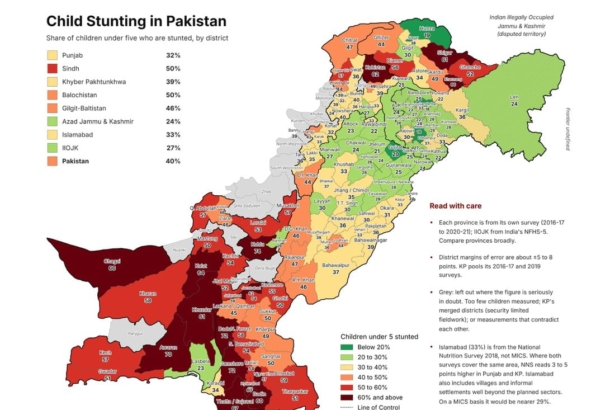
*THE CHART:*
Title: Child Stunting in Pakistan – Share of children under five who are stunted, by district
Sources: MICS provincial 2016-17 to 2020-21, NNS 2018, NFHS-5 2019-21 IIOJK, WHO 2006 growth standard.
*National & Provincial:*
Punjab 32%, Sindh 50%, Khyber Pakhtunkhwa 39%, Balochistan 50%, Gilgit-Baltistan 46%, Azad Jammu & Kashmir 24%, Islamabad 33%, IIOJK 27%, Pakistan 40%.
*District Extremes:*
– Above 60%: Chagai 66%, Kohlu 74%, Kalat 64%, Khuzdar 61%, Kharan 58%, Awaran 70%, Kech 57%, Gwadar 51%, Killa Saifullah 57%, Zhob 48%, Lasbela 23% (green), Q. Abdullah 57%, Loralai 53%, Qilla Saifullah, Mastung 50%, Kachhi 54%, Jhal Magsi 52%, Dera Bugti 47%, Musakhel 57%, Dera Ghazi Khan 46%, Rajanpur 47%, R.Y. Khan 46%, Dadu 72%, Jamshoro 72%, Tharparkar 51%, Thatta/Sujawal 60-67%, Qambar 72%, Sanghar 50%, Shigar 61%, Ghanch 52%, Hunza 19% healthy.
– Below 30% (Healthy): Hunza 19%, Nagar 19%, Leh 24% IIOJK, Kargil 36%, Muzaffarabad 17%, Jhelum Valley 13%, Bagh 15%, Poonch 18%, Kotli 13%, Bhimber 13%, Gujrat 20%, Gujranwala 25%, Sialkot 22%, Narowal 24%, Lahore 33%, Jhelum 21%, Chakwal 24%, Islamabad appears as 33% vs MICS 29%.
Legend: Below 20% dark green, 20-30% light green, 30-40% yellow, 40-50% orange, 50-60% red, 60%+ dark maroon. Grey = data in doubt.
*REACTION 1 – FBR CHAIRMAN RASHID MEHMOOD LANGRIAL:*
Sharing the chart, he wrote a detailed note titled “What we have already decided”:
“We speak of the future as if it were open. This map suggests otherwise. The children on it were under five when they were measured. In the 2040s they will run our farms, offices and factories; in the 2060s they will be the parents and taxpayers on whom an ageing country leans. Two in five of them are stunted. Whatever we choose to do now, for them this part of the future has already been decided, before they could choose anything.
A child’s height at two is a kind of ledger. It records, with no possibility of appeal, whether her mother ate, whether the water was clean, whether someone helped when she had diarrhoea, whether anyone thought she mattered enough to reach. The ledger in Gujrat reads one way. In Thatta it reads another. In Haripur and Kohistan, a hundred and fifty kilometres apart, the same province records two different countries.
We like to believe this is history, or geography, or poverty, things that happen to us. But the greenest districts were never the richest land. They were the places where girls went to school, where men found work beyond the village, where the state and the market arrived. The map is not a record of what nature gave us. It is a record of whom we chose to reach.
We are a society that discounts the future heavily. We defer, we borrow, we promise. But children cannot be deferred. The first thousand days do not wait for a better budget year.
Somewhere in Jamshoro a girl stunted in 2018 will be a mother by 2045. What we failed to give her, she will not be able to give her child. The question this map asks is not about them. It is about us.”
*REACTION 2 – PLANNING MINISTER AHSAN IQBAL:*
Federal Minister for Planning, Development and Special Initiatives Prof. Ahsan Iqbal has repeatedly raised alarm:
– “Around 25 million children are out of school in Pakistan, while the rate of child stunting stood at approximately 40 per cent. Without improvements in education, healthcare and nutrition, Pakistan could not compete effectively in the global economy.”
– He termed unchecked population growth and stunting a “national emergency” and “national security threat” saying “The fact that we have sustained a 40% stunting rate over the past 40 years while our peer countries have progressed is a national failure.”
– “Stunting is not just a health issue. It’s a reflection of failures in clean water access, sanitation, nutrition, education, and healthcare.”
– He called for establishment of dedicated task forces in all provinces to address anemia and child stunting on urgent basis, and for devolving authority to district and local governments.
– “Pakistan’s future depends on the health, education and quality of life of its people. Investing in health and development of women, girls and children is essential for building human capital.”
– “The first five years of a child’s life are critical for physical, cognitive and emotional development. The children growing up today would shape Pakistan in 2047.”
– He stressed early childhood development, quality education and investment in human resources as fundamental to future growth.
*REACTION 3 – HEALTH MINISTER MUSTAFA KAMAL:*
Federal Minister for Health Syed Mustafa Kamal:
– “Approximately 43 per cent of children suffered from stunting caused by malnutrition, affecting their physical and cognitive development and limiting their potential to contribute to the economy.”
– He said 68% of population is youth, but dividend can become liability. Population crossed 260 million with 2.5% growth and fertility 3.7%.
– “The health sector should not focus solely on treating patients or constructing hospitals but also ensure access to clean drinking water, timely vaccination, adequate nutrition and proper maternal care.”
– He highlighted “Many such deaths were linked to unsafe drinking water, infectious diseases, lack of vaccination and malnutrition.”
– He noted around 1,300 children under five die daily, about 10,000-11,000 mothers die annually during childbirth from preventable causes.
– “Every child should receive essential healthcare from birth, including the recommended 13 childhood vaccine doses.”
*EXPERT VIEW & BACKGROUND:*
Nutrition experts say 60% of children in Pakistan lack access to standard quality food, leading to chronic stunting.
NNS 2018 documented: Stunting 40.2% in sample of 76,000 children, wasting 17.7% highest ever measured and above WHO 15% emergency threshold, 28.9% underweight, 53.7% anaemia in children 6-59 months, 42% anaemia in women of reproductive age, 58% household water samples contaminated with coliform bacteria.
UNICEF data also puts stunting around 40% and wasting near 20%.
Determinants identified: short birth interval, maternal BMI, low birth weight, household wealth, mother education, improved water, hygiene, sanitation, food availability, gender equality.
Economic cost estimated $17 billion annually in lost productivity, cognitive loss, and health burden.
Government initiatives referenced: National Anemia Reduction Plan for Women, Adolescent Girls and Children 2025-2030, school feeding programs in Dera Ghazi Khan, Rajanpur, Muzaffargarh, Layyah and others, Benazir Income Support, provincial MICS and NNS surveys.
*BOTTOM LINE:*
The chart obtained by Minute Mirror shows stunting is not random but geographic and political. Where girls go to school and services reach, stunting falls below 20-30%. Where services fail, it crosses 70%. The first 1000 days cannot wait for better budget year.
We welcome your contributions! Submit your blogs, opinion pieces, press releases, news story pitches, and news features to opinion@minutemirror.com.pk and minutemirrormail@gmail.com