Summary
- There is a particular kind of stillness that settles over a government hospital waiting room by nine in the morning — not calm, but resignation.
- Waiting, in Pakistan, is not simply something that happens to citizens.
- Hours spent outside a district officer’s chamber, waiting for a signature or a seal, were not an unfortunate side effect of colonial administration — they were part of its architecture, a deliberate choreography of deference.
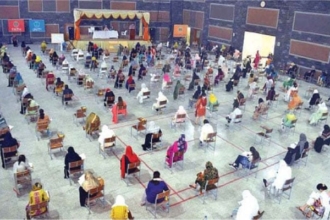
There is a particular kind of stillness that settles over a government hospital waiting room by nine in the morning — not calm, but resignation. Mothers with infants balanced on their hips, old men leaning on canes, clerks shuffling files behind a counter with the unhurried rhythm of people who know no one can make them move faster. Ask how much longer it will take, and the answer is always the same: “Just a little more, please sit.” That “little more” has a way of stretching into three hours. I have watched this scene repeat itself in banks, in passport offices, in the corridors outside magistrates’ courts, in the queues that form outside utility bill counters at the end of every month. And each time, the same question surfaces: when did we allow waiting to become a national temperament rather than an occasional inconvenience?
It is tempting to dismiss this as a minor administrative failing, the kind of friction every developing country lives with. But that framing lets the real issue slip away. Waiting, in Pakistan, is not simply something that happens to citizens. It is something that is done to them — deliberately, structurally, and with a logic that rewards those who administer the wait far more than it burdens them.
We are taught, almost from childhood, that patience is a virtue close to godliness — that the one who waits is never truly at a loss. There is nothing wrong with this teaching in itself. The trouble begins when the state and its institutions borrow this moral vocabulary and repurpose it as camouflage for their own inefficiency. When a citizen is made to stand for three hours to renew a document that should take fifteen minutes, he is quietly instructed to interpret his ordeal as a test of character rather than what it actually is: a failure of management dressed up as a lesson in humility. Patience, in this arrangement, stops being a private virtue and becomes a public punishment — one that falls almost exclusively on those without the means to escape it.
Because escape, of course, is available — just not equally. The waiting room is never actually classless. The person who can place a phone call to someone inside, who knows an official by first name, who can slip a note or a note of currency across a desk, does not wait at all. He walks past the queue as though it were scenery rather than a barrier. Meanwhile, the woman three hours into her wait with a sick child on her lap watches this happen and understands, perhaps for the first time that day, exactly where she stands in the order of things. The queue, then, is not simply about time lost. It is a daily, almost ritualistic demonstration of who matters and who does not. Every institution that runs on delay is, whether it intends to or not, running a small seminar in inequality.
The roots of this go back further than most of us are comfortable admitting. The colonial bureaucracy the British left behind in the subcontinent was never designed to serve the governed efficiently; it was designed to remind them, continuously, of their subordinate position. Hours spent outside a district officer’s chamber, waiting for a signature or a seal, were not an unfortunate side effect of colonial administration — they were part of its architecture, a deliberate choreography of deference. Independence changed the flags and the faces behind the desks, but it did not dismantle the choreography. If anything, the new local elite inherited the posture along with the paperwork, and found it just as useful for maintaining distance from the people they now governed in the name of self-rule. Walk into most government offices today and the message a citizen absorbs within the first five minutes is unmistakable: you are a supplicant here, not a rights-holder. The wait that follows is simply that message being enforced.
There is a psychological cost to all this that rarely makes it into policy discussions. A population trained, generation after generation, to expect delay eventually stops valuing time altogether — its own or anyone else’s. This is one reason, I suspect, why meetings in our part of the world so rarely begin when scheduled, why a “two o’clock” invitation is understood by everyone as a suggestion rather than a commitment. A society whose formal institutions treat citizens’ hours as worthless cannot be expected to treat time as precious in its informal life either. What begins as bureaucratic dysfunction hardens, over the years, into something closer to cultural instinct — and the economic cost of this instinct, multiplied across millions of citizens and millions of wasted hours, is almost certainly larger than we imagine. Economists who study developing economies have long argued that the aggregate hours lost to inefficient public administration represent a hidden tax on productivity — one that never appears on a balance sheet but shapes the trajectory of a nation as surely as inflation or debt.
None of this is to say waiting is inherently without value. Philosophically, there is a case to be made for its usefulness — that enforced stillness can produce reflection, that patience cultivated honestly can deepen character. The mystic traditions of this very region have long treated waiting as a spiritual posture rather than a punishment, the anticipation before union treated almost as sacred in itself. But there is a crucial distinction between that kind of waiting and the kind imposed at a government counter. One is chosen, entered into freely, its meaning constructed by the person experiencing it. The other is compulsory, stripped of any dignity or agency, its only purpose being administrative convenience. To collapse these two forms of waiting into one — to romanticize the queue as though it were a spiritual exercise — is to dress up exploitation in the language of virtue, and that is a sleight of hand worth resisting.
Technology is often offered as the solution, and it is not a trivial one. Token systems, appointment applications, digital verification — these have measurably improved certain services, and where they have been implemented seriously, citizens have felt the difference. But technology alone treats the symptom, not the disease. A faster queue is still a queue built on the assumption that the citizen’s time matters less than the official’s. Until that underlying assumption changes, digitization simply produces a more efficient version of the same indignity. Countries that have genuinely transformed their public service culture — Estonia is the example most often cited, having digitized nearly its entire government interface — succeeded not because they installed better software, but because they redefined what citizens were owed, and then built the software to deliver it.
Real change, then, cannot be legislated from above alone. It requires institutions to treat performance against citizens’ time as a measurable, non-negotiable metric of success — not an afterthought. But it also requires something from citizens themselves. As long as we continue to treat a well-placed phone call or a discreet payment as a clever way to beat the system, rather than a betrayal of everyone still standing in line behind us, we remain complicit in sustaining exactly the hierarchy we claim to resent. A fairer system cannot be built by those unwilling to honor their own place within it.
The question, in the end, is not whether queues will ever disappear — no functioning society is entirely free of them. The real question is this: will we insist that waiting be organized around fairness and equal standing, or will we continue to let it serve as a quiet, everyday reminder of who holds power and who does not?