Summary
- Genuine empowerment requires not merely providing women with access to transportation but also ensuring that public spaces, roads and institutions are safe, accessible and responsive to their needs.
- Similarly, the Virtual Women Police Station, the Women Safety App and Punjab Women’s Helpline 1043 provide mechanisms through which women can seek assistance, report harassment and access institutional support.
- Its real measure is whether women can travel to work, attend educational institutions and participate in public life without fear of harassment or violence.
By Muhammad Imran, Staff Member, SAHSOL-LUMS and Maria Batool, SAHSOL Graduate-2025 and Asma Rahmat, Final Year Law Student, SLC
In 2016, I had the privilege of visiting India with a delegation of 60-plus students from LUMS, crossing the Wagah Border on foot. It was a memorable journey, not least because Amritsar, the first major city on the Indian side, offered me a glimpse of an everyday reality that I had long wished to see in Pakistan. As we travelled along the roads, I was struck by the sight of women, ranging in age from their twenties to their sixties, confidently riding scooties. For me, it was more than an ordinary scene of urban life; it symbolised freedom of movement, self-reliance, and women’s growing independence. I remember thinking that one day, I hoped to witness the same transformation in Pakistan.
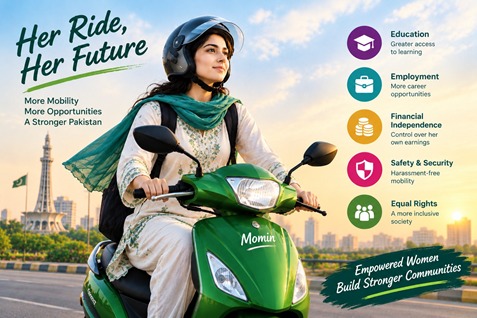
Today, that dream is becoming a reality. Increasingly, Pakistani women are taking to the roads on scooties, challenging traditional barriers to mobility and opening up new possibilities for themselves. For female students and working women in particular, a scooty is far more than a means of transport: it can provide greater autonomy, reduce dependence on others, save time, and improve access to education and employment. This transformation represents an important step towards women’s empowerment, allowing them to navigate public spaces with greater confidence and independence. What I witnessed in Amritsar in 2016 as a hopeful possibility is now emerging before my own eyes in Pakistan. It is a reminder that meaningful social change often begins with a simple sight that inspires us to imagine a different future.
Women’s mobility is an essential component of empowerment, independence, and equal participation in public life. In Pakistan, particularly in Punjab, the growing number of women riding scooties and motorcycles represents a positive change in social attitudes and a practical response to the challenges of urban transportation. For many women, independent mobility reduces dependence on family members, makes education and employment more accessible, and enables greater participation in economic and social activities. However, the ability to ride a scooty is meaningful only when women can travel without fear of harassment, intimidation, or violence. Genuine empowerment requires not merely providing women with access to transportation but also ensuring that public spaces, roads and institutions are safe, accessible and responsive to their needs.
The Punjab government has introduced several initiatives intended to promote women’s mobility and safety. Programmes such as Women on Wheels have encouraged women to learn motorcycle riding and overcome traditional barriers to independent transportation. Such initiatives are commendable because they challenge restrictive social attitudes while providing women with a practical means of travelling to educational institutions, workplaces and other destinations. Similarly, the Virtual Women Police Station, the Women Safety App and Punjab Women’s Helpline 1043 provide mechanisms through which women can seek assistance, report harassment and access institutional support. Nevertheless, the effectiveness of these initiatives depends on their accessibility, public awareness, timely response, and ability to translate complaints into tangible protection.
The assault reported on 22 October 2026 on Lahore’s Mozang Link Road has brought the vulnerability of women travelling independently into sharp focus. The incident, followed by the Chief Minister Maryam Nawaz’s personal contact with the victim, the reported arrest of the suspect, and subsequent judicial proceedings concerning bail, demonstrates both the importance of prompt official attention and the limitations of relying on individual intervention. The Chief Minister’s response may provide reassurance to the victim and signal that violence against women will not be ignored. However, a system of public protection cannot depend on whether an incident attracts media attention or whether a senior political figure personally intervenes. Every woman, regardless of her social status, financial circumstances or public visibility, must have access to an effective and reliable mechanism for protection and justice.
The incident also highlights the broader structural challenges confronting female scooty riders in Punjab. Women may encounter harassment, threatening behaviour, inappropriate comments, deliberate obstruction and intimidation while travelling on public roads. These risks are compounded by inadequate awareness of complaint mechanisms, uneven enforcement of the law and social attitudes that continue to treat women’s independent mobility as unusual or objectionable. In some circumstances, women may hesitate to report harassment because they fear social stigma, victim-blaming or the possibility that their complaints will not receive an adequate response. Consequently, the problem cannot be addressed exclusively through criminal proceedings against individual offenders. It requires a coordinated response involving law enforcement agencies, transport authorities, educational institutions, communities and the provincial government.
The issue also raises important constitutional and legal considerations. The Constitution of Pakistan recognises equality before the law under Article 25 and protects the dignity of individuals under Article 14. Article 9, which safeguards life and liberty, is also relevant to the broader responsibility of the state to protect individuals against threats to their safety. Although these constitutional guarantees do not eliminate every risk encountered in public spaces, they establish an important framework for evaluating the state’s response to violence, harassment and discrimination. Women must be able to exercise their lawful freedom of movement and participate in public life without being subjected to intimidation. The effective enforcement of existing laws, the accessibility of complaint mechanisms and the accountability of responsible institutions are therefore essential to translating constitutional guarantees into practical protection.
The Punjab government should move beyond individual schemes and adopt a comprehensive, long-term policy specifically addressing women’s mobility and road safety. Such a policy should integrate transportation access, prevention of harassment, emergency assistance, investigation and accountability within a single institutional framework. The government should establish a dedicated reporting and rapid-response mechanism for incidents involving women travelling on scooties and motorcycles, supported by effective coordination between the Punjab Police, Safe City authorities and existing women’s protection services. Complaints should be recorded promptly, assessed according to their urgency, and followed through to a documented outcome. Women should also be able to report incidents without unnecessary procedural barriers, while confidentiality and protection against retaliation should be treated as essential elements of the process.
The existing Women Safety App, Virtual Women Police Station and Helpline 1043 should be strengthened through better public awareness, accessible reporting procedures and transparent monitoring of response times and complaint outcomes. Their effectiveness should be assessed not merely by the number of complaints received but by whether women obtain timely assistance, whether cases are properly investigated and whether appropriate legal action follows. Police officers responsible for responding to harassment and violence should receive specialised training in victim-sensitive procedures, evidence preservation and the protection of complainants. Where surveillance footage or other digital evidence is available, relevant authorities should ensure its lawful preservation and timely use in investigations. At the same time, the privacy and dignity of victims must be protected throughout the process.
The government should also expand practical support for women who wish to ride scooties or motorcycles. Affordable riding lessons, access to licensing facilities, road-safety training and financial assistance for women from lower-income households can make independent transportation more attainable. Educational institutions and workplaces should be encouraged to support safe commuting arrangements, while local authorities should improve street lighting, road maintenance and the safety of routes frequently used by women. Traffic enforcement must apply equally to all road users, and harassment or intimidation should be addressed through appropriate legal procedures rather than dismissed as a minor inconvenience. Public-awareness campaigns should reinforce the principle that women have the same right as men to use public roads and that responsibility for preventing harassment rests with perpetrators and the institutions charged with enforcing the law, not with women who choose to travel independently.
The government should introduce measurable indicators to evaluate the success of its policy. These could include the availability of accessible reporting channels, average emergency-response times, the proportion of complaints investigated, the provision of riding and licensing opportunities, and women’s reported sense of safety while travelling. Periodic public reporting, subject to appropriate privacy safeguards, would help identify weaknesses and strengthen institutional accountability. Consultation with female riders, civil-society organisations, transport experts and law-enforcement agencies would also ensure that policy decisions reflect the actual experiences of women rather than assumptions about their needs. A policy developed through consultation and assessed against measurable outcomes would be more sustainable than isolated announcements or short-term campaigns.
Most importantly, the Punjab government should recognise that women’s safety is a matter of public responsibility rather than a privilege dependent on personal connections or political attention. The Chief Minister’s intervention in an individual case may demonstrate concern, but effective governance requires institutions capable of responding consistently to every complaint. Arrests and judicial proceedings must follow the law, and the courts must remain free to determine questions of bail and guilt independently on the evidence and applicable legal standards. Public pressure and executive concern should strengthen the administration of justice without compromising due process or judicial independence.
Ultimately, the empowerment of women cannot be measured simply by the number of scooties distributed, riding licences issued or training programmes conducted; thought these are important. Its real measure is whether women can travel to work, attend educational institutions and participate in public life without fear of harassment or violence. Punjab has taken positive steps towards improving women’s mobility, but these initiatives must be supported by reliable enforcement, accessible protection services and sustained institutional accountability. The government should therefore adopt a comprehensive Punjab Female Rider Safety and Mobility Policy that combines prevention, rapid response, legal accountability, safer infrastructure and public education. The right to ride must become the freedom to travel safely. Until every woman can use public roads without fear, discrimination or dependence on personal intervention by those in power, the promise of genuine empowerment will remain incomplete.
We welcome your contributions! Submit your blogs, opinion pieces, press releases, news story pitches, and news features to opinion@minutemirror.com.pk and minutemirrormail@gmail.com