Summary
- The IMF’s October 2026 analysis identifies more neutral taxation, better treatment of investment costs and stronger administration as routes to growth.[6] Its findings support scrutiny of damaging burdens; they do not establish our preferred Pakistani rates as universally optimal.
- 311, “Ministry of Finance and IMF to Convene High-Level Workshop on Reforms for a Modern and Growth-Friendly Tax System in Pakistan,” 20 October 2026.
- [6] International Monetary Fund, Fiscal Monitor, October 2026, chapter 1, “Taxing Better to Boost Growth,” executive summary and analysis of tax neutrality, investment costs and administration.
The citizen should not need a personal connection to obtain a refund, discover how public money was spent or secure a service already financed through taxation. A fiscal system earns legitimacy when ordinary people can enforce ordinary rights. This series began with the question of who should pay. It concludes with an equally demanding question: what obligations must the state accept in return?
Our exchange with Dr Ehtisham Ahmad helped clarify the issues. Integrated administration can reduce duplication, while equalisation can strengthen the capacity to provide comparable services. Neither automatically protects provincial autonomy, closes infrastructure gaps or makes officials accountable. The distinction between collecting revenue and controlling policy remains essential. Our disagreement concerns the institutional safeguards and distributional choices through which those principles would operate in Pakistan, rather than the value of coordination itself.
The immediate policy debate offers an opening. The government’s announcement of the October 20–21, 2026 Ministry of Finance–International Monetary Fund (IMF) workshop identified a broader, fairer, simpler and more predictable system as its objective.[1] These are useful commitments against which subsequent decisions can be assessed. A workshop announcement does not establish implementation. Its credibility will depend on legislation, published accounts and changes in the experience of taxpayers.
The reform architecture we set out in Towards Broad, Flat, Low-rate and Predictable Taxes remains our starting point.[2] Simpler liabilities, wider effective coverage and coordinated administration belong together. Our proposed rates must be costed against current bases and expenditure needs before implementation. Advocating them does not require pretending that Pakistan-specific causal estimates have already established their yield. The public deserves a proposal strong enough to disclose what remains unknown.
The first undertaking should be to publish the accounts on which reform depends. Release collections reconciled with refunds, advances and adjustments; the age and status of refund claims; tax-expenditure estimates; and an explanation of revisions. Use an announced calendar and consistent definitions. The IMF’s Fiscal Transparency Code treats timely, reliable reporting as a central obligation.[3] Parliamentary scrutiny is weakened when members cannot distinguish additional taxation from a change in the timing of receipts.
The second undertaking should be to reach ownership that has escaped a fair contribution. Start with immovable property, where an identifiable asset provides an administrative foundation. Publish valuation methods, establish independent appeals and protect modest households through clearly defined thresholds or hardship relief. The IMF’s property-tax guidance supports broad coverage at modest rates.[4] Additional receipts should be connected visibly with local services, without implying that every neighbourhood may retain all the revenue its wealth generates.
A wider wealth base requires more preparation. Specify eligible assets, liabilities, valuation dates and beneficial ownership. Avoid counting both company assets and shareholders’ claims as independent wealth. Compare an annual stock levy with better taxation of capital returns and transfers. The IMF’s How to Tax Wealth favours strengthening taxation of actual returns over a general annual wealth tax.[5] We must answer that objection through design and evidence. A small percentage of wealth can still absorb a large part of a low annual return.
The third undertaking should be to reduce the cost of being productive and compliant. Publish a multiyear tax-policy framework with prospective changes, consultation and clear transition provisions. Rationalise withholding, remove unjustified duplication and make credits and refunds work. The IMF’s October 2026 analysis identifies more neutral taxation, better treatment of investment costs and stronger administration as routes to growth.[6] Its findings support scrutiny of damaging burdens; they do not establish our preferred Pakistani rates as universally optimal.
Simplicity must be judged at the taxpayer’s desk. How many returns, notices and offices does a small enterprise face? How long does an appeal or repayment take? A portal that reproduces contradictory demands has digitised the problem. The Organisation for Economic Co-operation and Development’s (OECD) 2025 report links simplification with tax certainty and growth.[7] Pakistan should measure compliance time and dispute resolution alongside collection, and publish whether reforms actually reduce those burdens.
The fourth undertaking should bind coordination to democratic accountability. A common collecting institution must operate under an agreed legal framework that specifies revenue ownership, policy powers, access to information, appointments, audit and remedies. A change of name cannot resolve these questions. Provinces need usable accounts and enforceable transfer arrangements; local governments need predictable resources and public scrutiny. The World Bank’s 2026 federalism assessment identifies coordination and stronger local financing among the reform options.[8]
Equalisation should address differences in revenue capacity and the cost of comparable services. Separate funding should address inherited infrastructure deficits, with provision for staffing and maintenance. Citizens must be able to see why a deprived district receives additional resources and whether those resources arrive. An allocation formula loses its purpose if discretionary delays reverse its intended distribution. Every tier should report both entitlements and payments, so responsibility for a shortfall can be established.
The fifth undertaking should give Zakat and Ushr the institutional seriousness their moral purpose demands. Define eligible bases and beneficiaries, maintain separate accounts, respect applicable exemptions and doctrinal diversity, and audit distribution. Protect equal citizenship in the provision of general public services. The IMF’s 2026 regional volume recognises Zakat within broader taxation arrangements.[9] Invoking our roots cannot excuse poor records or arbitrary disbursement. Trust requires proof that assistance reached an eligible person without humiliation or patronage.
Implementation should begin with a published preparation period. Within a proposed first six months, reconcile the fiscal baseline, map legal responsibilities, identify pilot areas and disclose the package’s distributional assumptions. This is an implementation proposal, not an assertion that every property register can be repaired within six months. Early commitments should be tasks government can verify. National collection forecasts should follow measured coverage, valuation and payment experience rather than precede them.
During the following budget cycle, phase affordable rate reductions alongside demonstrable improvements in coverage and expenditure. Protect essential services and publish the financing of any temporary shortfall. Independent evaluators should compare outcomes with an explicit baseline and credible comparison groups wherever possible. Report disposable household resources, investment, employment, compliance costs and access to services. Part VI explained why a before-and-after increase in revenue alone cannot establish that reform caused the improvement.
The compact also needs a correction mechanism. Review concessions on stated dates. Require public explanations when service or payment commitments are missed. Permit taxpayers and subnational governments to challenge decisions before independent forums. If a pilot reveals inequitable valuations or lower-than-expected net receipts, correct the design before expansion. Predictability requires rules for change; it does not require preserving a mistake or pretending that one legislature can bind all its successors.
What emerges is a direction supported by evidence, with choices still requiring measurement: a greater contribution from under-taxed ownership, lower avoidable burdens on livelihoods, credible social finance and accountable spending. We have not demonstrated that wealth alone can finance the state or that every rate cut raises revenue. We have set out how Pakistan can test a fairer alternative. The series ends with that obligation: government must account for the money it demands, and reformers must account for the promises they make.
Endnotes
[1] Government of Pakistan, Press Information Department, PR No. 311, “Ministry of Finance and IMF to Convene High-Level Workshop on Reforms for a Modern and Growth-Friendly Tax System in Pakistan,” 20 October 2026. The release describes the October 20–21 agenda and stated objectives; it is not evidence that the reforms were enacted or implemented.
[2] Huzaima Bukhari and Ikramul Haq, Towards Broad, Flat, Low-rate and Predictable Taxes, third revised edition (PRIME Institute, November 2024), Executive Summary, pp. vii–xi. The book supplies the policy starting point; its proposed rates are not presented here as current law or econometrically verified revenue forecasts.
[3] International Monetary Fund, The Fiscal Transparency Code (2019), Pillar I, including principles 1.1.4 on tax expenditures, 1.2 on frequency and timeliness, and 1.4 on integrity. The reporting arrangements proposed in this article apply these general principles to Pakistan.
[4] Martin Grote and Jean-François Wen, How to Design and Implement Property Tax Reforms, IMF How To Note 2024/006, 19 September 2024. DOI: 10.5089/9798400288753.061. The note supports broad property-tax bases at modest rates, with attention to valuation, billing and enforcement; it supplies no forecast of this proposed Pakistani package.
[5] Shafik Hebous, Alexander Klemm and Geerten Michielse, How to Tax Wealth, IMF How To Note 2024/001, 8 March 2024. DOI: 10.5089/9798400266881.061. The note distinguishes taxation of returns, stocks and transfers, and prioritises strengthening capital-income taxation and closing loopholes. It is cited as a substantive counterargument to a general annual wealth tax.
[6] International Monetary Fund, Fiscal Monitor, October 2026, chapter 1, “Taxing Better to Boost Growth,” executive summary and analysis of tax neutrality, investment costs and administration. Its cross-country findings and model-based assessments are not estimates of the effects of the author’s proposed Pakistani rates.
[7] OECD, Enhancing Simplicity to Foster Tax Certainty and Growth: OECD Report to the G20 (OECD Publishing, 2025). DOI: 10.1787/086f71ab-en. The report provides comparative guidance on simplification; the compliance indicators proposed here require measurement in Pakistan.
[8] World Bank, “Pakistan: Strengthening Fiscal Federalism to Drive Development,” 1 July 2026, accompanying Strengthening Fiscal Federalism in Pakistan. The release discusses federal expenditure adjustment, revenue mobilisation, coordination and predictable local transfers. The sequencing and safeguards proposed here are the author’s assessment.
[9] Mario Mansour and Shafik Hebous, eds., Taxation in the Middle East and North Africa: Prospects and Possibilities (IMF, 2026), chapter 3, p. 46, note 13, and chapter 4, p. 74, note 6. References to Zakat concern particular fiscal arrangements and earmarking; they do not establish a Zakat-only financing model for Pakistan.
[Concluded]
_____________________________________________________
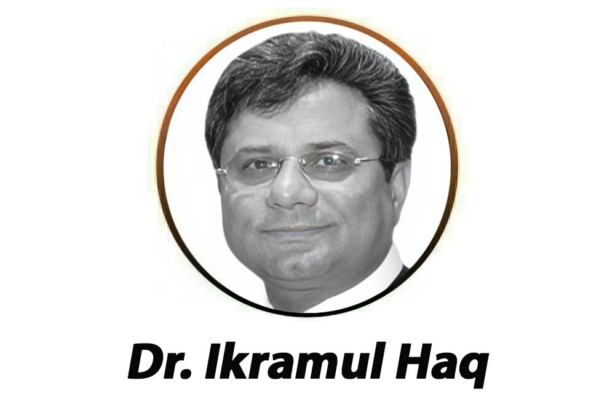
Dr. Ikramul Haq, Advocate Supreme Court, Adjunct Faculty at Lahore University of Management Sciences (LUMS), member Advisory Board and Visiting Senior Fellow of Pakistan Institute of Development Economics (PIDE), holds an LLD in tax laws. He was full-time journalist from 1979 to 1984 with Viewpoint and Dawn. He also served Civil Services of Pakistan from 1984 to 1996.
We welcome your contributions! Submit your blogs, opinion pieces, press releases, news story pitches, and news features to opinion@minutemirror.com.pk and minutemirrormail@gmail.com