Summary
- Pakistan Peoples Party (PPP) Chairman Bilawal Bhutto-Zardari has offered to request Prime Minister Shehbaz Sharif to end the emergency in Khyber Pakhtunkhwa (KP) if Pakistan Tehreek-e-Insaf (PTI) agrees to political dialogue and helps create conditions that make the measure unnecessary.
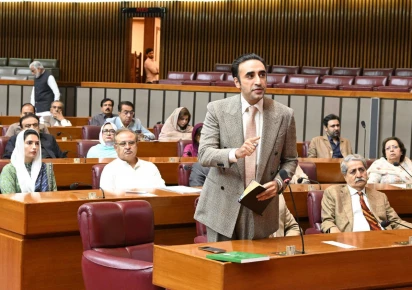
- Addressing the National Assembly on Wednesday, Bilawal urged PTI and other opposition parties to engage with the government and work towards a political solution.
- Referring to the National Action Plan, Bilawal said political consensus had previously helped Pakistan develop a coordinated response to terrorism.
Pakistan Peoples Party (PPP) Chairman Bilawal Bhutto-Zardari has offered to request Prime Minister Shehbaz Sharif to end the emergency in Khyber Pakhtunkhwa (KP) if Pakistan Tehreek-e-Insaf (PTI) agrees to political dialogue and helps create conditions that make the measure unnecessary.
Addressing the National Assembly on Wednesday, Bilawal urged PTI and other opposition parties to engage with the government and work towards a political solution. He said he would personally ask the prime minister to withdraw the emergency once the circumstances leading to its imposition had been addressed.
Bilawal maintained that the federal government had made efforts to negotiate with the opposition before taking the constitutional step. He acknowledged PTI’s right to oppose the decision but argued that the party, particularly its provincial leadership, had also contributed to the circumstances that led to the emergency.
The PPP chairman accused PTI of carrying out a “political suicide attack” on its own government in KP. He said the opposition could criticise the federal government and President Asif Ali Zardari, but it should also examine its own role in the developments.
Bilawal said he and other PPP leaders had initially called for negotiations before the government moved towards what he described as a “constitutional atom bomb”. He explained that the party wanted the government and opposition to resolve their differences over counterterrorism cooperation and remove the political, legal and constitutional grounds for imposing the emergency.
He said PPP representatives had participated in negotiations with the opposition. At one stage, he believed the talks were close to success after receiving reports that both sides were willing to agree on measures to tackle terrorism in KP.
According to Bilawal, the proposed understanding included identifying areas severely affected by terrorism and preparing an agreement involving the federal government, the provincial government and the KP chief minister. The arrangement was intended to establish a joint framework for counterterrorism efforts.
Bilawal said he had viewed the reported progress as an important opportunity for political cooperation on a national security issue. However, he criticised the provincial leadership for allegedly pledging not to cooperate with federal counterterrorism efforts.
He stressed that KP was among the provinces most affected by terrorism and said tensions with Afghanistan had added to the security challenges. He questioned how the PPP could oppose action intended to address these threats when its own leaders and workers had made sacrifices in the fight against militancy.
The PPP chairman said the emergency should be treated as a temporary measure rather than a permanent solution. While defending the decision in the prevailing circumstances, he acknowledged that addressing terrorism required a broader strategy and cooperation between political forces and state institutions.
Bilawal called for a united national response against militant groups, including the Tehreek-e-Taliban Pakistan (TTP) and the Balochistan Liberation Army (BLA). He also raised concerns about regional security and accused India of supporting militant activity in Pakistan, claims that New Delhi has disputed in similar contexts.
He said Pakistan faced several challenges simultaneously, including regional tensions, terrorism and domestic political confrontation. In his view, political parties should avoid deepening internal divisions while the country deals with these security concerns.
Bilawal also highlighted the importance of protecting political space for all parties. He said restrictions affecting one political group could ultimately harm other parties and ordinary citizens. Although he acknowledged that several political forces shared responsibility for the shrinking political space, he urged PTI to recognise its part in the situation.
The PPP chairman welcomed the government’s agreement to establish a parliamentary committee on electoral reforms. However, he said the initiative would have limited value without opposition participation and called for a more inclusive process.
Referring to the National Action Plan, Bilawal said political consensus had previously helped Pakistan develop a coordinated response to terrorism. He urged Parliament to provide a similar platform for discussion on national security and counterterrorism, with representatives from both sides of the House.
He said the PPP was willing to work with the opposition to establish a parliamentary mechanism for addressing these issues. Bilawal maintained that political disagreements should not prevent parties from cooperating on matters affecting the country’s security and stability.
Concluding his appeal, Bilawal urged PTI to return to dialogue and avoid actions that could close the door to negotiations. He said the constitutional decision on the KP emergency had already been taken, but political engagement could still help create conditions for its withdrawal.
He reiterated that the ultimate objective should be to restore normal political conditions in the province, strengthen cooperation against terrorism and provide relief to its people.
We welcome your contributions! Submit your blogs, opinion pieces, press releases, news story pitches, and news features to opinion@minutemirror.com.pk and minutemirrormail@gmail.com