Summary
- Iranian President Masoud Pezeshkian on Monday called for greater unity among regional countries during a high-level meeting in Tehran attended by officials from Pakistan, Saudi Arabia and Türkiye.
- Iranian Foreign Ministry spokesperson Esmaeil Baqaei said the meeting could pave the way for further cooperation on regional security.
- Against this backdrop, Monday’s meeting brought Pakistan, Saudi Arabia, Türkiye and Iran together to discuss regional cooperation and possible diplomatic approaches to reducing tensions.
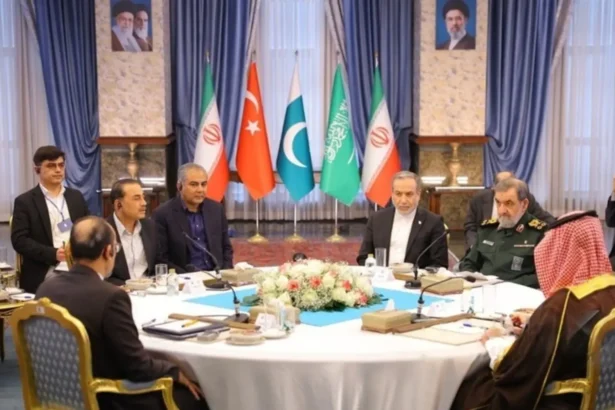
Iranian President Masoud Pezeshkian on Monday called for greater unity among regional countries during a high-level meeting in Tehran attended by officials from Pakistan, Saudi Arabia and Türkiye. The talks focused on regional security, cooperation and the consequences of the ongoing US-Israeli war against Iran.
Pezeshkian said the participation of representatives from influential Islamic countries could help strengthen regional unity and coordination. He urged Muslim nations to stand together and adopt a common position on challenges facing the region.
The meeting brought together Chief of Defence Forces and Chief of Army Staff Field Marshal Asim Munir, Interior Minister Mohsin Naqvi, Saudi Defence Minister Prince Khalid bin Salman and Türkiye’s intelligence chief Ibrahim Kalin. Iranian Foreign Minister Abbas Araghchi and senior security officials also attended the discussions.
Pakistan’s military media wing, Inter-Services Public Relations (ISPR), confirmed earlier that Field Marshal Munir was visiting Tehran but did not disclose further details about his engagements.
Iranian state television reported that the four countries had agreed to continue discussions following their initial meeting. The talks aim to strengthen cooperation on regional peace and security, although no detailed agreement was announced.
Iranian officials said the discussions covered major security challenges, including Israeli policies, developments in Palestine and Lebanon, and the wider consequences of the conflict involving the United States and Israel.
Iranian Foreign Ministry spokesperson Esmaeil Baqaei said the meeting could pave the way for further cooperation on regional security. He stressed that lasting stability would depend on cooperation and trust among countries in the region rather than reliance on external powers.
Iranian officials described this approach as “endogenous security”, meaning regional countries should take primary responsibility for protecting their own security and maintaining stability.
The meeting also comes amid efforts to reduce tensions and revive diplomatic engagement. Saudi Deputy Minister for Public Diplomacy Rayed Krimly said the visit was part of continuing efforts by members of the Makkah Defence Alliance to encourage de-escalation, dialogue and diplomatic solutions.
He also highlighted the role of Qatar and Pakistan in ongoing mediation efforts aimed at easing the crisis.
The discussions mark a significant diplomatic engagement between Iran and the three countries associated with the Makkah defence pact, which was signed in August. Under the agreement, an armed attack against one member is treated as an attack against all.
The meeting comes as regional tensions have intensified, with fighting involving Saudi Arabia and Yemen’s Houthi movement and increasingly sharp exchanges between Washington and Tehran.
Field Marshal Munir had visited Iran the previous week. During that visit, Iranian officials reportedly said the United States needed to take initial steps to rebuild trust. Tehran also indicated that its seven-point proposal could serve as a starting point for renewed negotiations.
According to Iran’s ISNA news agency, Baqaei said the idea for Monday’s meeting emerged during Munir’s earlier visit and was subsequently accepted by Tehran.
War continues to threaten regional stability
The conflict began in late February when the United States and Israel launched attacks on Iran while Washington and Tehran were engaged in negotiations over Iran’s nuclear programme.
A ceasefire in April ended the initial phase of intense bombardment, but tensions persisted over the Strait of Hormuz, a critical route for global oil and liquefied natural gas shipments.
Iran has asserted control over the strait and targeted vessels attempting to pass without its authorisation, while the United States has imposed a naval counter-blockade on Iranian ports.
Diplomatic efforts to reach a lasting settlement remain stalled following the collapse of a proposed agreement in June. The conflict has also spread across the region, adding to security concerns involving Saudi Arabia and the Houthis in Yemen.
Against this backdrop, Monday’s meeting brought Pakistan, Saudi Arabia, Türkiye and Iran together to discuss regional cooperation and possible diplomatic approaches to reducing tensions. Further talks are expected as the countries explore ways to strengthen security coordination and support efforts to stabilise the region.
We welcome your contributions! Submit your blogs, opinion pieces, press releases, news story pitches, and news features to opinion@minutemirror.com.pk and minutemirrormail@gmail.com