Summary
- State Bank of Pakistan data for end-June 2026 place total debt and liabilities at Rs.
- State Bank of Pakistan, “Pakistan’s Debt Profile”, including debt and liabilities, central government debt, external debt and external debt-servicing data, June 2026.
- Ikramul Haq, “Company Raj to Debt Raj—IV: Revenuecracy: from Company Collector to Pakistan’s fiscal state”, Minute Mirror, September 19, 2026.
Part IV ended by asking whether Pakistan had replaced colonial revenue extraction with democratic fiscal government—or merely nationalised the Collector and internationalised the revenue target. That question leads directly to debt. Revenuecracy explains how the state extracts. Debtocracy explains what happens when revenue, production and exports remain too weak to sustain the state, and refinancing becomes a recurring condition of governing.
In February 2020, we used the term “debtocracy” in an article. The language was deliberately stark. We wrote of a “debt prison” and a “debt-slavery-syndrome” to emphasise that chronic indebtedness has political as well as economic consequences. Six years later, the metaphor needs refinement, not abandonment. Debt is not slavery in the literal sense. Creditors do not own a sovereign state. The serious question is how much effective policy freedom remains when old obligations can be met only through new borrowing, rollovers or externally supported adjustment.
The numbers now make that question unavoidable. State Bank of Pakistan data for end-June 2026 place total debt and liabilities at Rs. 99.59 trillion. Central government debt alone stood at Rs. 83.64 trillion. External debt and liabilities reached US$ 138.85 billion. Pakistan serviced about US$ 21.59 billion of external debt during fiscal year 2025-26; around US$ 10.14 billion fell in the final quarter.
These figures must not be mixed indiscriminately. Total debt and liabilities, public debt, central government debt and external debt are different measures. Nor does a large headline number prove insolvency. The International Monetary Fund (IMF) currently assesses Pakistan’s public debt as sustainable under its baseline. The same assessment says medium-term risks remain high because of large gross financing needs and difficulty in securing external financing.
That apparent contradiction is the essence of debtocracy. A debt stock may be statistically sustainable and still constrain sovereignty. Sustainability asks whether obligations can probably be serviced. Fiscal sovereignty asks what must be taxed, cut, postponed, pledged or renegotiated in order to service them.
The government’s own Fiscal Policy Statement 2026 reveals the pressure. In fiscal year 2024-25, net federal revenue after provincial transfers was Rs. 9.947 trillion. Mark-up payments alone were Rs. 8.887 trillion—nearly 89 percent of that net federal revenue. Development expenditure, including net lending, was Rs. 1.414 trillion. A state can remain solvent under such arithmetic, but its capacity to build schools, hospitals, water systems, transport networks and productive infrastructure becomes severely compressed.
Debt-to-gross domestic product is not enough. S. Ali Abbas, Alex Pienkowski and Kenneth Rogoff’s Sovereign Debt: A Guide for Economists and Practitioners usefully treats sovereign debt through its composition, sustainability, management, default risks and institutional setting. The amount owed matters. So do maturity, interest cost, currency, creditor structure, refinancing needs, domestic savings, revenue capacity and the productive assets created by borrowing. This distinction will become important in the next part.
Some advanced economies carry large sovereign debts without entering IMF programmes. Others can borrow cheaply for long periods in their own currencies. Their debt is supported by high revenues, productive economies, deep capital markets and institutional credibility. Pakistan can become vulnerable at a lower debt-to-GDP ratio because the denominator tells only part of the story.
The more revealing ratios are debt to revenue, debt service to revenue, external servicing to export earnings, and financing requirements relative to reserves and dependable foreign-exchange inflows. A sovereign does not repay creditors with GDP. It pays from fiscal revenue and, for external obligations, from foreign exchange.
The borrowing itself is not the enemy. China, India and many developed economies have used long-term finance to build infrastructure and productive capacity. Pakistan too has financed dams, power projects, roads and other assets through external borrowing. The question is what proportion of accumulated debt has enlarged the economy’s capacity to repay, and what proportion has financed recurring deficits, current expenditure or the refinancing of earlier obligations.
Borrowing for a productive asset can enlarge future fiscal space. Borrowing merely to preserve present solvency mortgages it. Pakistan’s 2020 debtocracy problem was therefore not simply that debt had become large. It was that the state was borrowing while leaving the structural causes of borrowing substantially intact.
The same danger remains: a narrow and inequitable tax base; privileges and tax expenditures; losses in state-owned enterprises; energy-sector liabilities; weak exports; low productivity; inadequate human capital; and an administrative order better at collecting from the already documented than expanding productive capacity.
The IMF did not create these failures. Pakistan enters Fund programmes through its own government. Nor is every condition attached to financing harmful. Fair taxation of undertaxed sectors, transparent public finances, viable energy pricing and accountability of state-owned enterprises are reforms Pakistan needs irrespective of the lender.
The sovereignty problem arises when reform is repeatedly undertaken under refinancing pressure rather than through a democratically owned development strategy. Timing then changes. Distributional choices narrow. Measures arrive as prior actions, performance criteria or structural benchmarks. Parliament retains legal authority, but the economic cost of rejecting an agreed measure may become prohibitive.
This is the link between debtocracy and the “fiscal sovereignty capture” discussed in Part III. Sovereignty does not disappear when debt crosses a particular percentage of GDP. It contracts as the cost of saying “no” rises.
There is another danger. External conditionality can provide domestic rulers with an alibi. Tax increases, tariff adjustments or expenditure compression can be presented as requirements of the lender. Structural privileges that helped create the crisis may survive. The creditor acquires leverage; the government avoids full ownership; citizens experience adjustment.
This is why blaming the IMF is analytically insufficient. Debtocracy begins at home before external leverage becomes possible.
The escape is neither default nor isolation. Saeed Ahmed, a former senior IMF adviser, has recently framed the issue as recovery of economic sovereignty: external assistance should serve nationally determined development rather than substitute for domestic ownership of policy. That is the distinction Pakistan must recover.
Self-reliance does not mean refusing foreign capital. It means acquiring the capacity to choose when to borrow, from whom, on what terms and for what productive purpose.
Debt should finance transformation: human capital, water, energy, transport, technology, competitive agriculture and industry, climate resilience and institutions capable of raising productivity. Future generations can reasonably service liabilities that leave them a more productive economy. They should not inherit debt accumulated because the present state could not reform itself.
Part IV showed how revenuecracy can become the domestic transmission mechanism of fiscal sovereignty capture. Debtocracy explains why that transmission keeps recurring. A state that repeatedly pledges future fiscal capacity merely to preserve present solvency eventually discovers that debt is no longer financing policy. It is helping to determine its boundaries.
Part VI will therefore ask a harder comparative question: why can some countries carry much larger sovereign debts without losing policy autonomy, while Pakistan remains vulnerable at a lower ratio? The answer lies not in debt alone, but in the economic, fiscal and institutional capacity behind it.
References
- Huzaima Bukhari & Dr. Ikramul Haq, “Dealing with ‘debtocracy’”, Business Recorder, February 14, 2020.
- State Bank of Pakistan, “Pakistan’s Debt Profile”, including debt and liabilities, central government debt, external debt and external debt-servicing data, June 2026.
- Dr. Ikramul Haq, “Debtocracy & bankruptcy of ideas”, Minute Mirror, August 14, 2026.
- Finance Division, Fiscal Policy Statement 2026, Government of Pakistan.
- International Monetary Fund, Pakistan: Third Review Under the Extended Arrangement Under the Extended Fund Facility and Second Review Under the Resilience and Sustainability Facility Arrangement, IMF Country Report No. 26/101, May 2026.
- S. Ali Abbas, Alex Pienkowski & Kenneth Rogoff (eds.), Sovereign Debt: A Guide for Economists and Practitioners, Oxford University Press, 2019.
- Saeed Ahmed, “Quest for economic sovereignty”, Dawn, September 26, 2025.
- Dr. Ikramul Haq, “Company Raj to Debt Raj—III: From sovereignty to conditionality”, Minute Mirror, September 18, 2026.
- Dr. Ikramul Haq, “Company Raj to Debt Raj—IV: Revenuecracy: from Company Collector to Pakistan’s fiscal state”, Minute Mirror, September 19, 2026.
[To be continued]
________________________________________________________________
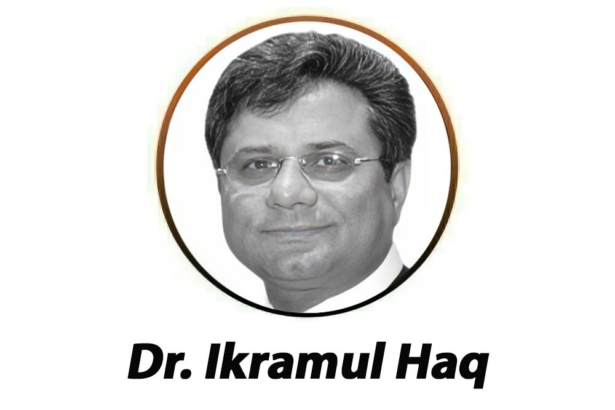
Dr. Ikramul Haq, Advocate Supreme Court, writer, literary critic, Adjunct Faculty at Lahore University of Management Sciences (LUMS), member Advisory Board and Visiting Senior Fellow of Pakistan Institute of Development Economics (PIDE), holds an LLD in tax laws. He was full-time journalist from 1979 to 1984 with Viewpoint and Dawn. He also served Civil Services of Pakistan from 1984 to 1996.
We welcome your contributions! Submit your blogs, opinion pieces, press releases, news story pitches, and news features to opinion@minutemirror.com.pk and minutemirrormail@gmail.com