Summary
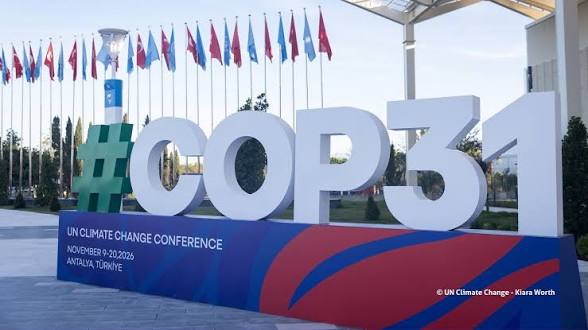
- The 31st United Nations Climate Change Conference (COP31) opened in Antalya, Türkiye, on Monday with calls for faster climate action, fair financial support for developing countries and stronger international cooperation to tackle global warming.
- In their opening statements, UN Climate Change Executive Secretary Simon Stiell and COP31 President-Designate Murat Kurum said the world must move beyond making promises and focus on practical steps to address the climate crisis.
- Stiell said the conference should focus on solutions to increase climate finance, expand renewable energy, improve electricity networks and reduce methane emissions.
The 31st United Nations Climate Change Conference (COP31) opened in Antalya, Türkiye, on Monday with calls for faster climate action, fair financial support for developing countries and stronger international cooperation to tackle global warming.
In their opening statements, UN Climate Change Executive Secretary Simon Stiell and COP31 President-Designate Murat Kurum said the world must move beyond making promises and focus on practical steps to address the climate crisis.
Both leaders called for stronger cooperation between developed and developing countries, better access to climate finance and the use of clean energy to reduce pollution and protect communities from climate-related disasters.
Stiell said COP31 must mark a new phase in global climate action, with greater attention given to implementing existing commitments and delivering practical solutions.
He said previous climate conferences had helped set global targets, establish priorities and build political support for climate action. The Paris Agreement, in particular, had sent strong signals to governments and international markets.
As a result, around 90 per cent of large renewable energy projects were now cheaper than fossil fuel alternatives, while climate adaptation was becoming a more important part of national policies.
However, he warned that progress remained far too slow and unfair, particularly for countries and communities most affected by climate change.
“Progress is nowhere near fast or fair enough,” he said, adding that COP31 must turn global targets and national climate plans into practical steps.
Stiell said the conference should focus on solutions to increase climate finance, expand renewable energy, improve electricity networks and reduce methane emissions.
He called for the implementation of the commitment made at the previous climate conference to triple finance for climate adaptation. He also highlighted the difficulties many developing countries face in accessing funds that have already been promised.
He said the world must also work towards tripling global renewable energy capacity by 2030 and improving electricity networks across countries and regions.
According to Stiell, reducing methane emissions, particularly from the oil and gas and waste sectors, could make a major contribution to limiting global warming.
He said action on methane and the wider use of electricity could together reduce projected global warming by around half a degree.
The UN climate chief said the world was already facing serious consequences of rising temperatures, including disasters in the Himalayas and growing pressure on communities and economies.
He also warned that a strong El Niño climate pattern could make the existing climate crisis worse.
Stiell said vulnerable countries and communities continued to pay the highest price for a problem they had contributed least to creating.
He called for fairness to remain central to the transition towards clean energy and climate resilience, saying that protecting people and economies from global warming was in the interest of every country.
Referring to the recent rise and uncertainty in fossil fuel costs, he said energy price shocks had affected households and contributed to inflation across the world.
He argued that renewable energy offered a practical way to reduce such risks. According to him, renewable energy had saved the world around $500 billion last year and another $265 billion during the first half of this year.
He added that investment in climate adaptation also produced clear economic benefits by reducing the damage caused by disasters.
Stiell said the partnership between Türkiye and Australia was an important feature of COP31, as both countries were working to promote practical solutions through negotiations and the conference’s Action Agenda.
He also called for stronger cooperation between governments, businesses, financial institutions and other organisations to turn climate commitments into action.
On the negotiations, he said consensus remained central to the UN climate process and that strong agreements were needed on adaptation, mitigation, finance and a just transition.
He said an agreement on the Just Transition Mechanism would help countries ensure that all sections of society could benefit from the shift towards a cleaner economy.
He also called for clear agreements on climate finance, including ways to meet the commitments of providing at least $300 billion annually to developing countries and mobilising $1.3 trillion a year from public and private sources.
Stiell warned that the UN Climate Change Secretariat was facing growing responsibilities with shrinking financial resources. He said the organisation had already introduced measures to improve efficiency but could not continue doing more with fewer resources.
“Mandates are growing. Funds are shrinking,” he said.
Earlier, COP31 President-Designate Murat Kurum welcomed delegates to Antalya and said climate change could no longer be treated as a separate environmental issue because it was closely linked to food security, energy, health, economic development and international security.
He said wars, political tensions, rising living costs, economic uncertainty and supply chain disruptions were creating additional challenges for countries already facing the effects of climate change.
Kurum explained that a drought in one part of the world could affect food prices in another, while water shortages and extreme weather could disrupt industries, increase migration and create security problems.
“Each crisis makes the others worse,” he said.
He said climate policy was now also development policy, food policy, energy policy, urban policy and health policy.
Kurum said Türkiye wanted COP31 to become an Implementation COP, where countries would focus on turning their promises into results that people could see in their daily lives.
He said Türkiye, together with Australia, wanted to bring developed and developing countries closer and ensure that the concerns of vulnerable nations, particularly small island states in the Pacific, were heard.
He said the conference would be guided by three principles: dialogue, consensus and action.
Kurum said climate decisions would have real value only when they produced changes in people’s lives, including lower energy bills, better public transport, stronger infrastructure and new employment opportunities.
He also highlighted Türkiye’s 35-by-35 Global Electrification Pledge, which aims to increase electricity’s share of final energy consumption to 35 per cent by 2035.
He said the transition would require greater use of renewable energy, stronger electricity networks, energy storage, improved efficiency, clean transport and green industries.
On climate finance, Kurum referred to the agreement reached in Baku, under which developed countries committed to providing at least $300 billion annually to developing countries by 2035. He also referred to the wider target of increasing public and private climate finance to $1.3 trillion annually.
He said these commitments must now be supported by actual funding and investment.
To help achieve this, Türkiye plans to introduce a Climate Implementation Bridge to connect investors with projects requiring funding, countries needing technology with those able to provide it, and local needs with international resources.
Kurum also highlighted the importance of trust in international climate cooperation, saying countries needed timely access to promised funds and confidence that agreed decisions would be implemented.
He referred to the Turkish concept of ‘imece’, which means people working together and sharing responsibilities to complete a task that is too difficult for one person alone.
He said this spirit of cooperation should guide international efforts to tackle climate change.
Kurum said the success of COP31 would not be measured only by the agreements reached in meeting rooms but also by the investments launched, technologies shared, cities made more resilient and farmers protected from climate-related risks.
He called on countries, businesses, scientists, financial institutions and young people to contribute to climate action.
Both opening statements reflected a shared message: the world has already made many climate commitments, but the real challenge is to turn them into action.
The two-week conference in Antalya is expected to provide an opportunity for countries to discuss ways to speed up the energy transition, increase financial support for vulnerable nations and strengthen international efforts to limit global warming.
We welcome your contributions! Submit your blogs, opinion pieces, press releases, news story pitches, and news features to opinion@minutemirror.com.pk and minutemirrormail@gmail.com